My Son Used My Contractor’s License Without Asking—Then His Wife’s Email Exposed Their Lie
Phân cảnh 1: The discovery of fraud
My son didn’t ask to borrow my truck, my tools, or even money. He borrowed the one thing I could not replace: my contractor’s license.
I found out when the state licensing board called about a kitchen renovation I had never bid, supervised, or inspected. The permit listed my company. The insurance certificate carried my policy number.
And the emails to the homeowner ended with my daughter-in-law calling herself a member of my staff.
When I confronted them, my son said, “Your license was just helping us get started. We were going to tell you after the first job.”
He expected anger, then forgiveness, then a signature that would make the problem disappear. Instead, I asked for the project bank records and told both of them not to touch another dollar.
What they had treated like a harmless family shortcut was already an active complaint, a failed electrical inspection, and a test of whether my name still belonged to me.
My name is Mark Dalton. I’m 56, and I own Dalton Residential Group outside Raleigh, North Carolina.
Phân cảnh 2: Family tensions and business
We have 11 employees and renovate older homes, build additions, and occasionally take on a custom house.
I started the business at 26 with a used pickup and worn tools. The license came after night classes, exams, financial statements, and long hours studying building codes.
I learned that a contractor sells more than labor. He sells the promise that when something ugly is hiding inside a wall, he won’t disappear.
My son Ryan grew up around that business. He’s 30 now, better with clients than I was at his age, and impatient in a way I probably was, too. After college and a sales job, he came to work for me as a project coordinator.
Ryan wanted to be a project manager within six months. I told him he needed more time reading plans, scheduling trades, and managing budgets. He heard that as me holding him back.
After 2 years, he quit.
“I’m never going to be more than your kid here,” he said on his last day.
I didn’t argue. I told him I would pay for the licensing classes when he was ready and help him study, but I would not put him in charge of clients’ homes before he could manage the responsibility.
He left without taking the offer.
His wife Klo supported him. She was 29, bright, organized, and worked in digital marketing. She believed Ryan’s own company was overdue and thought caution was something older people used to protect their advantage.
6 months after Ryan quit, they announced a side business called Oakline Home Projects. Ryan told us it would focus on painting, flooring, cabinet, and smaller cosmetic jobs while he worked toward his license.
I said that sounded reasonable. In North Carolina, larger projects cross a threshold where a licensed general contractor is required. Ryan knew that.
We had discussed it more than once. I even sent him the name of a good insurance agent and two study guides.
He thanked me and never mentioned Oakline again.
The licensing board called on a Tuesday morning in April.
Phân cảnh 3: Confronting the evidence
The investigator’s name was Denise Morgan. Her voice wasn’t accusing. That made the call worse.
She was confirming information connected to a homeowner complaint about a renovation valued at $72,000.
“Mr. Dalton? Are you saying Dalton Residential Group did not contract for the Bennett project?” she asked.
“I’m saying I’ve never heard that name or address.”
There was a pause. I could hear her keyboard.
“Were Ryan Dalton or Khloe Dalton authorized to act for your company?”
My hand tightened around the phone.
“Ryan is my son. He hasn’t worked here in 6 months. Kloe has never worked here.”
Denise asked me not to speculate. She said she would email the complaint and permit documents and that I would be given a chance to respond in writing.
Before we hung up, she asked whether I had supervised any part of the work.
“No,” I said. “Not one minute of it.”
The email arrived 11 minutes later. I know because I watched the clock in the corner of my computer while I waited.
The building permit listed Dalton Residential Group as the general contractor. My license number was correct.
Attached to the homeowner’s complaint was a certificate of insurance carrying my policy number and company address. The certificate holder section had been changed to the Bennett property.
Then I opened the emails.
Khloe’s signature: readon relations, Dalton Residential Group. Under it was my office number and website.
In one message, she assured Laura Bennett that Ryan was heading the Dalton renovation team. In another, she wrote that all work was covered by our company insurance.
I read that sentence three times.
The complaint included photographs. The Bennett’s kitchen had been stripped to studs. Cabinets were stacked in the dining room.
A section of ceiling had been opened after the electrical inspector found junction boxes hidden above drywall and circuits that had not been installed by a licensed electrical contractor. Work had been stopped until the permit and contractor information were corrected.
I called Sandra, my office manager, into the room. She had worked with me for 14 years and knew every active job without opening a file.
“Is this ours?” I asked, though I already knew.
She looked at the address, then the permit. The color left her face.
“No. Who submitted this?”
I showed her Khloe’s email. Sandra sat down slowly.
We preserved our records. Payroll showed Ryan’s last day. His old email had been disabled, and our project software contained no Bennett estimate, contract, purchase order, schedule, or inspection note.
The insurance certificate was different. Ryan had once kept a sample on his company laptop for project requests. He had returned the laptop, but apparently kept a copy elsewhere.
The complaint included that old sample with a new address placed over the certificate holder box.
Phân cảnh 4: Confrontation with the son
At noon, our attorney, Melissa Grant, told me not to contact the homeowners or promise repairs. She said to notify my insurer and answer the board in writing before anyone could claim I had tried to hide the misuse.
“He’s my son,” I said.
“I know,” Melissa replied. “That changes how this feels. It doesn’t change what the documents say.”
I called Ryan after that. I asked him and Khloe to come to my office at 6:00, after the staff had left. I didn’t tell him what the call was about.
He arrived first, wearing work boots dusted with drywall. Chloe came in behind him carrying her laptop.
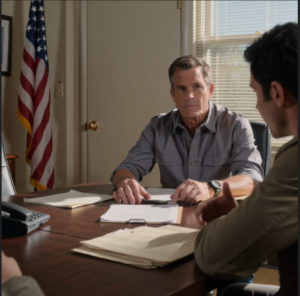
They sat across from me at the conference table where I had closed hundreds of legitimate contracts. I placed the permit between us.
Ryan stared at it, then at me. Khloe’s lips parted, but no sound came out.
“The licensing board called,” I said. “I need you to tell me exactly what you did.”
Ryan leaned back and rubbed both hands over his face for a few seconds. He looked like the 12-year-old who had once broken my miter saw and hidden the cracked guard under a tarp.
“The job got bigger than it was supposed to,” he said. “It started as cabinets and flooring.”
“You signed a $72,000 contract.”
“We added things. The wall came out. Then the homeowners wanted the whole layout changed.”
I looked at Chloe.
“Why did you tell them you worked for my company?”
She swallowed.
“They wanted to know Ryan had backing.”
“He didn’t.”
Ryan put both palms on the table.
“Your license was just helping us get started. We were going to tell you after the first job.”
He said it as if my license were a ladder he had borrowed from the garage.
“How did you expect that conversation to go?” I asked.
“We expected to finish the job,” he said. “We expected you to see I could do it.”
I asked who had performed the electrical work. Ryan named a handyman he knew from cabinet installations. The man was not a licensed electrical contractor.
Ryan insisted the work was temporary and would have been checked later.
“It was covered with drywall,” I said.
“Not all of it.”
That answer told me more than an apology would have.
Chloe opened her laptop and began talking quickly. She said the Bennett were overreacting, the inspector had been difficult, and the kitchen could still be completed if I added Ryan to my company for the duration of the job.
Then she suggested I say Ryan had been managing the project under my supervision.
“You want me to lie in writing to the board?”
“I want you to keep this from becoming bigger than it is,” she said.
Ryan looked at me.
“Dad, one letter from you fixes the permit.”
“No, it changes your lie into mine.”
I slid a second paper across the table. Melissa had drafted it that afternoon. It directed both of them to stop using my company name, license number, logo, phone number, and vendor accounts.
It also required them to preserve every document connected to Oakline and provide the Bennett contract, invoices, massage, and project account records by the next morning.
Ryan didn’t touch it.
“You had a lawyer write this before talking to me.”
“I talked to the board before I knew there was anything to discuss.”
He stood so fast the chair rolled backward.
“You’ve been waiting for me to fail.”
That hurt because part of him believed it. I had corrected his estimates, questioned his schedules, and refused to make him a manager.
To Ryan, every warning had become evidence that I didn’t respect him.
“I wanted you to be ready,” I said. “Those are not the same thing.”
He walked out. Khloe closed her laptop, took the notice, and followed him.
That night, my wife Amed found me sitting at the kitchen table with an old photograph. Ryan was nine in the picture, wearing my hard hat so low it covered his eyebrows.
We were standing in front of the first edition I ever built without another contractor checking my work.
Amy sat beside me.
“Are you going to report him?”
“The report already exists,” I said. “I’m going to tell the truth.”
My hands shook when I put the photograph back in the drawer. I wasn’t afraid of Ryan yelling at me. I was afraid the board would decide I had allowed him to use my license because he was my son.
Contractors had lost licenses for lending their names to people who weren’t qualified. If I looked like I had known, 30 years of clean work might not matter.
Phân cảnh 5: Managing the fallout
The next morning, I sent the board my written response. I included Ryan’s separation date, our active project list, network records, payroll records, and a sworn statement that neither Ryan nor Khloe had authority to represent Dalton Residential Group.
I notified the town of Kerry that my company had not applied for the permit or supervised the work. The town kept the stop-work status in place while the homeowners arranged to name a legitimate replacement contractor.
My insurer opened a file and reserved its position while it investigated the altered certificate. In plain English, that meant nobody was promising to pay for anything yet.
I hired Melissa to handle every response. Protecting myself was already costing money, even before anyone decided who was legally responsible.
Ryan delivered most of the Oakline documents the following afternoon. He did not come inside. He left a storage box with Sandra and drove away.
The records showed that the Bennett kitchen was Oakin’s first signed project above the licensing threshold. It also showed two unfinished proposals carrying my license number.
Neither had become a contract, but Ryan and Khloe had planned to keep using my name after the first job. One proposal described Oakline as a project division supported by Dalton Residential Group.
The project bank statements were worse. The Bennett had paid $41,000. About 27,000 had gone toward their kitchen.
Several thousand had paid for Oakline advertising, a trailer, software, and credit cards. Ryan called those startup expenses.
There was not enough left to correct the work and finish his promise. I felt sick, but I wasn’t surprised anymore.
Melissa arranged a meeting with the Bennett and their attorney so we could exchange records and establish what my company had and had not authorized.
Laura Bennett arrived carrying a binder thick with printed emails. Her husband Tim barely looked at me.
Laura said they had chosen Ryan because they searched my license and found my company’s history. Kloe had sent them photographs from our website and described Ryan as the next generation of the Dalton business.
Laura assumed Oakline was simply a trade name we used for renovations.
“Your reputation is why we let him tear our kitchen apart,” she said.
There was no useful defense to that. I told her I was sorry. My name had been used to gain her trust.
Melissa had warned me not to accept responsibility for a contract I didn’t authorize. So, I chose my words carefully.
But careful words did not make their dining room usable or remove the plastic sheet hanging where their kitchen wall had been.
Tim pushed a failed inspection report across the table. A licensed electrician had estimated nearly $9,000 to remove finished material, expose the unsafe work, replace it, and bring the circuits into compliance.
A replacement general contractor believed the entire correction and completion would cost more than the money left in Oakline’s account.
“Are you going to finish it?” Tim asked me.
“My company can’t adopt a contract we never priced or supervised,” I said. “But I will provide every record needed to show what happened. And Ryan needs to use the project money to correct the project before he keeps $1.”
The Bennett did not thank me. I didn’t expect them to.
Ryan called that evening. He had learned about the meeting from their attorney.
“You made me look like a criminal,” he said.
“Your emails made you look unlicensed. Khloe’s emails made her look like my employee. I showed them she wasn’t.”
“You could take over the job and charge me later.”
“With what money?”
He was quiet.
I told him the remaining project funds needed to be separated immediately and used only for the Bennett correction. If there was a shortage, he and Khloe would have to cover it.
My company would not pay for their startup costs or absorb their contract.
“So, you’re choosing strangers over your own son,” he said.
“I’m choosing not to make strangers pay for what my son did.”
For the next two weeks, Ryan tried every argument except the one I needed to hear. He said I had denied him a path in the company. He said I had more money than he did.
He said losing my license was unlikely and losing Oakline was certain.
Kloe told Amy that I was destroying their future over paperwork. Amy listened, then asked Kloe one question.
“If the license was only paperwork, why didn’t you use your own?”
After that, Khloe stopped calling her.
The board investigator interviewed me, Sandra, the Bennett, Ryan, and Klo.
Phân cảnh 6: Investigation and resolution
Denise never told me what conclusion she was leaning toward. She asked why Ryan had retained access to an insurance certificate and whether I had ever permitted him to use the license informally.
I answered honestly. Allowing a family member to cut a corner once would have been enough to make every denial look convenient. Fortunately, there was no such history.
Our employees learned about the complaint when an inspector called. I explained that the company name had been used without authorization and that no active Dalton job was involved.
I did not ask them to keep a family secret.
Sandra changed our controls, so insurance certificates came from our agent and permit verifications went through her and me.
The real turning point came from Khloe. Without telling her attorney, she emailed Laura Bennett and offered to complete the kitchen at cost if Laura would sign a statement saying Ryan had always been operating with my knowledge.
Kloe wrote that I was distancing myself now because of the inspection and that the family had an internal misunderstanding about supervision.
Laura forwarded the email to her attorney. Her attorney forwarded it to Melissa and the board.
When Melissa showed it to me, I closed my eyes.
Kloe had tried to create the evidence they needed by asking the homeowner to sign something that wasn’t true. Instead, she had documented that they knew my knowledge and supervision were the central issue.
Ryan called me from their apartment that night. He sounded tired rather than angry.
“I didn’t know she sent it,” he said.
“Do you agree with what she wrote?”
He took a long breath.
“No.”
“Then tell the investigator that.”
“That could bury us.”
“You’re already buried, Ryan. The question is whether you keep digging.”
3 days later, he submitted a corrected statement. He admitted I had not known about the project, had not approved the use of my license, and had not supervised him.
He said using my information had been his decision and that Khloe’s job title in the emails was not real.
It was the first action he took that protected someone besides himself. It did not save Oakline.
Through a voluntary settlement with the Bennett, Ryan and Khloe turned over every dollar remaining in the project account. They returned materials that could be returned, sold the new trailer, and added personal money to cover the correction shortfall.
The Bennett hired another licensed general contractor and a licensed electrician. Their kitchen remained unfinished for months, but the unsafe work was removed and the permit was transferred properly.
In exchange for the payments and full cooperation, the Bennets resolved their financial claims without dragging all of us through a lawsuit.
I did not contribute company money. That was the boundary Ryan fought hardest and needed most.
If I had paid, the lesson would have been that my caution was optional because my wallet would rescue him.
The investigation lasted nearly 4 months. I slept badly and felt a knot whenever the office phone rang.
We lost one potential client, and legal fees took the profit from a small bathroom project. Telling the truth protected me, but it did not make the damage painless.
In August, the board notified me that it was closing the matter against my license without disciplinary action.
Phân cảnh 7: Moving forward
The records supported that my company had not contracted for, authorized, or supervised the Bennett project, and that I had acted promptly when I learned of the misuse.
The letter did not praise me. It simply left my license intact, which was all I had wanted.
Ryan was formally directed to stop representing himself as a licensed general contractor.
Without my number, my insurance information, or the Bennett money, Oakline had no way to continue taking the kind of work they had built the business around. They closed it before the end of summer.
He came to my office a week later. There was no dramatic apology. He stood beside the conference table and looked at the framed license on the wall.
“I thought you were keeping it from me,” he said. “Like you had something I deserved and wouldn’t share.”
“I would have helped you earn your own.”
He nodded.
“I know that now.”
I told him I loved him, but he would not return to Dalton residential group. Not then.
Trust could be rebuilt, but not by putting him back in the same place where he had already confused family access with authority.
Before he left, I said the one thing I needed him to understand.
“My reputation isn’t a ladder you can steal a few rungs from. Every rung has someone’s home and someone’s money resting on it.”
He didn’t argue.
Ryan eventually took an estimating job with a building supply company. It paid less than he expected and gave him no impressive title, but he was good at it.
Months later, he enrolled in a licensing course with his own money.
Kloe returned to marketing work. Their marriage went through a rough stretch, though they stayed together.
Amy and I see them for dinner occasionally. We talk carefully, but at least we talk honestly.
At Dalton Residential, the complaint became a line in our history instead of the end of it.
Sandra still verifies every permit. Our insurer now sends certificates directly to clients and municipalities.
I stopped assuming that people close to me understood the weight of the things I had built.
One cool morning that fall, I stood inside a finished addition while sunlight came through a row of new windows. The framing inspection had passed. The final electrical work was clean, and the homeowners were moving their furniture back in.
My name was on the permit by the front door because I had priced the job, supervised it, and accepted responsibility for it.
For the first time in months, seeing my own name felt peaceful again.
If your child used the reputation you spent 30 years building without permission, would you protect them from the consequences or protect the name they chose to risk?