I Never Told My Son-in-law I Own His Company — Then His Parents Offered Me $92,000 To Disappear
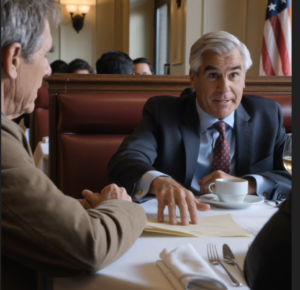
There was a folded stock certificate on the tablecloth, 4 in from my coffee cup, older than my son-in-law was. Clipped behind it was a single sheet with a number typed on it that had a comma and then another comma.
My daughter’s father-in-law slid it across the linen with two fingers, the careful way you’d move something that might still bite you. And he set it low so the bus boy wouldn’t catch it.
“Take this, Warren, and let’s call it a clean break.”
The second page said, “Full and final separation from all family matters, financial and personal.”
My son-in-law sat across from me adjusting a cuff link he’d owned for exactly 9 weeks, and he told me, not unkindly, that this wasn’t about me. It was about scale.
He’d been named president of Callahan Freight Systems 7 weeks earlier. I’ve owned every voting share of that company since 1987.
He didn’t know that.
I need to tell you the whole thing tonight, front to back, because the part people are going to want is the part where I say four words into a phone. And I’m telling you right now, that’s not the part that changed me. That part plays well on a screen.
What actually got me happened 40 minutes later, alone in my truck in a church parking lot at 11 at night. But before I get there, do something for me.
Tell me down in the comments where you’re listening from tonight and what time it is on your clock right now. I like knowing there’s somebody real on the other end of this. And if you’ve ever had to disappear a little bit just to see somebody clearly, tell me that, too, because I don’t think I’m the only one who’s done it.
My name is Warren Aldis Ketering. Everybody but my mother called me Al. I’m 64.
I grew up outside Teroot, Indiana, in a farmhouse my grandfather framed with lumber he cut himself off land the bank eventually took anyway. My father drove a delivery route for a dairy for 31 years, and I got my commercial license the week I turned 18 because there wasn’t another plan on the table.
In 1987, I bought a used flatbed with a blown transmission for $3,800. I borrowed from a man named Herb Callahan, who ran one truck out of a gravel lot and was tired of driving it himself.
That flatbed is Callahan Freight Systems. Now, 39 years later, there are 210 trucks and six cross talk terminals between Indianapolis and Louisville. And if you’ve had a refrigerator, a mattress, or a pallet of drywall delivered anywhere in that corridor in the last 15 years, there’s a fair chance it rode on one of my trailers.
Almost nobody knows that. And that was deliberate. And I’m going to tell you why.
I sold day-to-day control in 2009, not ownership. I kept every share of voting stock in a trust with one trustee, which is me. And I put a board on top of the operation that answers to that trust and nobody else.
I stepped back so far that the company’s own recruiting video still uses a photo of Herb Callahan, who’s been dead since 2004, like he’s still the man in charge.
Loretta Byum has chaired that board for 11 years. She reports to me, and outside of my accountant, maybe four people in the state of Indiana know that arrangement exists.
My wife’s name was Colleen. She died in April of 2019. Ovarian, 6 months from diagnosis to the funeral, which everybody tells you is fast, and none of them have ever sat with somebody while it happens.
She sang alto in the choir at Street Bonafice for 22 years, and she taught third grade before that. And she was the only person who could tell me I was wrong without me arguing about it first.
The last real conversation we had, she was in a hospital bed we’d rented and put in the front room because the stairs weren’t happening anymore. And she said, “Al, when I’m gone, don’t you dare start writing checks to make yourself feel better.”
I said, “What checks?”
She said, “You know what checks? You’re going to want to fix the hole in your chest with money, and it won’t work. And then you’ll just be a rich man who’s still hollowed out, and now people resent you on top of it.”
Then she said, “Keep driving the truck.”
She meant the 08 Silverado, cracked side mirror, 180,000 mi, a dent in the tailgate from a loading dock in Bloomington that I never bothered to fix.
I still drive it. I still wear the canvas coat with the scorch mark on the sleeve from a welding job that went sideways in a trailer yard in 1991. I could buy 400 of that coat brand new. I’ve got nothing left to prove with a new one.
My daughter is Danielle. She’s 31. She’s a physical therapist at a rehab clinic on the east side, and she spends her days getting stroke patients to lift a spoon again, one finger at a time, and cry the good kind of tears when it finally works.
She is the reason for every decision in this story, including the parts where I come off looking like a man running an operation on his own family. And I’m not going to stand here and tell you I’m innocent of that.
Danielle met Preston Whitlock at a golf fundraiser in Carmel 5 years ago. Whitlock is a name that means something on the north side of Indianapolis: three generations of it, a country club membership older than the club’s current clubhouse, a scholarship fund with the family name stencled on a plaque in a high school gymnasium.
Preston is 34, went to a small private college in Ohio, and then a graduate program I won’t bother naming. And the first time Danielle brought him up to the house, he shook my hand with both of his and asked me 11 questions about the freight business and actually waited for the answers.
I liked him. I want that said plainly before anybody decides I’m a cold man who set a trap. I liked him, and I wasn’t wrong to like him, and that’s exactly what makes the rest of this sit so heavy in me even now.
He knew me as a retired dispatcher with a paidoff ranch house and a truck that needed a new mirror. He knew Danielle as a girl who went to a state school and worked two jobs through her doctorate program, which she did because I let her.
Here’s the reason. When I was 29, with maybe 14 trucks to my name, my younger brother Dwayne asked me for money to buy into a bar downtown. I gave it to him. He never paid a dime of it back, and I let that go.
Then he asked again, 18 months later, and I told him no, and he hasn’t said a word to me since 2001. 25 years.
My mother passed with two sons living 40 minutes apart who couldn’t sit in the same pew for her funeral.
Money doesn’t turn people into anything new. It just takes away their reason to keep hiding who they already were.
So, I kept it quiet. I wanted to know who my daughter had married before there was a single dollar visible for him to want. That was my call, and I’ve paid for it, and I’ll keep paying for it.
For almost 2 years, nothing happened worth telling you about. He was decent to her. He had taken a job at Callahan, as it happened, in the Louisville terminal, mid-level logistics coordination.
I didn’t put him there. He applied on his own through the regular channel, and I checked quietly, and he was solid. Average reviews. Showed up on time, didn’t cut corners.
Then, 22 months ago, Danielle drove up on a Sunday by herself. She sat at my kitchen table for close to an hour, not touching the coffee I’d poured her. And then she said the sentence I’ve turned over in my head every day since.
She said, “Dad, I need you to promote him.”
I said, “Come again.”
She said, “I need to know who he really is before we have a baby. And he’s never once had real power that was his own, only what his family already had. So, put him somewhere high, take the training wheels off, and let’s find out.”
I told her, “Absolutely not.”
She said, “Then I find out in 15 years instead, with a kid already in the house when it happens.”
Let me stop right there, because I’ve had people hear this part of the story and call my daughter cold-blooded. And I want to say something directly to anybody thinking that right now.
She was 28 years old. She had watched her mother disappear over 6 months in a rented hospital bed in our front room. She had exactly one example of what a marriage was supposed to look like, and it had been a good one, and she was scared to death of getting it wrong.
And she had access to a tool that almost nobody alive has. She used it.
If you’ve ever wished you could fast forward 10 years into somebody’s character just to see if they’d hold up, don’t you dare sit in judgment of my daughter for actually having the means to do it. You’ve wanted the same thing. She just had a company to spend.
I called Loretta Byum on a Tuesday. I said, “Is Preston Whitlock ready for a terminal vice presidency?”
She said, “Honestly, he’s about a year out, but he’s close.”
I said, “Give it to him now.”
She said, “Al, that’s not how this board operates.”
I said, “I know. Do it anyway. And Loretta, take the guard rails off him completely. No mentor assigned, no oversight committee. Let him build his own team from nothing.”
She was quiet on the line for longer than felt normal. Then she said, “You understand exactly what you’re setting up to find out.”
I told her I did. I didn’t. Not really.
16 months after that call, the board named him president of the entire company. That part wasn’t my doing. By then, he’d genuinely earned it on paper.
The Louisville and Cincinnati numbers were the best they’d been in a decade. And Loretta voted for him and told me to my face she was going to before she did it. And I said, “Fine.”
The announcement ran in a trade newsletter on a Thursday. By the following week, he was a different person. Not slowly.
I want to be exact about this part because people love to say the mask slipped a little at a time, and it didn’t. It took 8 days.
First, it was the least Range Rover with a driver 2 days a week for efficiency. Then, it was the condo downtown with the skyline view sitting on top of the house in Zansville they already owned outright.
Then Sunday dinners at my place stopped, and Danielle started driving into the city to meet him at things instead. Then he started in on me directly.
The first time, I let it go by. We were at a steakhouse on Meridian Street, one of the good ones now, and he looked at my coat hanging on the back of my chair and said, loud enough for the table next to us to hear it, “Al, let me get somebody to send you a proper coat. Nobody’s judging, but I’ve got a public profile now.”
Danielle’s ears went red as a stop sign.
She said, “Pre.”
He laughed and threw his hands up like it was all a joke. And everybody at that table knew good and well it wasn’t.
I smiled and said, “The coat still does its job just fine.”
I want to be honest with you about what was moving through me right then. Because it wasn’t anger. It was something worse than anger.
It was a slow, sick feeling like watching a load shift in a trailer bed at highway speed and knowing there’s not one thing you can do about it from the driver’s seat.
And underneath that feeling, this part: I built the ramp he climbed. My daughter asked, and I said, “Yes.” Whatever he was becoming, I’d supplied the altitude for it.
The second month after the promotion, the phone call started. Danielle at 11 at night, sitting in her own car, in her own garage, not wanting to go inside.
He’d taken her off their joint checking account, not out of spite, he said, just a consolidation strategy his family’s financial people had recommended. He told her a woman in her position needed to stop dressing like she still worked hourly.
He told her the clinic job was fine as a hobby, but she ought to think about how it looked now.
A hobby. She keeps a drawer of thank you notes from families whose father learned to button his own shirt again after a stroke. A hobby.
Then he told her to stop having me over to the condo because my truck was leaving oil spots on his reserved parking space.
Then his parents arrived, Harold and Gene Whitlock. Harold is 76, silver-haired, the kind of man who gets a table without a reservation. And he talks about working people the way you’d describe weather in a country you’ve never actually visited.
Jean is a very specific breed I’d only ever read about: warm as sunshine to your face and something else entirely by her third sentence.
They stayed at the condo for 5 weeks, and I watched my son-in-law dissolve slowly into both of them. 5 weeks, and even his vowels started to shift.
The kid from the little Ohio college who’d once asked me how a loadbearing axle rating worked started saying things like “in our sort of circle” without a hint of irony.
Danielle’s birthday landed on the 14th of October. I’d spent 5 months on her gift down in my garage workshop, evenings and weekends, with a book and a stack of ruined red oak.
Her mother used to refinish old furniture as a hobby of her own. And there was one particular jewelry box Colleen had started building the year she got sick and never finished.
I found the half-built frame in the attic 18 months after the funeral, and I taught myself, slow and clumsy, how to finish what she’d started. I ruined three of them getting the joinery right.
The fourth one, when I finally set the hinges and closed the lid for the first time at 1:00 in the morning in that cold garage, made a small, clean sound that took me straight back 15 years to Colleen’s sewing room on a Sunday afternoon. And I sat down on the concrete floor and didn’t get up for a while.
I wrapped it in a moving blanket and drove it into the city myself. Danielle saw the shape of it, and her hand went straight to her mouth.
Preston lifted it out of my hands, not roughly. That’s the thing about him. He was smooth about everything, turned it over once, set it down on the marble island like a sample somebody had dropped off, and said, “That’s sweet. We’ll find a shelf for it somewhere.”
Then he turned to the room and said, “Danielle, show him the bracelet.”
There was a box already open on the counter with something inside it worth more than my first three trucks combined.
He said, “Not everything has to be a garage project, Al. No shame in letting a professional handle a gift.”
Danielle walked into the bedroom and shut the door quietly. I stood in that kitchen with my hands still curved around a box that wasn’t in them anymore. And I said the only thing I said to him the entire night.
I said, “Pre, a man’s real worth shows up in what he’s like when there’s nothing in it for him. Right now, by that measure, you’re worth about as much as that empty box.”
He laughed, genuinely delighted, and clapped me on the shoulder and said, “Put that on a plaque somewhere.”
I drove home with the heat blowing on that cracked mirror the whole way, and I’ll tell you what ran through my head for that entire hour, and it wasn’t revenge. I promise you that.
What ran through my head was, “Colleen, I have made a terrible mistake, and it’s got our girl standing right in the middle of it.”
5 days after that, a heavy cream envelope showed up in the actual mail, engraved, my name spelled correctly. An invitation.
The private room at the Marrow Club downtown, the one with the stone fireplace. Harold and Gene Whitlock and Preston Whitlock. Request the pleasure. Wednesday, 7:00.
And handwritten at the bottom: “We’d like to discuss where the family goes from here.”
Danielle’s name was nowhere on that card.
I sat with it at my kitchen table for the better part of an hour because I already knew. You know when you know. There’s a particular smell that comes off a piece of stationery like that, and it has nothing to do with the ink.
So I did the only thing I know how to do when I’m scared and can’t fix the actual problem. I went and looked at numbers.
I spent Monday down in my home office pulling every Callahan financial statement there is because, as the sole voting shareholder, I can see every line item in that company right down to the coffee budget.
I wasn’t hunting for anything. Understand me. I was scared for my daughter, and looking was the only motion available to a worried man sitting still.
I found it in under two hours. 4 months of freight brokerage business funneled to an outfit called Beexley Logistics Partners LLC, registered out of a mailbox store in Fisers.
Brand new vendor, no competitive bid process, rates running about 13% above what we’d been paying for the same lanes. $380,000 in fees since June.
I pulled the Secretary of State filing. The registered agent was an attorney’s office in Carmel, soul member, a holding company, same registered agent again, and the mailing address on that filing traced straight to a house on Gist Reservoir.
Harold and Gene Whitlock.
I found it on the county property records in about a minute flat. I sat back in my chair and didn’t move for a while.
Now, here’s the piece that turns the whole story sideways. And I didn’t have it yet that Monday. I got it two days later from Loretta, who has a contact at a regional bank. And once I had it, everything I thought I understood flipped over.
The Whitlocks are broke. Not tight on cash. Broke.
They’d overextended on a development deal in Fisers back in 2010, and it never came back. 17 years of borrowing against the Guist house to keep looking like the family they used to be. A second mortgage in 2014, a third position line of credit in 2020.
That gymnasium plaque with their name on it, the outstanding balance on it was a home equity loan.
Their son had been quietly propping them up since he was 26 years old. Sit with that.
Every tailored suit, every “hour sort of family” line, the driver, the condo. Preston Whitlock wasn’t a wealthy man sneering down at a poor one. He was a drowning man in a $3,000 suit, hollering at the shore.
And that did not excuse one single thing he’d done to my daughter. Not one thing.
I want that understood clean and separate from what I’m about to say because I’ve had people hear this part and start feeling sorry for him. And know what you’re carrying is never permission for what you do to the people within reach of your hands.
But it explained him. And I’ll be honest with you, this is the part I still haven’t fully made peace with. The moment I understood all of it, I felt something I did not want to feel.
I felt sorry for him anyway.
Wednesday came, the Maro Club. I wore the canvas coat. Of course, I did.
And I’ll be straight with you about my own motive there, too, because I’ve had people call it dignified. And it wasn’t only that. Part of me wore that coat to make a point.
And a man making a point isn’t standing quite as far above the room as he thinks he is.
I pulled the Silverado up to the valet stand. The young man took my keys, looked at the truck, then at me, and I handed him a 20, and he said, “Thank you,” and meant it.
The private room was small, six chairs, a real fire going, even though it wasn’t cold out. One window looking onto an alley, and a server named Doris, who I found out later had worked there 26 years.
They were already seated, all three of them, lined up on the far side like a tribunal. The smiles switched on the second I walked in and switched off about 2 seconds after that. All three at once, which is something you’d have to witness to believe.
The first course took 35 minutes, and not one true word got said. Harold did his thing, talked about the family’s holdings in the present tense as though none of it had ever been mortgaged. Went on about how his father used to say that capital was a moral obligation.
Gene asked me twice in two slightly different ways whether I’d ever done any real traveling. Preston barely spoke. He turned his water glass by the stem, a quarter turn at a time, over and over.
I watched his hands through the entire meal. Here’s exactly what I was thinking while they talked, and I’ll give it to you straight.
I was thinking, “There is still a door out of this room. Any one of you says one honest, decent thing in the next 20 minutes, and I drive home a different way tonight.”
Nobody did.
The main course came out. Doris set the plates down and left. Harold waited for the door to click shut, and Preston cleared his throat.
I want to slow this next part all the way down because I’ve replayed these 11 minutes more times than is healthy for a man my age, and I can give you every second of it if you want it.
He put both forearms flat on the table. He looked at a spot about 4 in to the left of my face, nodded at me, past me, and he said, “Ow, Danielle’s life is going to look a certain way from here on out. There are rooms she needs to be in. And there’s a version of this where you’re standing at the edge of that, awkward for everybody. And there’s a version where we’re all honest with each other and just handle it cleanly.”
I said, “Handle what, Preston?”
And Harold jumped in because Harold could never wait his turn.
He said, “Look at yourself. We are sitting in a private room at the best club in this city, and you walked in wearing a work coat with a burn mark on the sleeve. This family has spent three generations building a name, and my son runs a company doing better than 800 million a year, and we simply cannot have—”
He stopped himself cold.
I said, “Finish the sentence.”
He said, “We cannot have you in the photographs.”
“Not in the photographs.”
I set my fork down, and that’s when Jean opened her handbag. She pulled out a plain white envelope, already unsealed, took the contents out and set them on the tablecloth, pushing them toward me with two fingers.
A folded certificate and a clipped agreement with a signature line and a date already filled in. I picked it up and read it slowly, right there at the table, taking my time on purpose.
Harold started to say something around the middle of the first page, and I raised one hand, and he actually stopped. And that surprised all three of them, and it surprised me a little too.
The second page, under a heading that said “terms of separation,” spelled it out in plain language. No contact, direct or indirect, with Danielle Ketering Whitlock. No calls, no letters, no showing up anywhere she might be, with an actual measured distance written into the clause.
If you have ever had a piece of paper handed to you that legislates you out of the life of somebody you love more than your own heartbeat, you know that your ears do something strange in that moment.
Everything goes quiet and far away and unbearably loud all at the same time. And your own hands feel like they belong to somebody else.
I looked up and asked Preston one single question. I said, “I want to hear you say it. Not your father. Not this paper. You, out loud. Your own words.”
The room went completely still. The fire popped once. Somewhere back in the kitchen, something clattered onto tile, and you could hear it clean through the wall.
Jean reached over and laid her hand flat on her husband’s forearm, which I understood later was meant to keep him quiet.
Doris appeared in the doorway, read the temperature of the room in half a second, and backed out without a sound. 26 years teaches a person that instinct.
Preston looked directly at me, and for about 3 seconds, something moved behind his face that I recognized. He was 29 again in my kitchen, asking about axle ratings. It was right there, plain as day.
Then he put it away.
He said, “Al, you don’t belong in the middle of this, and it isn’t cruelty. It’s just arithmetic. Take the money, buy yourself something quiet down in Naples, and call it a good outcome.”
He picked up his wine glass and said, “Nothing personal in it.”
There it is. That’s the line that stuck. 200 years of people saying “nothing personal” right before doing the single most personal thing there is.
He sat back. And I want to tell you exactly what moved through me in that instant because it wasn’t triumph. And if I stood here and told you it was, I’d be selling you something.
What I felt was grief, cold and complete all the way down. Because right then I finally understood that the young man who’d once shaken my hand with both of his was gone for good, and I had helped build the road that took him there, and there was no version of tonight or any night after it where he came back down it.
I said, “Jean, might I ask which bank issued this?”
She said, “First Merchants, Downtown Branch,” in a tone you’d use to answer which fork to use for salad.
I said, “That’s the same institution holding the third position line of credit against the house on Gist Reservoir, the one with the gymnasium plaque money sitting inside it.”
Nothing happened for one full second.
Then Gene Whitlock’s face came apart quietly, not dramatically. She was too well put together for that. Her chin moved maybe a quarter inch, her eyes flicked to her husband and back, and both her hands dropped into her lap.
Harold said, loud, “I don’t know what exactly you think you—”
I said, “Harold, sit down. You’re on your feet.”
He was. He hadn’t even noticed doing it. He sat.
And Preston—Preston was actually looking at me now for the first time in close to a year. And there was a question forming behind his eyes that he already understood he wasn’t going to like the answer to.
He said, very quiet, “How do you know that?”
I said, “Because you’re trying to buy me off with money you borrowed against a house you’re about to lose, and because I’ve spent 39 years learning that when a man announces loudly what he has, it’s usually because he’s counting it before it disappears.”
Then I reached into the canvas coat, the one with the scorch mark, and took out my phone, set it face up in the middle of the table, right on top of their agreement, and put it on speaker at full volume.
Preston said, “Who are you calling?”
I didn’t answer him. I pressed one saved contact. Direct line, doesn’t route through an assistant. Doesn’t route through anybody at headquarters. Rings on one device that stays on one person at all times.
It picked up on the first ring. Crisp and immediate.
“Al, everything all right?”
I watched my son-in-law’s whole body lock into place because he knew that voice cold. He’d heard it in his ear every Monday morning for a year straight. That voice had handed him a title in a boardroom with a photographer standing by.
Loretta Byum, chair of the board of Callahan Freight Systems.
His father said, confused, “Who is that?”
Preston didn’t answer his father. He couldn’t. His hands had slid off the table and were flat on his own thighs, and his jaw was moving slightly side to side without a single word coming out of it.
I said, “Loretta, I’m sitting with Preston Whitlock and his parents. I’d like you to tell them just plainly what my role at the company is.”
And Loretta, who is the most economical talker I’ve ever worked with in my life, said, “Mister Ketaring founded Callahan Freight Systems in 1987 and holds 100% of the company’s voting shares. This board operates entirely at his direction.”
Nobody at that table took a breath.
Gene looked at the certificate on the table, then at me, then back at the certificate.
Harold Whitlock said in a small voice that had nothing left in it, “What?”
And here’s where I did the thing everybody watching probably expects. Except I didn’t do it. Because I want you to understand something real about revenge. And this is the whole reason I’m sitting here telling you any of this.
Everybody thinks the satisfying part is the destruction. It isn’t. The destruction takes about 4 seconds, and then it’s over, and you’re still just sitting in your chair.
I said, “Loretta, don’t terminate him.”
Preston’s head came up sharp.
I said, “Where do we stand on Beexley?”
Loretta said, “Forensic accounting started 11 days ago. We’ve got the vendor filings, the routing changes, and confirmation from the bank on the wire transfers. Preliminary exposure sits around 380,000. Council’s memo lands on your desk Friday.”
11 days.
I watched that number land in my son-in-law like a spike going into a railroad tie because right then he understood what I just told him without saying it directly.
This hadn’t been a man reacting to an insult over dinner. This had been running for almost 2 weeks.
The check on the table, the private room, the fireplace, that whole engraved evening, none of it had ever mattered. It had already been decided before anybody picked out a wine list.
He said, “Oh, God,” and put his face into both hands.
And his mother, I want you to hear this part clearly because this is the moment I keep coming back to more than any other. His mother did not reach for her son. She reached for the certificate.
She slid it back across the tablecloth toward her own side of the table and laid one hand flat over it. Her son was sitting 18 in away from her with his face buried in his hands, and she secured the paperwork.
I’ve thought about that single movement more than anything else that happened in that room because right there, in one motion of one arm, I understood exactly how Preston Whitlock got built.
He didn’t turn into that man in 8 days in a corner office. He’d been under construction for 34 years by two people who would always, without fail, reach for the paperwork first.
I said, “Loretta, I’ll call you tomorrow. Thank you.”
And I hung up. And then I said the last thing I said to any of them that night.
I said, “Pre, you’re going to resign in the morning, and you’re going to cooperate completely with the audit. And if you do that, I’m not going to push for a criminal referral. Not for your sake. For my daughter, who is going to have to explain the next 10 years of her life to people no matter what happens tonight, and I’d like the version she has to tell to be shorter.”
He said into his hands, “Al—”
I said, “Don’t.”
I stood up, put the coat back on, left a 20 under the edge of my plate for Doris, because none of these three were going to think of her, and I picked up the two-page agreement, not the certificate, folded it once, and put it in my inside pocket because I wanted it. And I still can’t fully tell you why.
At the door, I turned around. Harold was staring straight into the fire. Jean already had the certificate zipped into her purse.
Preston hadn’t moved, face still down, hands still over his eyes, sitting in a suit that cost more than my first truck, in a private room he’d paid for with money that was never his to begin with.
And standing right there in that doorway, after every single thing that had happened, I still felt sorry for him. I don’t know what that says about me.
Then I got my truck back and drove. And now here’s the part I actually wanted to tell you about tonight.
I made it three blocks before I had to pull off into the parking lot of St. Bonafice, dark and empty at that hour. And I put the truck in park, and I did not start it up again for a long while.
I sat there behind that cracked mirror, 64 years old, forehead against the steering wheel, and I came apart completely the way I hadn’t since that front room in 2019 because I had one.
That’s the whole truth of it. I won all the way in 11 minutes in front of everybody who mattered in that room, and it didn’t repair a single thing.
My daughter’s marriage was still finished. My wife was still gone. I still had to drive home to a dark house where nobody was waiting up to ask me how it went.
Nobody ever tells you that part. Every story like this one ends with the walk out the door and the good closing line. Nobody ever stays behind in the parking lot.
Danielle was sitting on my porch step when I finally got home, close to midnight, in her coat, in the cold.
She stood up and said, “Dad.”
And she handed me a folder. Inside were printed emails between Preston and his father going back 8 months. The whole Beexley arrangement laid out in black and white.
She’d found them in August and had been quietly copying everyone since. Underneath that was a second document.
She’d filed for divorce that Friday, 4 days ahead of the dinner.
I said, “You knew about tonight?”
She said, “I knew he was going to try something. I didn’t know it would be that.”
And then she said the thing, and I’m going to give it to you exactly the way she said it.
She said, “Dad, I’m the one who did this to him. I’m the one who asked you to promote him. I wanted to know, and now it’s cost him everything, and I don’t feel bad about it, and I think that probably says something is wrong with me.”
I set the folder down on the step next to her and said, “Danielle, listen to me. You didn’t build him into this. You uncovered what was already there. Nothing you did put those emails in that account. He wrote every one of them himself.”
She cried out there on the cold step for a long while. And I stood there and let her, which is something I only learned how to do very late in my life.
That was 14 months ago. Here’s where everything landed.
Preston resigned that Thursday morning. The audit closed out at just over 400,000. He signed a restitution agreement, and he’s paying it back on a schedule that runs into his 50s.
And he works now for a regional trucking outfit out of Columbus. And by every account that reaches me, he’s good at the job and keeps his head down.
He’s never once reached out to me. I don’t hold it against him.
His parents lost the house on Gist Reservoir 11 months ago. It went to auction in February, and as far as I know, they haven’t spoken to their son since he signed that restitution agreement because the paperwork named the LLC, and the LLC named them, and apparently that was the one bridge that finally wouldn’t hold.
They reached for the paperwork. They just kept on reaching.
Danielle’s divorce finalized this past winter. She’s still at the clinic on the east side. She comes for dinner every Sunday now, and she brings the jewelry box with her.
And about 3 months ago, she started actually keeping things in it. Her mother’s old rosary, a few photographs, the earrings Colleen wore to her own wedding.
And that’s the best that house has felt since 2019.
Here’s what I know now that I didn’t know sitting at that table. I used to think the lesson in a story like this one was about humility. Rich man in a work coat, arrogant kid gets his comeuppance. Don’t judge a book by its cover. The whole familiar sermon.
It isn’t that at all.
The real lesson is that money never once made a single person into anything they weren’t already. Not my brother, not Preston, not the Whitlocks. All it ever does is take away whatever reason they had left to keep pretending otherwise.
Every one of those people was already exactly who they turned out to be back when they were 19 years old with nothing yet to show for it. The money just switched the lights on in the room, which means the thing worth actually watching for in a person isn’t how they carry themselves when everything’s going well for them.
It’s how they treat somebody who has absolutely nothing they need.
So, here’s the one small free thing I’d ask you to actually go do this week. Next time you’re sitting across from somebody, a date, a new friend, somebody you’re thinking about going into business with, watch closely how they talk to the waitress, the valet, the guy restocking shelves at 11 at night, somebody with zero power over them and never will have any.
Don’t make excuses for it. Don’t tell yourself they were just having a bad day. That is not a small moment to brush past.
That’s the entire forecast for who they are, handed to you completely free of charge, and almost everybody looks away from it because actually looking is inconvenient.
I looked away for two straight years myself. In a steakhouse on Meridian Street, when a man made a joke out of my coat in front of a full table, I smiled and said it still does its job just fine. That failure belongs to me, and I own it.
And the question I sit with most mornings now, coffee in hand at that same kitchen table, isn’t “Who am I?” That one’s too easy. Everybody answers that question in their own favor.
The real question is, “Who would I become if nobody could ever tell me no again?”
Because Preston Whitlock found out his answer to that question at 34 years old in 8 days flat. And he didn’t care for it. And there’s no handing that answer back once you’ve got it.
Most of us never get put in the position to find out. Most of us just never get the chance.
Now, tell me something, because I read every single one of these comments myself.
Comment one if you believe I was right, that hiding what I actually had was the only honest way to learn the truth about the man who married my daughter.
Comment two if you believe I was wrong, that a father who runs tests on people is really just running a con on the very people he claims to love, and that if I’d simply been straight with everyone from day one, none of this ever happens.
And comment three if you think the real question here was never about me at all, but about Danielle, a woman who deliberately handed power to her own husband just to watch what he’d do with it, because that’s the one my daughter and I still go around about at that same kitchen table. And neither one of us has won that argument yet.
And tell me where you’re listening from tonight and what time it is where you are right now. Somebody wrote me a while back that it was 2:00 in the morning where they were, in a hospital break room after a double shift. And I thought about that woman for a solid week afterward.
And if any version of this has ever happened in your own family, if you’ve ever watched somebody get handed a little bit of power and turn into a person you didn’t recognize anymore, put it down in the comments.
You will not be the only one standing there. Not even close.
If you stayed with me the whole way through tonight, go ahead and hit subscribe before you head out. That’s the only thing I’ll ever ask you for.
There’s a new one of these every week. And underneath every single one of them sits the same exact question, which is what a person actually does the moment they truly believe nobody can stop them anymore.
Somebody can always stop them.
Thanks for sitting with me tonight. Go get some rest. I’ll see you next.