“GET OUT OF OUR HOUSE!” My Son Said—Then the Lawyer Revealed Who Really Owned It
The son I raised tried to take everything.
Chapter 1. The Paper on My Kitchen Table
“Sign it, Mom. Or by tomorrow morning, everybody in Harbor’s End will know what kind of mother you really are.”
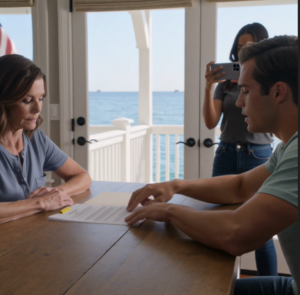
My son pushed a contract across the kitchen table with two fingers. The page was marked with yellow stickers where my signature was supposed to go. Behind him, through the screen door, his girlfriend held her phone at chest height. I could see the tiny red light on the screen. She was recording me.
“Ethan,” I said, “why does a company in Boston have a contract to buy my land?”
He didn’t blink. “Because I finally found somebody willing to pay what it’s worth.”
“It’s not yours to sell.”
“You always say everything you have is for your family. I’m your family.”
I turned the paper over. The buyer wanted my house, the old net shed, and the narrow strip of waterfront where my father had tied his lobster boat for forty years. The offer was large enough to make a young man imagine he would never have to work again. It was also less than half of what a waterfront broker had once told me the property might be worth. Someone was in a hurry.
“How did they get my tax records?” I asked.
Ethan’s jaw tightened. “Why are you making this difficult?”
“How did they get them?”
He looked toward Vanessa, waiting outside. Then he said something I had never heard him say in all the years I had raised him.
“Maybe you should be grateful I stayed your son this long.”
For a moment, I couldn’t hear the gulls over the harbor. I couldn’t hear the refrigerator clicking behind me. I could only see the boy I had carried home at two years old, asleep against my shoulder, and the stranger standing where that boy should have been.
“Get Vanessa’s phone out of my house,” I said.
Ethan laughed. “There it is. The crazy side. Keep going. People are going to love this.”
I put the contract down without signing. “You have until tonight to explain what you’ve done with my documents.”
“Or what? You’ll throw me away like everybody else did.”
That hurt. He knew it would. He knew every soft place in me because I had spent seventeen years showing them to him. Vanessa lifted the phone a little higher. Ethan leaned close enough for me to smell the expensive cologne I’d paid for at Christmas.
“You can give us the money quietly,” he whispered. “Or you can lose a whole lot more than money.”
He left the contract on the table and walked out. The screen door slammed. I watched Vanessa lower her phone and smile at him as if they had just finished a successful rehearsal.
Then I noticed something at the bottom of the last page. Under a line labeled “Seller Acknowledgement” was an electronic signature in my name, Maggie Sullivan, dated three days earlier. I had never seen the document before that morning, and I knew, before I picked up the phone to call my lawyer, that my son had already begun.
Chapter 2. What the Water Took
People who visit our village in July call it picturesque. They photograph the blue lobster traps stacked along the wharf and the little white houses pressed against the hills. They buy clam chowder at Rose’s Harbor Diner, take pictures of the lighthouse, and tell us how lucky we are to live somewhere so peaceful.
They don’t see November, when the wind works through every crack in a house. They don’t see the mornings a boat comes home short one man. And they don’t know how quickly a small town can turn a private sorrow into something everybody thinks they own.
I was forty-nine that summer. I kept the books for our fishermen’s cooperative and sold rope, gloves, and marine supplies out of a narrow shop beside the harbor. My father had left me the house and the net shed. My mother had left me a biscuit recipe, a silver thimble, and a stubborn habit of saving everything that might be useful later.
I had once had another child. His name was Daniel. He was six months old when he disappeared. My husband, Tom, was supposed to take him to a pediatric appointment in a town up the coast. Instead, Tom stopped at the apartment of a woman named Diane Reed. He left our baby in his car. When he returned, the passenger window was broken and the car seat was empty.
I can still remember the policeman asking what Daniel was wearing: a blue sweater, soft gray pants, and a little blanket I had stitched with three yellow ducks. I remember saying the ducks twice because my mind could not understand why a stranger would need to know about them.
The search lasted weeks. Volunteers walked the shore in raincoats. Fishermen checked coves and boat ramps. My father took his boat out every day, even when the weather turned. Someone found a small blue mitten beside a drainage ditch, but it wasn’t Daniel’s. Every ring of the telephone made my heart stop.
Months later, police arrested a man on an unrelated theft charge. He claimed he’d taken a baby from a parked car and, frightened by the search, abandoned him near the tidal river during a storm. His account shifted each time he told it. No remains were recovered. The case stayed open, but eventually people stopped speaking about Daniel as though he might come home. I did not.
Tom confessed the affair only after Daniel was gone. I divorced him before the next winter. He moved away with Diane for a while, lost his repair business, and died years later after a drunk-driving crash. I felt no triumph when I heard. There was nothing he could give back to me.
For a long time, I could not enter the small room at the end of the hall. Then, one afternoon, a social worker called about a little boy who needed a permanent home. He was two, with dark blond hair, solemn eyes, and a habit of clutching the sleeve of anyone kind enough to sit beside him. His name was Ethan.
I did not adopt him to replace Daniel. At least, I told myself I didn’t. I knew no child could do that. But I was lonely, and I had a house with an empty bedroom, and Ethan needed somebody who would come back when she said she would.
I learned how he liked his toast. I sat through ear infections and school concerts and rainy soccer games. When he woke from nightmares, I stayed on the floor beside his bed until his breathing slowed. I told him he was adopted as soon as he was old enough to understand, always in language that made clear he belonged here. He called me Mom. I never asked for anything in return.
The first signs of trouble seemed ordinary. Ethan hated being told no. He borrowed things and forgot to return them. At thirteen, he lied about breaking a neighbor’s window. At fifteen, he blamed the teacher for an assignment he had never completed. I made excuses. I remembered how frightened he had been as a toddler and mistook every demand for a plea to feel safe.
At eighteen, he was accepted into a state university with partial financial aid. I cried when the letter came. I had saved for his education in a separate account, adding what I could each month, even when the roof leaked and my truck needed a new transmission.
Then he met Vanessa Reed. I recognized the last name before I met the girl. In a town our size, there are some names that carry an entire history behind them. Diane Reed’s daughter had grown up mostly outside Harbor’s End, returning for summers and holidays. Vanessa was twenty, beautiful, quick with a compliment, and very good at noticing what other people wanted to hear.
I tried not to hold her mother’s sins against her. I invited Vanessa to supper. I asked about her plans. She said she wanted to create travel videos and lifestyle content in Boston. Ethan watched her speak as though she were describing a kingdom he had already inherited.
Soon he stopped talking about university. He wanted to move with her, rent an apartment, buy equipment, and build a brand. When I suggested he take classes while exploring those dreams, he called me…
The argument might have ended there. Children grow up. They choose lives their parents don’t understand. I could have lived with that. What I couldn’t live with was the money.
Chapter 3. The Cost of Love
The first unfamiliar charge was for a hotel in Boston. Then came a camera store, a jewelry shop, and a rental car deposit. I had given Ethan an authorized-user card for emergencies while he prepared for school. He had treated it like an open invitation.
When I asked, he said Vanessa needed good equipment to start her business. “It’s an investment,” he told me. “You invest in boats and nets. Why can’t you invest in us?”
“Because you didn’t ask,” I said.
He rolled his eyes. “You would have said no.”
That was the moment I should have taken the card away. Instead, I asked him to repay the charges over time. I wanted him to learn responsibility without feeling abandoned. He promised, kissed my cheek, and went out that night to celebrate with Vanessa. He made one payment, then nothing.
A week later, the bank called about a larger attempted charge. Ethan had tried to use the card to pay a deposit on a Boston apartment. When the transaction was declined, he told the leasing office I was his business partner and would approve it shortly.
I froze the card. He stormed into the shop before noon.
“You embarrassed me in front of Vanessa.”
“You used my account without permission.”
“I was going to tell you.”
“When? After the lease was signed?”
He knocked a box of brass fittings off the counter. The pieces scattered across the floor like coins. An old fisherman named Lou Mercer quietly stepped outside and pretended he hadn’t heard.
That evening, Diane Reed called. Her voice was still smooth and patient, the way it had sounded when she once told me that Tom had been unhappy long before he met her.
“Maggie, these kids are in love,” she said. “Maybe you could stop punishing Vanessa for what happened between us.”
“This isn’t about you and Tom. It’s about my credit card.”
“You always did need someone to blame.”
I hung up before she could say more.
Two days later, I learned that Ethan had approached a real estate developer from Boston. The man had been asking questions about our waterfront for months. Several older owners had refused to sell. The developer wanted a string of connected parcels for a boutique resort and private marina. My house stood between two properties he was already negotiating to buy.
Ethan had told him I was considering retirement and that he could help persuade me. He had sent photographs of the deed, property tax statements, and the old survey in my desk drawer. The buyer had drafted a proposed agreement. Ethan, apparently impatient, had clicked through an online signing link using a saved account on my laptop.
When I asked him about it, he didn’t even deny it. “It’s not like the sale is final,” he said. “You can still sign the real papers.”
“You signed my name.”
“I helped you get an offer.”
“Those are not the same thing.”
He pointed out the window at the harbor. “Look at this place. Half the boats are older than their captains. You want me to waste my life here because you can’t let go of Grandpa’s shed.”
I thought of my father coming home with cracked hands and cold cheeks, always checking the ropes before he checked on himself. I thought of the old planks he’d replaced one at a time because a new shed cost more than he could afford. The building wasn’t grand. It smelled of salt and engine oil, but it had never been for sale.
“I won’t sign,” I told Ethan.
“Then you’re choosing dead people over me.”
He left before I could answer. That night, I sat at my desk with the bank statements spread around me and finally admitted a truth I’d been avoiding. I was no longer helping my son grow up. I was helping him avoid growing up.
The next morning, I called Helen Brooks.
Chapter 4. The Locks
Helen’s office sat above the pharmacy on Main Street. She had been my lawyer since my mother died, and she had the useful habit of letting silence do its work. I told her about the card, the property documents, the forged electronic acknowledgement, and Ethan’s threats. She asked to see everything.
Then she said, “First, we secure the accounts. Second, we notify the buyer that there is no authorized sale. Third, we preserve every message. And, Maggie, you cannot solve this by arguing with him in your kitchen.”
I wanted to say she didn’t understand. Ethan wasn’t a stranger trying to cheat me. He was the boy whose forehead I had kissed before his first day of kindergarten. But that was exactly why I needed help.
The bank removed his access and opened the dispute. Helen contacted the developer, who quickly confirmed that no binding transfer had occurred and that the signature was being investigated. She also reviewed my estate documents. I had named Ethan as my principal beneficiary years earlier, never imagining a reason to reconsider.
“You can change your plans,” Helen said, “but do it carefully. Don’t make promises about what the law automatically does or doesn’t allow.”
I signed instructions for a new estate plan and asked her to document the reasons for the changes. We also discussed Ethan’s living arrangements. He was nineteen, but that didn’t mean I could ignore the rules about occupancy. Helen prepared written notice and a lawful timetable. I didn’t want to become the person he would later claim I was.
When Ethan came home, he found me waiting at the table with a folder and a cup of tea that had gone cold.
“You called a lawyer?” he asked.
“Yes.”
“Against your own son?”
“To protect my property and my accounts.”
He read the notice, his expression changing from disbelief to anger. “You’re kicking me out.”
“I’m asking you to make a plan to live independently. We can discuss the timeline through Helen.”
“You don’t get to stop being my mother because I made one mistake.”
“I haven’t stopped being your mother. I’ve stopped giving you unrestricted access to my money.”
He crumpled the page. “Same thing to you, apparently.”
I asked him to sit down. I told him I would still help him find work or speak to the university about his options. I offered to meet with a family counselor. He listened until I said I would not fund Vanessa’s move. Then his face hardened.
“You never wanted a son,” he said. “You wanted somebody who would never leave you the way your real kid did.”
I could feel the blood drain from my face. “Don’t use Daniel against me.”
“Why not? You use him against everybody else.”
I stood, not because I wanted to frighten him, but because I needed the table between us. “We’re done talking tonight.”
He laughed and pulled out his phone. “Good. I think other people should hear what you sound like.”
For the next few weeks, we communicated mostly through Helen. Ethan stayed with Vanessa and Diane while his belongings were collected and his occupancy was resolved. I changed the locks only after he had surrendered his keys and Helen confirmed I could do so. Every step felt colder than the last.
On the day he collected the final boxes, he stopped on the porch. The afternoon sun caught the dust in his hair. For one breath, he looked like a child again.
“If I apologized,” he asked, “would you put my name back in the will?”
There it was. Not “Would you forgive me?” Not “Could we start over?” The will.
“I would listen to an honest apology,” I said. “But I won’t bargain with you over an inheritance.”
He nodded as if I’d confirmed something. “Then don’t expect me to come back when you’re old.”
I watched his car turn onto the coast road. I wanted to run after him. I wanted to shout that there was still time to become somebody he could respect when he looked in the mirror. Instead, I went inside and washed the mug he had left in the sink.
That night, a message appeared on my phone: “You’re going to regret choosing that house over me.”
I saved a screenshot and sent it to Helen. Then I sat in the dark until the tide turned.
Chapter 5. The Boy on the Dock
I met Noah Bennett on a Tuesday when the rain came sideways across the harbor. I had gone down to the net shed to check a leak. Water was coming through the roof above the shelves, and I had already lost a carton of work gloves to damp and mildew.
Outside, a young man in a faded blue shirt was bent over the open engine compartment of Walter Bennett’s lobster boat. He had one foot braced against the dock and a wrench in his hand. The wind whipped his dark hair into his eyes. When the engine coughed, he leaned closer, listening as carefully as a doctor to a patient’s chest.
“You’re going to get soaked,” I called.
He looked up and smiled. “Already managed that, ma’am.”
“You should wait out the rain.”
“Walter’s got traps to check tomorrow. I’d rather finish now than make him miss a day.”
I knew Walter. Everybody did. He was nearly seventy and had fished these waters since he was old enough to hold a rope. His wife, Rose, worked mornings at the diner and kept half the village supplied with pie.
The young man tried the ignition again. This time the engine caught. He shut it off quickly, then gave the dashboard an affectionate pat.
“There you go,” he said.
As he climbed down, he noticed the water running from my shed roof. He asked if I had a ladder. I told him the leak could wait. He looked at the sky, then at the stack of supplies just inside my door.
“If the wind changes, you’ll lose those boxes,” he said. “I can move them out of the drip.”
He did it before I could offer payment. He carried the wet cartons, set dry boards beneath the others, and found a loose piece of flashing that explained the leak. His hands were rough, but his movements were careful.
“What’s your name?” I asked.
“Noah Bennett.”
“I’m Maggie Sullivan.”
“I know. You sell the good waterproof gloves. Walter says the cheap ones split before lunch.”
I laughed for the first time in weeks. We drank coffee under the shed awning while the rain softened. Noah told me he’d been accepted at the University of Maine to study mechanical engineering. He liked engines because they made sense. If something failed, there was usually a reason you could find. He had received financial aid, but he was saving for books, travel, and expenses the package wouldn’t cover.
“You could ask Walter and Rose for help,” I said.
“They’ve helped me my whole life. I’d like to carry some of it myself now.”
There was no performance in his answer. He wasn’t waiting for me to praise him. He simply stated what he believed.
I offered him paid work repairing the shed. He looked over the roofline and told me honestly which parts he could handle and which would require a licensed roofer. We agreed he would clear the damaged shelves, replace some interior boards, and help inventory my stock. I insisted on an hourly rate. He insisted on recording his hours.
Over the next month, Noah came by between shifts on the water. He never arrived without texting first. He put tools back where he found them. If he made a mistake, he told me before I noticed it. Those things sound small until you’ve spent years wondering whether someone is telling you the truth.
One afternoon, I brought him a sandwich and found him sitting on the dock with a textbook open beside a coil of rope. He was working through an engineering problem, chewing the end of a pencil.
“You know you’re allowed to rest,” I said.
“I am resting. This part’s interesting.”
He showed me a drawing of a gear system. I understood almost none of it, but I liked the way his whole face changed when he explained.
A few days later, I offered to advance him part of his wages so he could buy the laptop he needed for school. He refused. Then he suggested I could pay him for the remaining work when it was done. We shook hands on it like two businesspeople, and I respected him more for making me earn his trust.
Sometimes, when he turned toward the sun, something in the shape of his eyes caught at me. I told myself it was grief playing an old trick. After Daniel disappeared, I had seen him everywhere: in a toddler at the grocery store, in a school photograph, in a young man’s profile across a crowded ferry. Grief makes strangers familiar. I knew better than to mistake that for proof, so I said nothing.
Chapter 6. A Stranger at My Table
The day Ethan returned, Noah was repairing a kitchen window that had swollen in its frame. I had made tomato soup and grilled cheese for lunch. Noah sat at the table with a napkin tucked beneath his plate, explaining that Walter had taught him to check the weather by watching the clouds over the eastern point.
The back door opened without a knock. Ethan stopped in the doorway. He looked at Noah, the tools on the counter, and the two bowls of soup.
“What’s this?” he asked.
“Lunch,” I said. “You should have called.”
He ignored me. “Who are you?”
Noah stood. “Noah Bennett.”
“I wasn’t asking for your life story. Why are you in my house?”
“Ethan,” I said, “this is my house. Noah’s helping with repairs.”
Ethan’s eyes dropped to the faded work shirt Noah was wearing. “So you hired yourself a replacement son.”
Noah’s expression changed, but his voice stayed calm. “I’m here to fix a window.”
“Sure you are. You find a lonely woman with property on the water, and suddenly you’re doing favors. Pretty smart.”
“Enough,” I said.
Ethan stepped closer to Noah. “How much is she paying you to pretend you care?”
Noah looked at me. “I can finish the window another day, Mrs. Sullivan.”
“No,” I said. “You don’t have to leave because someone else is being rude.”
Ethan gave a sharp, disbelieving laugh. “You’d choose him over me?”
“I’m choosing not to let you insult a guest.”
“A guest. That’s rich.”
He pulled out his phone and took a picture of Noah standing beside the table. Then he took one of the tools and the soup. He was building a story in his head, arranging evidence to fit it.
“What are you doing?” I asked.
“Documenting things. You taught me to keep records, remember?”
He left as abruptly as he had arrived. I watched through the window as he sat in his car and typed for a long time before driving away.
Noah picked up his screwdriver. “I’m sorry. I didn’t mean to make trouble.”
“You didn’t.”
“He seemed hurt.”
I leaned against the counter. “He is hurt, but being hurt doesn’t give him the right to hurt everybody else.”
Noah considered that. “Walter says people sometimes throw their pain around because they don’t know where to put it. Doesn’t mean you have to catch it.”
I smiled despite myself. “Walter sounds wise.”
“He can be. Unless you’re asking him for directions. Then he’ll tell you how to get somewhere using a store that burned down in 1987.”
We laughed. It felt good to laugh in my own kitchen again.
That evening, a photo appeared on Vanessa’s social media account. It showed Noah standing beside my table, his hand on the back of a chair. The caption read, “Some mothers replace their children before the boxes are even unpacked.”
By morning, it had been shared hundreds of times. I called Ethan. He didn’t answer. Instead, he sent a message: “You wanted people to know the truth. Here it comes.”
Chapter 7. The Story They Sold
The first video lasted ninety seconds. Ethan sat in Vanessa’s car, his eyes wet, describing how his adoptive mother had turned against him when he fell in love. He said I’d cut off his money, forced him out, and brought a stranger into the house where he had grown up.
Some of what he said was true. That was what made it dangerous. I had stopped paying for his lifestyle. I had required him to move out through the proper process. Noah had eaten at my table. Ethan placed those facts beside accusations that I had never loved him and had used him as a substitute for a missing child. He left out the unauthorized charges, the forged acknowledgement, and the pressure to sell my property.
Then Vanessa posted a clip from our kitchen argument. In it, I could be heard saying, “We’re done talking tonight.” The video cut away before Ethan’s remarks about Daniel. It resumed with me standing behind the table, my face pale and furious. Underneath, Vanessa had added a caption: “This is how she talks to the son she adopted.”
A regional gossip page picked it up. Then a family drama podcast invited Ethan to speak. By the weekend, strangers were writing messages beneath photographs of my shop.
“How could you abandon him?”
“Adopted children are not disposable.”
“You should be ashamed.”
Some people in Harbor’s End defended me. Others said there must be something to the story. Lou Mercer stopped by with a bag of muffins and told me not to read the comments. The next day, a customer canceled a standing order of supplies, saying she didn’t want to be involved in controversy. I understood why. Small businesses depend on trust. A rumor doesn’t need to be proven to make somebody nervous.
Diane appeared in a video of her own. She said she had known me for years and that I had always been controlling. She described Vanessa as a gentle young woman who had only tried to love my son. Watching her speak, I remembered the night she’d told me Tom’s affair wasn’t something she could help. Her face had aged, but her talent for making cruelty sound reasonable had not.
Helen told me to stop watching. “We will preserve the original posts,” she said. “We can respond to false factual claims, but don’t let them drag you into a public argument about whether you’re a good mother. That isn’t a trial you can win online.”
I knew she was right. Still, I found myself rehearsing answers while I stocked shelves, while I cooked, while I lay awake. I wanted to tell every stranger about the fevers I’d sat through and the tuition I’d saved. I wanted to ask how a lifetime could be reduced to ninety seconds.
Then Ethan came to my porch with a livestream running. It was a bright Saturday morning. Tourists were walking toward the pier. He knelt on the front step with flowers in his hands while Vanessa stood across the street filming.
“Mom,” he called, loud enough for the neighbors to hear. “Please. I’m asking you to let me come home.”
I opened the inner door but kept the screen latched. “Turn off the camera.”
“Why? Are you afraid people will see us make peace?”
“I will speak with you privately, with Helen present. Not on a livestream.”
He lowered his head as if I’d struck him. “You hear that? She needs a lawyer just to talk to her own son.”
My neighbor, Mrs. Talbot, stood across the road with a grocery bag, watching. Two young men near the pier held up their phones.
“Ethan,” I said, “you know why the accounts were closed.”
He looked straight at the camera. “All I wanted was to build a life with the woman I love.”
I closed the door. My hands shook so badly I dropped the latch twice. Within an hour, the clip was everywhere. A caption said I’d refused to forgive my crying son on the doorstep. It did not mention that he had arrived with an audience.
That afternoon, someone scratched a word into the paint of my shop door. Someone else left a note beneath the windshield wiper of my truck. I reported both incidents, photographed the damage, and tried to keep working.
But the worst part wasn’t the strangers. It was that I recognized my son’s voice in every accusation. He knew me. He knew what would hurt, and he was using it carefully.
Chapter 8. The People Who Stayed
Noah came to the shop the morning after the porch video. He didn’t ask whether the rumors were true. He asked if I wanted him to fix the damaged door before the weekend customers arrived.
“You don’t have to get involved,” I told him.
“I’m already involved. I work here sometimes.”
“People are saying terrible things about you, too.”
He shrugged, though I could see the strain around his eyes. “Walter says if you spend your whole life trying to please the loudest person on the dock, you’ll never get the boat untied.”
He repaired the door, then helped me copy the security camera footage to a drive for Helen. The recording showed Ethan arriving with flowers, checking the camera angle, and waiting for Vanessa’s signal before kneeling. It didn’t tell the whole story, but it told more than his edited video.
That evening, Walter and Rose invited me to supper. Their cottage stood beyond the last row of houses, where the road narrowed beside a field of wild roses. The kitchen smelled of haddock chowder and fresh bread. Rose wore an apron printed with tiny blueberries. Walter argued cheerfully with the radio about the weather forecast. They didn’t treat me like a scandal. They asked whether I wanted more potatoes.
Noah came in late, his hair still damp from washing up. He set the repaired porch light on the counter and apologized for keeping everyone waiting. Rose touched his shoulder as he passed. It was an ordinary gesture, so easy and familiar that it made my throat ache.
Over supper, Rose told me how Noah used to dismantle broken clocks when he was little, then leave the pieces arranged on newspaper until Walter helped him put them back. Walter said Noah had always been more patient with machines than with people who pretended to know everything.
“He gets that from you,” Rose said.
“He gets his stubbornness from you,” Walter answered.
Noah rolled his eyes. “I’m right here.”
I watched them tease one another and felt something complicated: happiness that a young man had been so well loved, and grief for the home I’d imagined having with Ethan.
Later, while Noah helped Walter in the shed, Rose and I washed dishes. She asked gently whether I had any family nearby. I told her about my parents, both gone. And then, before I could stop myself, I told her about Daniel. She dried her hands and listened without interrupting.
When I finished, she said, “I can’t imagine carrying that all these years.”
“You learn how,” I said. “You just don’t learn how to put it down.”
Rose looked through the window toward Noah. “We had our own strange beginning with him.”
I glanced at her. “What do you mean?”
“We didn’t have him from birth. He came to us through the foster system. There were missing pieces in the records, and it took time before everything was settled. He was a baby when he was found after a storm.”
I kept washing the same spoon. “What storm?” I asked.
“One along the coast, years ago. Walter and I were living farther south then. We weren’t the people who found him, but we were the ones who stayed.”
The spoon slipped from my hand and struck the sink. Rose turned.
“Maggie?”
“I’m all right.” My voice sounded strange. “Do you know where he was found?”
“There was a marina. I think a rescue worker brought him in. Some of the paperwork was corrected later. Why?”
I told her it was nothing. I wasn’t ready to put an impossible hope into words. Rose studied me for a moment, then said she still had the few things that had arrived with Noah, sealed in a box along with copies of his early records.
She fetched it from a closet. The cardboard had softened at the corners. Inside were a hospital bracelet with faded writing, a knitted cap, a photocopied intake sheet, and a small blanket folded into a square.
Rose opened the blanket carefully. Three yellow ducks crossed the pale blue fabric. The middle duck was crooked, its beak stitched a little too high. I knew that crooked duck. I had made it myself because I was tired the night I finished the blanket, and Tom had laughed and said it looked like the duck was singing.
I gripped the edge of the counter.
“Maggie?” Rose asked again.
I couldn’t answer. Not yet. I had lived too many years with hope that turned into nothing. But my hands knew those stitches, and for the first time in nearly nineteen years, the thought that Daniel might be alive no longer felt like a dream I was ashamed to have.
Chapter 9. Three Little Ducks
Rose sat me down before my knees gave way. Walter came in from the shed and found the blanket between us. Noah stood in the doorway, confused by the sudden silence.
“What’s happened?” he asked.
I tried to speak. Nothing came out. Rose poured water into a glass and placed it in front of me.
“Maggie lost a baby many years ago,” she told him gently, “and she recognizes this blanket.”
Noah looked from her to me. He didn’t reach for the fabric. “Recognizes it how?”
“I made one,” I whispered, “for my son. Three ducks. The middle one was wrong. I never fixed it.”
Walter pulled out a chair. “We need to be careful,” he said. “A blanket isn’t proof.”
“I know.” I looked at him gratefully. “I know it isn’t.”
For the next hour, we went through what Rose had kept. Noah had been taken to a hospital after a volunteer rescue crew found him in a sheltered area near a marina following a coastal storm. A woman who had seen the child alone called for help. Early reports contained conflicting descriptions of where he had been discovered. No reliable identification had been attached to him.
After attempts to locate family failed, he entered foster care. Walter and Rose eventually adopted him through the court. They had lived in a different county then. A caseworker had told them the baby’s birth family could not be located. They had asked questions, but as the years passed, they trusted that the agencies had done what they could.
Noah knew he was adopted. He had never felt the need to search until recently, when a college medical history form asked questions he couldn’t answer. I gave them the date Daniel disappeared. Walter went to a drawer and returned with a folder of documents. The dates were close enough to make all four of us go quiet.
“I need to see the police file,” I said.
“And I need to know what this means for us,” Noah said.
He wasn’t angry. He was frightened, and I understood why. A stranger had arrived at his family table and might be about to rearrange his entire life.
“It doesn’t have to mean anything you don’t want it to,” I told him. “I won’t ask you to choose.”
Rose reached for his hand. “You are our son. Nothing changes that.”
Walter nodded once. “Not a thing.”
Noah stared at the blanket. “If there’s a chance, shouldn’t we find out?”
I called Helen the next morning. She helped me contact the detective responsible for reviewing Daniel’s old case and locate the correct agency for Noah’s sealed adoption records. There were privacy rules, consent forms, and long waits. The rescue account needed verification. A blanket, even one I remembered perfectly, could have reached a child in more than one way.
Noah and I agreed to a legally documented DNA test through an accredited laboratory. We signed the consent forms separately. The technician swabbed the inside of my cheek, then his. The whole appointment took less than half an hour. I had waited nineteen years for an answer that might arrive in a few days.
During the wait, I tried not to change the way I treated him. He still came to the shed. He still recorded his hours. Sometimes we talked about the test. Sometimes we talked about his classes or Walter’s stubborn engine.
Once, he asked what Daniel had been like.
“He laughed when the kitchen tap ran,” I said. “I don’t know why. I would turn it on, and he’d kick his feet like it was the funniest thing in the world.”
Noah smiled. “I used to love running water, Rose says. I flooded the bathroom twice.”
We both laughed, then fell silent. The resemblance could mean everything or nothing.
Meanwhile, Ethan announced another livestream. Vanessa posted a teaser promising “the truth about the replacement son.” Their followers filled the comments with guesses. Someone had photographed Noah walking beside me at the harbor. A stranger wrote that I must have been hiding a secret relationship. I reported the post, but I couldn’t erase the feeling of being watched.
Helen urged me not to disclose the DNA test publicly. “This is Noah’s private life, too,” she reminded me. “He gets a say.”
That was when I realized how easily fear could make me selfish. I wanted the whole world to know I had not invented my sorrow. I wanted to hold up proof that something beautiful might have survived. But Noah was not evidence in my argument with Ethan. He was a person with parents, a future, and questions of his own. So I waited.
Chapter 10. What the Camera Kept
Ethan’s second livestream began on a Sunday evening. He sat beside Vanessa under soft studio lights. Diane joined them by video call. They described me as a woman obsessed with control, someone who had replaced an adopted child with a young worker who needed money.
Then Ethan held up a photograph of my house. “She’d rather give that place to a stranger than help her own son,” he said.
I watched only the first few minutes before turning it off. Helen watched the rest for me. She had already collected the original posts, the timestamps, the bank records, and correspondence with the developer. The real estate company had confirmed in writing that I had not authorized the signature on the proposed acknowledgement and that it had suspended discussions about my property.
The full security video from my kitchen was harder to watch. It showed Ethan sliding the contract toward me, demanding that I sign, and Vanessa filming from outside. It also captured his threat to make the town turn against me. I hadn’t known the small camera above the pantry door recorded sound so clearly.
“This matters,” Helen said. “Not because it proves you were a perfect parent. Nobody is. It shows the public clip omitted the very conduct that prompted your response.”
With her help, I issued a short statement. I said I loved my son but had withdrawn financial access after unauthorized charges and a property transaction I had not approved. I asked people not to harass anyone involved. I shared no private adoption history and no information about Noah.
The developer’s written confirmation became public with its permission. Ethan’s claim that I’d agreed to sell the waterfront collapsed. Then a local reporter who had been skeptical of both sides compared the unedited porch recording with a version Vanessa had posted. The longer video showed Ethan checking the camera before kneeling and refusing my offer to speak privately with a lawyer present.
The reporter did not call me a saint. She wrote that family disputes were complicated, that Ethan’s feelings about adoption deserved care, and that the financial allegations required a separate factual examination. That was fairer than anything I’d read in weeks.
The response changed slowly. Some people apologized. Some simply stopped commenting. A few insisted there must be more I was hiding. There always would be. But customers began returning, and the cooperative board confirmed that my work would be judged on my work, not on viral clips.
Ethan sent me a furious message. He accused me of humiliating him. I forwarded it to Helen and did not reply. Three days later, Vanessa removed photographs of them together. A week after that, Ethan called from a number I didn’t recognize.
“She left,” he said.
I was standing in the shop, counting boxes of hooks. I sat down. “I’m sorry you’re hurting,” I told him.
“Don’t say that like you care. You did this.”
“I didn’t make Vanessa leave.”
“You took away everything I was supposed to have.”
“You still have choices, Ethan. You can work. You can go back to school. You can get help.”
He gave a bitter laugh. “Easy for you to say. You have the house. You have your new boy.”
I closed my eyes. “Noah isn’t part of this conversation.”
“You think he’ll stay when he finds out what you’re really like?”
The line went dead. For the first time, I didn’t call back.
That afternoon, the laboratory sent an email saying the results were ready through its secure portal. I stared at the notification for several minutes before calling Noah. He was on the boat with Walter and couldn’t come ashore until evening.
“Don’t open it without me,” he said.
“I won’t.”
I put my phone facedown on the table and waited for the sound of his truck.
Chapter 11. The Name I Never Stopped Saying
Noah arrived just after sunset. Rose and Walter came with him. Nobody suggested that I should read the result alone. We sat at my kitchen table, the same table where Ethan had pushed the contract toward me weeks earlier. The laptop screen lit our faces. Noah put his hand beside mine, not touching it yet.
I clicked the report. The laboratory stated that the tested samples supported a biological parent-child relationship between us with a probability greater than 99.99 percent. I read the line once, then again. The words stayed the same.
“Noah,” I whispered.
He stared at the screen. “Does that mean—”
“Yes,” Rose said softly. “It means what we think it means.”
I had imagined this moment in a thousand impossible ways. I had pictured running toward a child on a beach, hearing a voice call my name, finding a face I recognized in a crowd. I had never imagined sitting at my own kitchen table, unable to move, while a young man who had become my friend tried to understand that he was my son.
“Daniel,” I said before I could stop myself.
Noah looked at me. I covered my mouth. “I’m sorry. That’s the name I gave you. I know you’re Noah.”
He was quiet for a long time. Then he reached across the table and took my hand.
“You can tell me about Daniel,” he said. “I’d like to know him.”
That was when I began to cry. Not the controlled tears I’d learned to hide in public. Not the angry tears Ethan had brought out of me. I cried for a baby in a blue sweater, for my father searching the coast, for a nursery door I couldn’t open, for nineteen birthdays I had marked alone.
Noah moved around the table and held me. He smelled of salt, soap, and the engine oil that never quite washed out of his work clothes. I held him carefully at first, afraid of making a claim he wasn’t ready to give me. Then he hugged me tighter.
“I’m here,” he said.
Rose cried, too. Walter sat with one hand over his eyes. There was no triumph in the room, no winner and loser, only four people trying to make room for a truth too large for any one of us.
Later, we spoke about the years between. The detective reopened parts of Daniel’s file and worked with the relevant agencies to reconcile the old records. The investigation would take time. The original suspect’s shifting account, the chaotic storm response, and mistakes in early documentation had left gaps that could not be fixed in a night. The DNA result answered the question of who Noah was. It did not instantly answer every question about how he’d been lost.
I asked Noah whether he wanted to use the name Daniel. He shook his head gently.
“I’m Noah,” he said. “That’s who Walter and Rose raised. But Daniel can be part of my story, too.”
“Of course,” I told him. “You don’t have to change anything for me.”
I turned to Rose and Walter. “You kept him safe. You loved him when I couldn’t find him. I don’t know how to thank you.”
Rose took my hands. “We didn’t raise him for a reward, Maggie. We raised him because he was our boy.”
“He still is,” I said.
Walter cleared his throat. “Good, because he’s promised to fix my engine again next spring.”
We laughed through our tears. Over the following days, Noah asked about his first six months. I showed him photographs: Tom holding him awkwardly on a porch, my mother leaning over his crib, a picture of me asleep on the couch with him against my chest. We talked about Tom, too. I told the truth without asking Noah to inherit my anger. His father had failed him terribly. That failure was not Noah’s burden to carry.
He showed me pictures from his childhood: a tiny boy in rubber boots, a school science fair, Walter teaching him to tie knots, Rose standing beside him at graduation. I loved those photographs. They proved that even when I thought his life had ended, he had been living it.
One morning, we walked to the end of the pier before the boats went out. The harbor was silver beneath the early light.
“I used to come here and wonder where you were,” I told him.
“I’m sorry you had to do that.”
“You have nothing to apologize for.”
He leaned on the railing. “I don’t know what to call you yet.”
“Maggie is fine. Anything is fine.”
He thought for a while. “Could I call you Mom sometimes?”
I had to look out at the water before I could answer. “Anytime,” I said. “Only when you want to.”
Chapter 12. What the Tide Left Behind
The trouble with finding happiness after a long sorrow is that the rest of the world doesn’t stop moving. The roof still leaks. Bills still arrive. And people who have hurt you do not always become kinder because you have found something worth protecting.
Ethan learned about Noah’s identity through a rumor before I was ready to tell him. I had shared the news with only a few trusted people, but small towns have thin walls. He left three messages demanding to know whether Noah would inherit the house. I answered once, with Helen on the call.
“I found out something important about my past,” I said. “It doesn’t change the choices you’ve made.”
“So it’s true,” he said. “He’s the real son. I’m the extra one.”
“You were never extra. I loved you as my son, but I won’t give you money in exchange for peace.”
“You always wanted him instead.”
“I wanted both of you safe. That’s not the same thing.”
He hung up. A few nights later, my security system sent an alert. I was staying at Rose and Walter’s cottage after supper, so I saw the footage on my phone: Ethan at the back of my house, testing the door to the net shed. He had no permission to be there.
He forced a damaged side latch and entered carrying a flashlight. I called the police rather than going home. By the time an officer arrived, Ethan was searching a locked filing cabinet in the shed. He was detained, and the incident became part of the ongoing investigation into the property documents and unauthorized financial activity.
I gave a statement. I did not go outside to confront him. Later, Helen told me that Ethan had said he was looking for proof I’d promised him the property. I knew what he wanted. He wanted a piece of paper that could make the future feel guaranteed again.
The legal process was slow and less dramatic than the stories people tell online. There were interviews, records, decisions by people whose job was to weigh evidence. I didn’t pretend to know what every outcome would be. I only knew I would cooperate and would no longer protect Ethan from the consequences of his own actions by hiding what he had done.
Vanessa moved to Boston without him. Diane stopped posting about me when the questions turned toward her daughter’s edited videos. The resort developer found another site to pursue. Eventually, the gossip faded, as gossip does when it stops feeding people something new.
One afternoon, Ethan sent a letter through Helen. It wasn’t a full apology. He still blamed me for things I hadn’t done, but he wrote that he had started counseling and was looking for steady work. He asked whether we might speak someday.
I read the letter twice and put it away. I told Helen that if Ethan continued making real changes, I might consider a carefully arranged conversation in the future. I would not promise money, access to my home, or a place in my estate plan. Loving someone did not require making myself available to be harmed.
Summer turned to autumn. Noah left for university with a secondhand laptop, a truck full of carefully packed belongings, and three adults fussing over whether he had enough warm socks. Rose made sandwiches for the road. Walter checked the tires. I tucked a small envelope into Noah’s bag with a photograph of his first birthday and a note that said, “There has always been room for you here.”
Before he drove away, Noah hugged Rose and Walter, then turned to me.
“I’ll be back for the long weekend,” he said.
“You don’t have to come back just because we’re expecting you,” I told him.
He smiled. “I know. I want to.”
For the first time, I understood the difference. I had spent years trying to keep a son close by giving him whatever he asked for. Now I was watching another son leave, and I wasn’t afraid that distance would erase us. He had his own life to build. That was what I wanted for him.
In October, Noah came home to help Walter haul the last traps before the weather turned. I stood on the porch with Rose, each of us holding a mug of coffee while the two of them walked toward the boat. Walter complained about Noah’s college haircut. Noah complained that Walter’s engine sounded worse than before. Their voices carried across the water.
The net shed had a new roof. My shop was busy again. I had begun setting aside a small fund to help local students cover tools and books for vocational training because I’d learned how far a little practical help could go when it was offered without strings.
I still thought about Ethan. Some mornings I woke remembering him at six years old, sitting on the floor with a broken toy and asking me to fix it. Those memories were real. So were the things he had done as an adult. I did not have to erase either truth to go on living.
Noah waved from the boat. I waved back. For nineteen years, I had looked at the sea and imagined it holding the last trace of my child. I had thought every tide carried him farther away. That morning, the tide was coming in.
The boat rocked gently against its ropes, and my son was laughing with the man who had raised him. I went inside to put the kettle on. They would be hungry when they came home.
The end.