I Spent 3 Days Building My Daughter’s Deck—Then My Son-in-Law Said, “There’s No Room for You Here”!
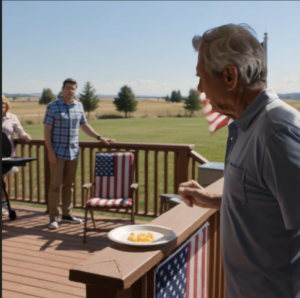
Phân cảnh 1: The deck and the betrayal
I spent three days building the deck my daughter had asked me for since spring, and I finished it the morning of the 4th of July with enough time to shower before my son-in-law told me I wasn’t welcome to sit on it.
I said nothing. I went inside and made one phone call. 20 minutes later, my daughter’s face went the color of the paint she just picked out.
Welcome back, my friends. I’m grateful every single time you show up for one of these. Tell me where you’re watching from tonight down in the comments.
And please remember, as always, some details in this story have been changed or dramatized for the sake of the telling, but the truth underneath it is real enough to matter.
Now, let me tell you how I ended up standing on the other side of my own kitchen window, watching a party I’d paid for.
The garage light in my shop has a pull chain that sticks in July heat, and it stuck that morning, same as it always did, and I stood there in the dark for a second before it caught, the way I’d stood there most mornings for the better part of 40 years.
I’d been awake since 5. Not because I set an alarm. I hadn’t owned an alarm clock since I retired from the county roads department, but because a man who spent three decades driving a grater before sunrise doesn’t lose the habit just because the job’s gone.
The shop smelled like sawdust and cut cedar, the same smell it had smelled like for three days straight while I built that deck board by board, level by level. The way I’d built everything on this property since 1988.
My name is Walter Puit. I’m 67 years old. I live outside Bosezeman, Montana, on 11 acres I bought the year before I married my wife, Carol, back when the land was nothing but sage brush and a well that hadn’t been drilled yet.
Carol passed four years ago this November. A stroke on a Tuesday morning while she was watering her tomato plants, and I found her in the garden with the hose still running.
I don’t tell people that story for sympathy. I tell it because everything I did after—every board I nailed, every fence I mended, every deck I built for my daughter—I did it the way Carol taught me to do things, which was slow and correct, and without cutting a single corner you’d regret later.
Carol and I had one daughter, Melissa. She’s 34 now, married 8 years to a man named Tyler Voss, and they have two boys, Cooper and Dean, seven and five, who I love enough that I’d have built that deck twice over if they’d asked.
Melissa had been talking about a deck since April. A place for the boys to run around on the 4th. A place for Tyler’s side of the family to sit when they came up from Billings for the holiday.
A place, she said, for the whole family to finally feel like we’re one thing.
I told her I’d build it.
I didn’t tell her I’d build it because I had three days off between physical therapy appointments for my knee, or because the lumber yard in town was having a sale on treated pine, or because building something with my hands was still the only thing that made the house feel less quiet since Carol died.
I just told her I’d build it, and I did.
I want you to understand what building a deck actually costs a man my age, because it matters later. I dug the footings myself, 12 of them, each one 30 inches down through Montana clay that fights you for every inch.
My knee—the same one that ended 30 years of hauling gravel and dropped me into an early retirement I never asked for—swelled up like a grapefruit by the second day. And I iced it at night, sitting in Carol’s old recliner because it was the only chair in the house that still smelled faintly like her hand lotion.
I said every joist with a level, not a guess. Because Carol used to say, “A man who eyeballs a level is a man who’s going to be sorry about it in 10 years.”
And she was right about that. The way she was right about most things.
I spent $420 of my own retirement money on lumber and hardware because Melissa and Tyler were, in Tyler’s words, “a little tight this quarter.” And I didn’t ask what that meant because it wasn’t my business to ask. Only my business to help.
I finished the last board at 11:00 in the morning on the 3r day, the 4th of July. Sweat soaked clean through my shirt, my knee throbbing in a way that told me I’d be paying for this for a week.
I stood back and looked at it the way I look at anything I’ve built with my own two hands. 12 by 16 ft of solid, level, sanded cedar decking. Railings I’d notched myself. Steps down to the yard where Cooper and Dean could run without a parent hovering over every splinter.
It was good work. It was honest work. And it was, as far as I understood things that morning, a gift.
I went inside, showered, put on a clean shirt, and walked back out to the kitchen, expecting to help Melissa with the potato salad because that had been the plan since the week before: I bring the potato salad, Tyler handles the grill, Melissa handles the kids, and everybody sits down together on the deck I just spent 3 days of my knee in my back building.
That was the plan. That was what I believed the day was going to be.
I want to back up here because there were things happening in the months before that Fourth of July that I didn’t understand the shape of until later.
Phân cảnh 2: Evidence of ulterior motives
And I think you need to understand them the way I eventually did. One piece at a time. The way you find nails scattered across a job site after a storm.
You don’t see the whole picture until you’ve picked up every single one.
The first thing happened in March, though I didn’t know what it was at the time. Melissa and Tyler had moved into the house next to mine two years earlier, a rental monthtomonth on a piece of land owned by a fellow named Dutch Aluldren who I’d known since high school.
It made sense at the time. Melissa wanted to be close after Carol passed, and I wasn’t going to argue with my daughter wanting to be near her father.
In March, I was walking the fence line between our properties, checking for the winter damage the way I did every spring. And I overheard Tyler on the phone in his backyard, pacing.
The way a man paces when he doesn’t want to be overheard and hasn’t checked whether anyone’s close enough to hear him anyway.
“No, my father-in-law is just—he’s old school, you know. He’s not going to fight us on it. He’s not the type.”
A pause.
“No, I already talked to Mel about it. She agrees the property should come to us eventually anyway. I mean, who else is he going to leave it to?”
I stood very still on my side of that fence line with a pair of wire cutters in my hand, and I did not make a sound.
I want to be honest with you: my first instinct wasn’t anger. It was something quieter and worse, a kind of cold settling in my chest.
Because I understood in that moment that my son-in-law had been having conversations about my land, my house, my life’s work with people who weren’t me, and that my daughter had apparently been part of at least one of those conversations.
I didn’t say anything to Melissa. I didn’t say anything to Tyler.
I went home and I sat down at Carol’s kitchen table and I did something I hadn’t done in years. I got out the small spiral notebook I used to keep in my shirt pocket back when I ran road cruise. The one I used for logging equipment hours and weather delays.
And I wrote down the date and a single line:
“Heard tea on phone. Talk of inheriting property. No discussion with me.”
I didn’t know yet that it would matter. I just knew it felt like something worth remembering correctly.
The second thing happened in April. I keep three vehicles registered under my name: my truck, Carol’s old sedan that I’d never had the heart to sell, and a flatbed trailer I use for hauling firewood and the occasional load of gravel for neighbors who still call me when they need something moved.
Tyler asked to borrow the trailer in April to haul what he called “some furniture” to a storage unit in town.
I said, “Sure,” because that’s what you do for family.
He had it back within the day, no trouble, and I thought nothing of it. Until I ran into Denny Aldren, Dutch’s boy, who works the storage facility off Route 10, at the hardware store in May.
Denny mentioned, in the easy way small town people mention things without realizing what they’re handing you, that Tyler had rented a unit back in April, a big one, and had been moving boxes in steadily every couple of weeks since.
Furniture, Denny figured, though he admitted he hadn’t looked close.
I thanked him, bought my washers and my box of screws, and drove home, turning that piece over in my mind. Melissa and Tyler’s rental house was, as far as I knew, fully furnished. There was no renovation happening.
There was no reason I could think of for a young couple with two kids and, by Tyler’s own account, tight finances to be renting climate controlled storage and filling it steadily month after month—unless they were preparing to move, or unless they were storing things they didn’t want me specifically to see.
I wrote it down. Date and a line:
“T renting storage unit since April. Filling it steadily. No renovation happening that I know of.”
The third thing happened in May, at my 67th birthday dinner, which Melissa hosted at her house. I’d had a good time, or what I thought was a good time, right up until I went looking for the bathroom and passed by the desk in their spare room where Tyler kept his home office setup.
The door was cracked open, and on the corner of the desk, in plain view—not hidden, not locked away, because why would he think I’d ever walk in there and look—sat a printed document with a county seal at the top.
I didn’t pick it up. I didn’t need to pick it up to read the header because the letters were large enough to catch from the doorway.
“Application for property tax assessment review.”
And beneath it, my parcel number, the one I’d known by heart since 1988. And beneath that, a name I did not expect to see listed as the requesting party.
Tyler James Voss.
I stood in that hallway for what felt like a long time, but was probably 10 seconds. A man doesn’t file a tax assessment review on a piece of property he doesn’t believe, on some level, is already his or is about to become his.
I went back to the party. I ate my cake. I said nothing.
And that night at home, I wrote it down. Date and a line:
“Found tax assessment paperwork on my property filed by tea without my knowledge.”
The fourth thing happened 3 weeks before the 4th of July, on a Sunday afternoon when I stopped by unannounced to drop off a box of Cooper’s old boots I’d found in my garage—boots I’d bought the boy myself the winter before. The kind of thing a grandfather does without thinking twice about it.
I came up the porch steps and heard voices through the screen door. Melissa’s mother-in-law visiting from Billings, a woman named Darlene Voss, who I’d met exactly twice and liked well enough, though I didn’t know her well.
I wasn’t trying to listen. I want that understood. But a screen door in July doesn’t hide much.
And Darlene’s voice carried the way voices do when a person believes they’re speaking privately among family.
“So once everything transfers over, are you two going to redo the whole property or just the house?”
Melissa’s voice, quieter, a little uncertain.
“We haven’t really—I mean, Dad’s still—”
“Oh, I know. I know. I just mean eventually. Tyler mentioned you two have been talking to somebody about the estate planning side of things. That’s smart. Better to have it figured out than to be scrambling later. God forbid.”
I stood on that porch with a box of a seven-year-old’s boots in my hands, and I felt something in my chest that I want to describe to you honestly because I think it’s important.
It wasn’t rage. It was grief, sharper than anything I’d felt since I found Carol in that garden.
Because I understood, standing there, that my daughter—my daughter, who I had raised alone through her teenage years after Carol’s first cancer scare kept her in and out of hospitals for 2 years, my daughter, who I had walked down the aisle myself because her mother was too sick that year to stand for long—my daughter had been sitting in rooms where people discussed my death and my property as a settled, upcoming, practical matter.
And she had not once come to me and asked how I was doing, or what I wanted, or whether I’d even made a will at all.
I knocked on the door instead of walking in. Melissa answered, surprised, a little flushed. I handed her the box of boots, told her they were for Cooper, said I couldn’t stay, and drove home.
That night, I wrote the longest entry yet in that notebook. And at the bottom of the page, I wrote four names.
My attorney, Frank Dietrich, who’d handled Carol’s estate and mine for 22 years.
My neighbor and oldest friend, a rancher named Gus Howerin, who’d known me since we were 19 years old, working the same road crew.
My accountant, a sharp young woman named Priaire, who’d caught two separate discrepancies in my property tax filings over the years that the county itself had missed.
And Denny Aldrin at the storage facility, who I called the next morning and asked plainly whether he’d be willing to let me know quietly if Tyler Voss ever asked to transfer that storage unit into a different name or moved anything out of it in a hurry.
Denny didn’t ask why. Denny’s father raised him not to ask why when a man like me asks a simple favor like that.
Phân cảnh 3: Preparations for the fourth
I want to tell you what I did in the two weeks before the 4th of July because none of it was dramatic and all of it mattered.
I drove into town and sat with Frank Dietrich for an hour and a half. I told him everything. The phone call by the fence line, the storage unit, the tax paperwork, the conversation through the screen door.
Frank had a way of listening that Carol always said made you feel like the most important person in the world for exactly as long as it took him to hear the whole story and not one second longer than that. Because after that, he got to work.
He confirmed what I already suspected. The property tax assessment review Tyler had filed required the signature of the current owner of record to proceed past a preliminary stage, and no such signature existed because I hadn’t signed anything.
It had stalled in the county system, harmless on its own, but revealing all the same.
Frank also confirmed something I hadn’t known: that under Montana law and under the specific terms of the trust Carol and I had set up together back in 2009, nothing on that 11 acres could transfer to anyone for any reason without my direct notorized authorization while I was alive and of sound mind, and without a specific set of legal triggers after I passed that I had full control over and could change at any time.
I asked Frank to draw up an updated version of my will that afternoon, one that made a few things very clear, and I told him I’d be back to sign it the week after the holiday.
He asked me if I was all right. I told him I was building a deck.
He didn’t need me to explain any further than that.
I drove to Gus Howerin’s ranch the next day. Gus and I sat on his porch with two cups of coffee, and I her to pull together, in writing, a clean summary of every payment I’d made toward Melissa and Tyler’s household over the past two years: the down payment help on their truck, the four months of rent I’d covered the winter Tyler was between jobs, the deck materials, the insurance I still carried on Cooper and Dean as dependence on my old work policy because Tyler’s job didn’t offer family coverage yet.
It came to just over $31,000.
I didn’t ask for that summary because I intended to ask for the money back. I asked for it because a man needs to know clearly and on paper exactly what he has given before he decides what he is and is not willing to keep giving.
The night before the 4th, I sat at Carol’s kitchen table with that notebook open in front of me, and I thought about her for a long time.
I thought about the year she was sick, and how frightened Melissa had been, and how I had promised both of them—promised out loud, standing in that hospital hallway—that whatever happened, this family would be all right, that I would make sure of it no matter what it cost me.
I still believe that promise. I want you to understand that because it matters for how the rest of this story goes.
I wasn’t building toward punishing my daughter. I was building toward making sure nobody mistook my patience for permission.
Phân cảnh 4: The holiday confrontation
The 4th of July came in clear and hot, the kind of Montana morning where the sky goes an almost unbearable shade of blue by 9:00 a.m.
I finished the deck by 11:00, as I told you, and by noon I’d showered and made my potato salad the way Carol always made it: red potatoes, not russetss, because she said russets went to mush; a spoonful of the pickle relish she used to buy from the same little grocery in town for 30 years; mustard she mixed herself instead of the pre-made kind.
I carried it next door at 1:00, same as we’d planned.
There were more cars in Melissa’s driveway than I expected. Darlene Voss’s SUV. A truck I recognized as belonging to Tyler’s brother, Brett, who lived in Billings. Two more vehicles I didn’t recognize at all.
I counted six people through the front window before I’d even reached the porch. And by the time Tyler opened the door, I counted 11, not including Melissa, the boys, or Tyler himself.
Nobody had mentioned a bigger gathering to me. Nobody had asked whether the deck—freshly built, freshly sanded, the sealant not even a full day cured—could hold that kind of weight and that kind of traffic.
Nobody had asked whether I’d mind, on a holiday I understood to be a small family cookout, sharing the day with a dozen people I’d met at most twice in my life.
Tyler opened the door and did not step back to let me in the way a man does when he’s glad to see you. He stood in the frame for a second, one hand on the door, looking somewhere over my shoulder at Gus’s truck pulling into my own driveway next door because I’d told Gus to come by around 2:00.
And this was closer to 1:30, and something in Tyler’s face shifted, quick and calculating, before he settled it back into a kind of tight politeness.
“Walter. Hey, you’re early.”
“Said 1:00,” I told him. “Brought the potato salad.”
He took the bowl from me the way a man takes something from a delivery driver he doesn’t especially want to talk to.
And I stepped inside, and the noise of the gathering hit me the way noise does when you weren’t expecting a crowd. Laughter. Someone’s radio playing country music too loud for 1:00 in the afternoon. Kids I didn’t recognize running through the hallway.
Melissa came around the corner from the kitchen, saw me, and her face did something complicated. A flash of something that looked almost like alarm before she smoothed it into a smile.
“Dad. Hi. You’re here.”
“Said I would be,” I told her. “Deck’s ready if anybody wants to see it before we set the food out there.”
That was when Darlene Voss appeared at Melissa’s shoulder, wine glass already in hand, though it wasn’t even 2:00, and looked me over with the particular expression of a woman assessing whether a piece of furniture matches the room.
“Oh, Walter, hi. I heard you built the deck yourself. That’s just wonderful at your age, really.”
She said it the way you’d praise a child for tying his own shoes.
I let that pass. I’ve let a lot of things pass in my life, and I’ve learned there’s a difference between the things worth answering and the things worth simply noting.
We moved out to the backyard, and I want to tell you honestly, my chest swelled a little seeing at 12 people, kids running, the smell of Tyler’s grill going—all of it happening on wood I’d cut and sanded and leveled with my own two hands over three days that had cost my knee more than I let on to anyone.
Cooper ran up and hugged my leg and told me the deck was the best deck in the whole world. And for about 10 minutes, standing there with my grandson’s arms around my knee, I let myself believe the day was simply what it appeared to be.
Then Tyler clinkedked a fork against a glass, and the yard went quiet, and he climbed the two steps up onto the deck—my deck—and stood at the railing I’d notched myself.
And I understood, watching him settle into that spot with the easy confidence of a man taking a stage that had been built for exactly this purpose, that something had been planned that I was not a part of planning.
“I just want to say a few words,” Tyler said, “since we’ve got everybody together.”
He looked around at the yard, at his brother, at Darlene, at a couple I didn’t recognize, who I’d later learn were friends of his from his old job in Billings.
“Some of you know we’ve been talking for a while now about, uh, the future. About this property.”
He gestured, a loose sweep of his hand that somehow took in not just Melissa’s rental house, but my property beyond the fence line, the house I’d built, the land I’d owned since before Melissa was born.
“Walter’s been incredible, letting us be close. And honestly, the plan going forward is that Mel and I are going to be taking over more of the day-to-day here, easing some of the load off him so he can really just relax and enjoy his grandkids instead of worrying about all the”—he made a vague gesture—“upkeep and maintenance side of things.”
There was a small round of applause. Darlene raised her wine glass.
Melissa was looking at the ground, and I watched her closely enough to see that her jaw was tight. The way Carol’s jaw used to get tight when she knew something was wrong and hadn’t yet found the courage to say so out loud.
I said nothing.
I stood at the edge of the yard with a paper plate in my hand, and I watched my son-in-law describe to a dozen strangers and near strangers a future for my land and my life that no one had discussed with me. Standing on a deck I had built with a knee that still throbbed from doing it.
And I felt something settle inside me, cold and clear and entirely without doubt.
Tyler stepped down from the deck, and that was when Darlene turned to me, smiling, and said the thing I want you to hear exactly the way she said it because I’ve turned it over in my mind since. And I don’t think she even understood what she was doing.
“Walter, honey, would you mind terribly—we’ve got the kids table set up inside since the deck’s a little snug with everybody. And honestly, at your age, you probably shouldn’t be standing around on your knee all afternoon anyway. There’s a lawn chair set up by the garage. It’ll be much more comfortable for you.”
I looked past her at the deck, full of people. Tyler’s people. Mostly people who had never lifted a hammer on this property in their lives, sitting in the shade I had built for my daughter and my grandsons.
I looked at the lawn chair by the garage, off to the side, in the sun, where a man was apparently meant to sit and watch a party happen on wood he’d bled his knee out for.
“Dad, it’s really not a big deal,” Melissa said quickly, not meeting my eyes. “It’s just—there’s not really room for everybody, and Cooper wanted his cousins close, and you understand, right? It’s just easier.”
I looked at my daughter for a long moment, and then Tyler, standing behind her, said the thing that I will remember for the rest of my life. Said it easily, almost gently, like it was a kindness he was doing me.
“Come on, Walt. No need to make this a thing. It’s just a chair.”
I did not raise my voice. I never have needed to.
I set my paper plate down on the porch railing, walked to the lawn chair by the garage, sat down in the full sun, and I watched, for the next 40 minutes, my son-in-law host a party for his family on the deck I had built.
While my grandsons ran back and forth between us, confused enough by the arrangement that even 7-year-old Cooper asked twice why grandpa wasn’t sitting with everybody, and got no real answer either time.
At 2:15, I took out my phone and I called Gus Howerin.
“You still around?” I asked.
Phân cảnh 5: Exposing the truth
“In my driveway,” Gus said. “Everything all right?”
“Give me 15 minutes,” I said. “Come around through the front.”
“15,” Gus said. “I’ll be there.”
I ended the call and sat in that lawn chair in the sun. And I finished my potato salad off a paper plate balanced on my knee.
And I listened to the sound of my son-in-law’s voice carrying across the yard, easy and confident, telling Brett something about how they were thinking of putting in a pool “once everything’s finalized.”
And I listened to Darlene ask Melissa, in a voice not nearly as quiet as she believed it to be, whether they’d decided yet what they were going to do with all Walter’s old tools and equipment “once things settled.”
And I listened to my daughter say quietly, “We haven’t really talked about that yet, Mom.”
And I noted, in the specific and permanent way a man notes the things that will matter later, that she had called Darlene mom easily, without thinking about it. The way you say something you’ve already decided is true.
At 2:30, a truck pulled into the driveway and Gus Howerin got out wearing his good shirt, the one he wears to funerals and to bank appointments, carrying a leather folder under his arm that I’d asked him to bring.
A folder that contained, among other things, copies of the deed to my property, copies of the trust documents Frank Dietrich had drawn up years earlier, and a copy of Pria Nyer’s summary of every dollar I’d put into Melissa and Tyler’s household over the past 2 years.
The yard went quiet the way a yard goes quiet when an unfamiliar truck pulls up on a family holiday and nobody immediately understands why. Tyler stood up from his seat at the deck table. Melissa turned. Darlene set her wine glass down.
I stood up from the lawn chair by the garage, and I walked toward the deck, my knee aching with every step. And Gus fell into place beside me, quiet, solid, the way he’d been solid beside me on job sites for 40 years.
“Everybody,” I said, and I did not need to raise my voice because a yard that quiet carries an ordinary voice a long way. “This is Gus Howerin. Some of you know him. He’s been my closest friend since before most of you were born, and he’s here because I asked him to be.
“And I asked him to be here because I think it’s time some things got said plainly in front of everybody, instead of whispered through screen doors and typed into planning documents I was never shown.”
Tyler’s face did something complicated.
“Walt, I don’t know what this is about, but—”
“You know exactly what this is about,” I said, not unkindly. Just as a statement of fact, the way you’d state a measurement.
“In March, I heard you on the phone by the fence line telling somebody I was old school, that I wouldn’t fight you on the property, that Melissa already agreed it should come to you both eventually. I wrote that down.”
I let that sit for a second.
“In April, you started filling a storage unit in town quietly, a little at a time. The kind of thing a man does when he’s getting ready to move somewhere he hasn’t told anybody about yet. I wrote that down, too.
“In May, at my own birthday dinner, I saw a property tax assessment application sitting on your desk with my parcel number on it and your name listed as the party requesting the review. That paperwork never had my signature because I never gave you permission to touch it, and it’s been sitting stalled in the county system for 6 weeks because of that. I wrote that down.”
I looked at Darlene.
“3 weeks ago, I stood on Melissa’s porch with a box of my grandson’s old boots and heard you ask whether they’d finished talking to somebody about estate planning for a property that isn’t yours and isn’t going to be. And I heard my daughter not correct you.”
The yard had gone entirely silent. Melissa’s face had lost its color the way paper loses color—all at once, evenly, everywhere.
“And today,” I said, “on a deck I built myself with a knee that’s going to hurt for a week because of it, I got told there wasn’t room for me. And I got sent to sit in a lawn chair in the sun while a party happened for people who’ve never once lifted a hammer on this property, so that Tyler could stand up on my work and announce a future for my land that nobody bothered discussing with the man who actually owns it.”
“Dad,” Melissa started, and her voice cracked on the word.
“I’m not finished,” I said gently.
But I said it plainly enough that she stopped.
“I want to be very clear about something because I think some of you have confused kindness for permission. Everything on the other side of that fence line—the house, the land, every fixture, and every fence post—has my name on it, and only my name on it, the same way it’s had my name on it since 1988, 4 years before Melissa was even born.
“The trust her mother and I set up together requires my direct notorized authorization before a single acre of it can transfer to anyone for any reason while I’m alive. And I have not given that authorization, and I did not give it this morning, and I am not going to give it this afternoon because somebody hosted a party and made an announcement.”
I turned to Tyler directly.
“You filed paperwork on property that isn’t yours, using information you had no right to use, without telling the man whose name is on it. In most places, that’s not just bad manners between family. That’s fraud, or the beginning of it.