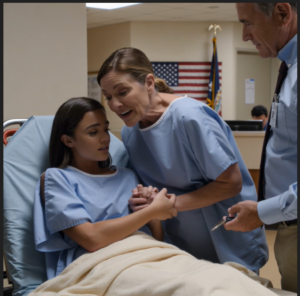
My Parents Called My Surgery Minor And Chose My Sister’s Graduation—The ICU Changed Everything
Phân cảnh 1: The split family
My name is Marggo Hail. I am 26 years old. And four months ago, my parents kissed me on the forehead in a hospital hallway, told me it was just a minor surgery, and drove 4 hours to watch my sister walk across the stage in a cap and gown.
6 hours later, my surgeon called them from the ICU.
My mother did not answer. She called back 47 minutes after that, standing in a restaurant bathroom with champagne still on her breath.
But what none of them knew—not my father, not my mother, not my sister, Delaney—was that Dr. Navaro had already told me before they wheeled me into the operating room that this was not minor. That he had tried to tell them to, and that no one had listened.
That single day split my family in two. Not loudly, not with screaming or slamming doors. It split away bone cracks under quiet, repeated pressure, invisible, until someone finally looks at the scan.
Before I go on, if this story feels familiar to you, take a moment to like and subscribe, but only if it genuinely speaks to something you have lived.
And leave me a comment. Tell me where you are right now and what time it is. I want to know who is listening.
Now, let me take you back to the fall of last year, to a house on Birwood Drive and the family that raised two daughters but only ever saw one.
Phân cảnh 2: Growing up in the shadows
The Hail family lived at 47 Birwood Drive. A three-bedroom colonial in a suburb just south of Pittsburgh, Pennsylvania. White siding, black shutters, and mailbox shaped like a little barn that my father installed the summer I turned 8.
From the outside, it looked like any other house on the block. Trimmed hedges, a basketball hoop in the driveway that nobody used anymore, an American flag that my father replaced every 4th of July with almost religious precision.
Inside, it looked like a shrine to my sister.
My name is Margot. I am the younger one. Three years behind Delaney in everything: birth order, attention, priority.
My father, Glenn Hail, managed a regional branch of a midsized bank in the suburbs. He wore press shirts everyday, kept his hair parted on the left, and believed in two things above all else: hard work and keeping up appearances.
My mother, Judith, taught third grade at Greenfield Elementary. She was the kind of woman other parents described as warm, devoted, always smiling at school events, always volunteering for bake sales. And she was all of those things, just not equally for both of her daughters.
Delaney was the son. I do not say this with bitterness. I say it because it was simply the gravitational truth of our household.
She was 3 years older, 5 in taller, and infinitely more visible. She talked early, walked early, read early. By the time she was in middle school, she was student council president—le in the school musical, captain of the debate team.
She filled rooms the way light fills a window: effortlessly, completely. My parents orbited her.
I was quieter. Not shy exactly, but careful. I liked drawing. I liked sitting in the corner of the living room with a sketchbook while everyone else watched Delany rehearse her lines for whatever play she was starring in that semester.
I was good at school, solid grades, never in trouble, but I was never the kind of kid who made adults stop and pay attention. I was what my mother once described to a neighbor, not knowing I was on the stairs listening, as “the easy one.”
She meant it as a compliment. I have spent 20 years trying to believe that.
The favoritism was not dramatic. Not—it was not the kind you see in movies where one child is locked in a closet while the other gets birthday cakes. It was softer than that, ordinary, almost invisible, unless you were the one standing in the shadow.
When Delaney turned 16, my parents bought her a silver Honda Civic, brand new. They surprised her in the driveway with a bow on the hood and a card signed by both of them. My mother cried. My father filmed the whole thing on his phone.
When I turned 16, I got the keys to my father’s old Ford Taurus. 200,000 m on it. The air conditioning worked on the passenger side only.
There was no bow. There was no card.
My father said, “It runs fine, Margo. Just be grateful.”
I was grateful. That was the problem. I was always grateful because I had been trained to expect less.
When it came time for college, Delaney applied to business programs on the East Coast. She got into three. My parents sat at the kitchen table one night, spreadsheets printed out, debating which school offered the best return on investment.
They paid her tuition in full. No loans, no negotiations.
My father said, “Delaney’s education is an investment in her future. That is what parents do.”
Two years later, when I got accepted into a design program in Philadelphia, I brought the acceptance letter to the same kitchen table.
My mother looked at it, smiled, and said, “That is wonderful, honey. Have you looked into student loans?”
I had. I took out $62,000 in loans. I paid every cent myself. My parents never once asked how.
There was a wall in the living room. My mother called it the family wall. It ran from the edge of the fireplace to the doorway of the kitchen, and it was covered in framed photographs.
I counted them once when I was 19. Not because I wanted to, but because I was home for Thanksgiving and had nothing else to do while Delaney held court at the dinner table.
12 photographs of Delaney. Her first dance recital, her prom, her high school graduation, her college move in day, her standing next to my father at some golf event, both of them laughing. Her holding a trophy, her in front of a Christmas tree, her blowing out candles at every age that apparently mattered.
Three photographs of me. My kindergarten school picture, slightly crooked in the frame. A family photo from a vacation in Myrtle Beach, where I’m partially hidden behind my mother. And one candid shot of me drawing at the kitchen table, taken by my grandfather, Earl, which my mother hung only after he pointed out the imbalance.
Three out of 15. That is the fraction of visibility I occupied in my own family home.
20%, if you want to do the math, though I tried very hard not to.
I never confronted them about it. Not once. I told myself it did not matter. I told myself I was being sensitive, that parents do not love their children equally in the same ways, that Delaney simply needed more of their energy because she was more of everything.
Louder, bigger, more ambitious.
I was fine on my own. I had always been fine on my own.
That was the lie I carried all the way into adulthood: that being overlooked was the same as being strong, that not needing anyone was a virtue, not a wound.
Phân cảnh 3: The onset of symptoms
After college, I moved to a small apartment in Pittsburgh. I worked as a freelance graphic designer, building a client list slowly, steadily, the way I did everything. I paid my rent on time. I paid my loans on time.
I called home once a week, usually on Sunday evenings. My mother would talk for 20 minutes about Delane’s latest accomplishment, whatever that week’s version was: a promotion, a new boyfriend, a trip to Europe.
Then she would say, “And how are you, sweetheart?”
And I would say, “Good, mom. Everything is good.”
And the call would end.
Good. That was my role. Margot is good. Margot does not need anything. Margot is fine.
My father and I had even less. He texted me on my birthday every year. Same message.
“Happy birthday, kiddo. Love, dad.”
Six words copypasted, I suspect, because the comma after kiddo was in the same place every year, like a thumbrint of minimal effort.
We talked at holidays. Surface level things: the weather, football, whether the Steelers had a shot that year. He never asked about my work. He never asked about my health. He never asked, period.
Delaney and I were not enemies. That is important to say. She was not cruel to me. She was simply indifferent, the way someone might be indifferent to a piece of furniture that has always been in the room.
She knew I existed. She just never thought about me when I was not directly in front of her.
We texted occasionally. She called on Christmas. She invited me to things sometimes, always as an afterthought, always with the energy of someone checking a box.
This was the shape of my family when September came last year, and something began growing inside me that I could not ignore.
Then one Tuesday morning, I woke up with pain so sharp it bent me in half. I thought it was stress. I thought it would pass. I told myself what I had always been told.
“It is nothing, Margot. You will be fine.”
The doctor said otherwise.
Phân cảnh 4: Doctor Navaro’s advice
The pain started small. A dull ache on my lower right side, the kind you notice for a second and then forget about because you are busy and 26 and convinced your body is still invincible.
I felt it first in early September, sitting at my desk, working on a logo redesign for a local bakery. I shifted in my chair, pressed my hand against my side, and the ache faded. I went back to work.
It came back 3 days later, sharper. I was in the shower, and it hit me like a cramp that could not decide where to settle. I leaned against the tile and breathed through it.
30 seconds, maybe a minute. Then it passed.
I dried off, got dressed, and told myself it was nothing. Bad food, a pulled muscle, stress from a deadline I was behind on.
By the third week of September, the pain was no longer something I could push aside. It came every day, sometimes twice, always on the right side, always deep, like something inside me was pressing against a wall it was not supposed to touch.
I started losing weight without trying. 5 lb in 2 weeks. My jeans felt loose. My face looked thinner in the bathroom mirror.
I was tired in a way that sleep did not fix, the kind of tired that sits behind your eyes and makes everything feel like you’re moving through water.
Ren noticed before I did. We were having dinner at a tie place near my apartment, and she put her fork down mid-sentence and stared at me.
“You look like you have not slept in a month.”
“I am fine.”
“Margot, you just winced picking up a glass of water.”
I had not realized I did that.
She made me promise to see a doctor. I kept the promise only because Ren is the kind of friend who will show up at your door if you do not.
Dr. Navaro was not my first doctor. My primary care physician ran some initial tests, blood work, and ultrasound. When the ultrasound came back, she went very quiet for a moment and then said she was referring me to a specialist.
She did not explain why in detail. She just said, “I want someone with more experience to take a look at this.”
That is how I ended up in the office of Dr. Raphael Navaro, a surgeon at Alagany General Hospital. He was in his mid-50s, calm-foed, with reading glasses he kept pushing up his nose.
His office smelled like hand sanitizer and old books. There were diplomas on the wall, a small cactus on his desk, and a framed photo of two teenage girls I assumed were his daughters.
He pulled up my scans on a monitor and turned it so I could see.
“Miss Hail, you have an ovarian mass. Right side. It is approximately 7 cm.”
He pointed at a gray shadow on the screen that looked like a cloud trapped in the wrong sky.
“Based on the imaging, it is likely a complex cyst, possibly a dermmoid or a borderline tumor. We will not know for certain until we remove it and send it to pathology.”
“Remove it,” I repeated.
“Surgery. A laparottomy, most likely, given the size and location. General anesthesia. You will be in the hospital for at least one night, possibly two, depending on what we find once we are in there.”
He said the words carefully, the way someone handles something fragile.
He explained the risks: bleeding, infection, the possibility that the mass was attached to surrounding tissue or blood vessels, which would complicate removal. The small but real chance that, if pathology came back concerning, further treatment might be necessary.
He used the word serious twice. He never once used the word minor.
“Do you have family nearby?” he asked.
“My parents are about 40 minutes away.”
“Good. I strongly recommend having someone with you, not just for the emotional support, but because the first 12 to 24 hours after surgery are critical. You will need someone to advocate for you if you cannot advocate for yourself.”
I nodded. I thanked him. I scheduled the surgery for October 27th.
And then I sat in my car in the hospital parking garage for 15 minutes, hands on the steering wheel, not driving anywhere, just breathing.
Phân cảnh 5: Parents prioritize graduation
That evening, I called my mother. I told her everything. The pain, the tests, the referral, Dr. Navaro, the mass, the surgery date.
I spoke clearly. I did not minimize. For perhaps the first time in my life, I did not say, “I am fine.”
My mother listened.
Then she said, “Oh, honey, that sounds like a cyst. Delaney had one of those in college, remember? They put her on birth control and it went away on its own.”
“Mom, this is not the same thing. It is 7 cm. They need to operate.”
“I know. I know. I am just saying it is probably nothing. These things are very common. When is the surgery?”
“October 27th.”
The pause that followed is something I will never forget. It was not a pause of concern. It was a pause of calculation.
“Margot, that is the same weekend as Delane’s graduation.”
Delaney was finishing her MBA at Colia. The ceremony was on October 27th, the same day, in New York, 4 hours away from Pittsburgh.
“I know the timing is bad,” I said carefully. “But Dr. Navaro said this should not wait.”
Another pause. Then my mother’s voice shifted into that bright, managing tone she used when she was rearranging reality to fit a version she preferred.
“Well, I am sure it will be a quick procedure. These things usually are. You will probably be out by lunchtime, and Ren can be there with you, right? She’s such a good friend. We will call you the second the ceremony is over. We will probably be back by late evening.”
I held the phone against my ear and stared at the wall of my apartment. At a framed print I had designed myself, abstract shapes in muted blue, the only art I had ever hung.
I thought about telling her what Dr. Navaro actually said. About the risks, about the word serious, about how he specifically asked if I had family nearby.
Instead, I said, “Okay, Mom.”
Because that is what I always said.
My father was even more direct. He called me 2 days later, not to ask about the surgery, but to tell me he had booked a hotel near Colia for the weekend.
“Your mother tells me you have a little procedure that week. You will be fine, kiddo. Doctors these days love to make everything sound worse than it is. It is how they justify the bill.”
He laughed at his own joke.
“Delaney works so hard for this MBA. We cannot miss it.”
“I understand, Dad.”
“That is my girl.”
I did not tell Delaney myself. I assumed my mother told her. Weeks later, I learned that my mother had described it to Delaney as, “Margot is having a small cyst removed. Nothing major. She’s being a little dramatic about the timing.”
Delaney’s response, relayed back to me eventually by my mother herself in a moment of accidental honesty, was, “Well, she can reschedu, can’t she?”
She did not ask me. She did not call. She did not text.
She simply absorbed the version of events that required the least from her and moved on.
Phân cảnh 6: Entering the hospital
October 27th arrived like a verdict, and I prepared to face it the way I had faced everything in my life. Alone.
I arrived at Alageney General Hospital at 5:45 in the morning. The sky was still dark, that heavy October dark that feels like the world has not decided whether to wake up yet.
The parking garage was nearly empty. My footsteps echoed against the concrete in a way that made me feel very small.
I had packed a bag the night before. Toothbrush, phone charger, a change of clothes, a book I knew I would not read. I also packed a pair of thick socks because my feet are always cold and hospitals are the coldest places on Earth.
These are the things you think about when you’re preparing to be unconscious on a table while someone cuts into you. Not the big things, the small ordinary things. Socks, chapstick, whether you remembered to lock the front door.
The admissions desk was staffed by a woman with kind eyes and a lanyard that said Brenda. She checked my name, my date of birth, my insurance. She asked me to sign four forms.
She handed me a plastic bracelet with my information printed in tiny letters and snapped it around my wrist.
Then she looked at the form and said, “Emergency contact, Judith Hail. Is she here with you today?”
“She’s not able to make it.”
Brenda paused for just a moment. A small pause. Professional, not judgmental, but present.
“Is there someone else we should contact in case of emergency?”
“Renlu. She will be in the waiting room.”
“Okay.” She wrote it down. “She will be here soon?”
“She is on her way.”
Brenda smiled and directed me to the pre-operative area on the third floor. I walked through hallways that smelled like floor cleaner and recycled air, past signs pointing to radiology and the cafeteria and the chapel.
The chapel. I had never been a religious person, but I looked at that sign longer than I should have.
The preop area was a long room divided by curtains into individual bays. Each bay had a hospital bed, a chair, a monitor, and a small hook for personal belongings. There were eight bays on my side. I was in bay number four.
The curtain was a faded blue green, the color of something that had been washed a thousand times. I changed into the hospital gown. It tied in the back, and I could not reach the top tie, so I left it loose.
A nurse came in, introduced herself as Colleen, and started my IV. She was maybe 40, with short brown hair and a calm, steady energy that made you trust her immediately.
She explained what would happen. The anesthesiologist would come by, then Dr. Navaro, then I would be taken to the operating room. Total time from sedation to recovery estimated at 90 minutes to 2 hours, depending on what they found.
Depending on what they found.
She said it gently, but I heard what lived underneath those words. Colleen taped the IV line to my hand and checked the monitor. Then she looked at the empty chair beside my bed.
“Family coming later?”
I had prepared for this question. I had rehearsed the answer in my bathroom mirror that morning while brushing my teeth.
“My friend is on her way. My parents had a prior commitment.”
Colleen nodded. She did not press, but something shifted in her expression. A small tightening around her eyes, the kind of thing only someone who has been watching faces their whole life would notice.
She placed a warm blanket over my legs without being asked.
“I will check on you every 15 minutes until we go,” she said. “You’re not alone in here, okay?”
I nodded. And then she pulled the curtain closed, and I was.
I lay on the bed and stared at the ceiling tiles. I counted them. 12 across, nine deep. I listened to the sounds around me.
In bay 2, a man was talking quietly with a woman I assumed was his wife. She kept saying, “You’re going to be just fine, Richard. I am right here.”
In Bay Six, a teenage boy was laughing nervously while his mother held his hand and his father stood at the foot of the bed making jokes about the hospital gown.
In bay 7, an elderly woman was praying softly in Spanish while someone, a daughter, maybe, stroked her hair.
Everyone had someone. Every single person in that room had a hand to hold, a voice telling them it would be okay. A presence that said, “You matter enough for me to be here.”
I had a text message. It had arrived at 5:22 that morning while I was brushing my teeth.
“Good luck today, sweetheart. Call us when you wake up. So excited for Delaney today. Wish us luck, too. Love, Mom and Dad.”
Wish us luck, too.
As if my surgery and Delaney’s graduation were parallel events of equal weight. As if both were celebrations. As if I was not about to have a mass cut from my body under general anesthesia while they sat in an auditorium clapping.
I read the text three times. Then I turned my phone face down on the bed and did not look at it again.
Phân cảnh 7: Support from Ren
At 6:20, Ren arrived. She came around the curtain holding a small bouquet of yellow daisies and a paperback copy of a novel I had been meaning to read for months.
Her eyes were red, which meant she had been crying in the car, and her smile was wide, which meant she was trying to hide it.
“Hey,” she said softly.
She put the flowers on the side table and sat in the empty chair.
“I am here.”
Two words. That is all it took to crack something open in my chest.
“Thank you,” I said, and my voice broke on the second word in a way I had not expected.
Ren took my hand. She did not say everything would be fine. She did not say my parents should be here. She did not fill the silence with noise. She just held on.
At 6:50, the anesthesiologist came by, a tall man named Dr. Kim, who explained the sedation process in a voice so monotone it was almost soothing. He asked about allergies, prior surgeries, when I last ate.
I answered everything. He marked something on his clipboard and told me he would see me in the operating room.
At 7:00, Dr. Navaro appeared. He was already in his surgical scrubs, a blue cap over his hair, his reading glasses replaced by a pair he wore in the O.
He looked at me, then at Ren, then at the empty space behind her where a family should have been.
“Miss Hail, how are you feeling?”
“Nervous,” I admitted.
He nodded. “That is normal.”
He paused.
“Is there anyone else coming?”
“No.”
He held my gaze for a moment. Not pity, something closer to recognition, like a man who had seen this before and still had not made peace with it.
“All right,” he said quietly. “We going to take very good care of you in there.”
At 7:15, two orderlys came and unlocked the wheels of my bed. Ren squeezed my hand one last time.
“I will be right here when you wake up,” she said.
I nodded, unable to speak because if I opened my mouth, I knew I would ask her to call my mother and beg her to come. And I was not going to do that. Not today. Not ever again.
They wheeled me down a long corridor and through a set of double doors into the operating room. It was cold and bright and filled with equipment I did not recognize.
Dr. Navaro was already there, standing beside the table, gloved and ready. The anesthesiologist placed a mask over my face.
“Count backwards from 10,” he said.
10, 9, 8.
The last thing I saw before the world went dark was Dr. Navaro’s face. His brow was furrowed. His jaw was set.
It was not the expression of a man performing a routine procedure. It was the expression of a man preparing for something he hoped would not go wrong.
Phân cảnh 8: Complications in surgery
What I am about to describe was told to me later, pieced together from surgical notes, from Ren, from Nurse Colleen, and eventually from Dr. Navaro himself. Because I was not there for any of it.
I was somewhere between alive and not, floating in a chemical darkness where time does not exist and the body becomes a thing that other people are responsible for.
The surgery began at 7:22 in the morning. For the first 30 minutes, everything went as planned. Dr. Navaro made the incision, access the abdominal cavity, and located the mass on my right ovary.
It was larger than the imaging had suggested. Not 7 cm, closer to 9. But size alone was not the problem. The problem was location.
The mass had grown into a position where it pressed against the right ovarian artery and had developed adhesions, bands of scar-like tissue that had attached it to the surrounding structures. It was tangled in a way that the scans had not fully revealed.
Navaro later told me that the moment he saw the extent of the adhesions, he looked across the table at his surgical assistant and said two words.
“Call vascular.”
That was at 7:54 in the morning.
At 7:54, 260 mi northeast, my mother was ironing Delane’s dress in a hotel room near Columbia University. My father was downstairs in the hotel lobby, drinking coffee and reading the sports section on his phone.
They had driven up the night before, arrived late, slept in a king-siz room that cost $280 a night. My mother had laid out her outfit on the spare bed, a navy dress she had bought specifically for the occasion, shoes to match, pearl earrings my father had given her for their 25th anniversary.
At 8:12, Navaro attempted to separate the mass from the artery. A small vessel tore. Not the main artery, a branch, but enough.
Blood began to pull in the surgical field faster than suction could clear it. My blood pressure dropped. The anesthesiologist adjusted my fluids, pushed medication, called out numbers that made the room go quiet.
At 8:12, my mother was curling her hair in the bathroom mirror. She later told me she had been humming.
By 8:45, the vascular surgeon, a woman named Dr. Priya Anand, had arrived and was scrubbed in beside Navaro. Together, they worked to isolate the bleeding vessel and clamp it.
My blood pressure stabilized briefly, then dropped again. They ordered two units of blood. A transfusion line was started.
At 8:45, Glenn and Judith Hail walked into the auditorium at Columbia Business School. Judith texted Delaney a heart emoji. Glenn saved two seats in the fifth row.
At 9:15, Navaro successfully removed the mass, but the adhesions had caused more damage than anticipated. There was a small tear in the paritonyium that needed repair. Another vessel was leaking.
The surgery that was supposed to take 90 minutes was now approaching the 2-hour mark with no end in sight.
At 9:15, the ceremony began. The dean gave a welcome address. Judith squeezed Glenn’s hand.
Phân cảnh 9: Graduation day celebration
In the waiting room at Alagany General, Ren sat with her phone in her lap and the yellow daisies wilting in their plastic wrapper on the chair beside her. She had been told the surgery would take about 90 minutes. It had now been 2 hours.
She went to the nurse’s station and asked for an update.
“The procedure is still underway,” the nurse said. “Someone will come speak with you when there is news.”
Ren sat back down. She stared at the clock on the wall. She texted me, knowing I could not read it, just to have something to do.
“Still here, still waiting. You are going to be okay.”
At 10:30, 3 hours and 8 minutes into the surgery, my heart rate became irregular. The anesthesiologist called it out. Navaro paused. The room held its breath.
Medication was administered. My heart steadied.
But the moment had cost something, a reminder that the body on the table was not just a surgical problem, but a person balanced on the edge of a very thin line.
At 10:30, Delaney Hail’s name was called. She walked across the stage at Colia, shook the dean’s hand, and held her diploma up to the audience.
Judith stood up. Glenn stood up. They clapped so hard their palms stung. Judith was crying.
She pulled out her phone and took seven photographs in quick succession. Glenn recorded a video, his hand trembling slightly, not from fear, but from joy.
2 minutes later, Judith posted the best photograph to Facebook. The caption read, “The proudest moment of my life. My baby girl did it. MBA from Columbia. We always knew you would change the world, Delaney.”
The proudest moment of my life.
At that exact moment, Dr. Navaro was elbow deep in my abdomen, his forehead damp, his voice steady but tight, telling his team, “I need more suction on the left. Priya, how is that vessel?”
At 11:45, nearly 4 and 1/2 hours in, Navaro completed the final repair. The mass was out, the bleeding was controlled, the tear was sutured, but my body had been through a war.
I had received three units of blood. My vitals were stable but fragile. Navaro made the decision to send me to the ICU for monitoring rather than the standard recovery room.
At 11:45, the Hail family walked out of the auditorium into crisp October sunlight. Delaney was between her parents, and arm around each of them. They were laughing.
A classmate offered to take their photo. They posed in front of the Columbia banner, three hales, bright-faced and complete.
No one mentioned me. No one checked their phone.
In the waiting room, Ren had not moved. 5 hours. She had watched families come and go, watch surgeons deliver news, both good and terrible, watch the clock make its slow, indifferent circuit.
Phân cảnh 10: Ren contacts the parents
She had called my phone six times, knowing it was off, just to hear my voicemail. She had bitten her thumbnail down to nothing.
At 12:30, a nurse finally came to the waiting room.
“Are you here for Margot Hail?”
Ren stood up so fast the daisies fell to the floor.
“She’s out of surgery. She’s being moved to the ECU.”
“I see you?” Ren’s voice cracked. “Why the ICU? It was supposed to be—”
“The surgeon will speak with you shortly. Please have a seat.”
Ren did not sit. She stood in the middle of the waiting room, hands shaking, phone in her grip, and did the thing I had not done, the thing I would never have asked anyone to do.
She called my mother.
Judith did not answer. Ren called again. No answer. She called my father. No answer. She called Judith a third time, a fourth time, a fifth.
At 117 in the afternoon, Dr. Rafael Navaro walked out of the surgical wing, still in his scrubs, his cap pulled off and crushed in one hand. His face carried the particular exhaustion of a man who had just spent nearly 6 hours keeping someone alive against complications he had warned about.
He found Ren standing by the nurse’s station, white-faced, clutching her phone.
“She is alive,” he said first, because that is what good surgeons do. They answer the only question that matters before anything else.
“She is stable, but the surgery was significantly more complex than anticipated. I need to speak with her family.”
Ren looked at him with something between rage and grief.
“I have been trying. They are not answering.”
Navaro took the phone number himself. He walked to the nurses station, picked up the hospital line, and dialed.
And somewhere in a restaurant in Manhattan, surrounded by laughter and champagne glasses and the warm glow of celebration, Judith Hail’s phone began to ring from a Pittsburgh area code she did not recognize.
This time, she did not silence it.
Phân cảnh 11: Parents receive the news
The restaurant was called Lucas. It was a small Italian place three blocks from the Columbia campus. White tablecloths, candles, and glass holders. The kind of restaurant that feels like an occasion even when nothing special is happening.
The Hail family had a table for six. Glenn and Judith on one side. Delaney and her boyfriend, a man named Trent who worked in consulting, on the other. Two of Delane’s classmates filled the remaining chairs.
There were bread sticks on the table and a bottle of procco that Glenn had ordered with a pride that bordered on ceremony.
Judith’s phone buzzed in her purse. She glanced at it. A Pittsburgh number she did not recognize. She silenced it and turned back to the conversation.
It rang again. She reached into her purse, declined the call, and set the phone face down on the table.
“Probably a scam,” she said to no one in particular.
Glenn nodded without looking up. He was in the middle of telling Trent about Delane’s first spelling B trophy. A story he had told at least 40 times in the last 20 years, each time with the same enthusiasm as the first.
The phone rang a third time. Same number.
Judith frowned. She picked it up, excused herself, and walked toward the back of the restaurant, past the restrooms, into a narrow hallway near the kitchen that smelled like garlic and dish soap.
She answered with the mild irritation of someone who had been interrupted during an important meal.
“Hello.”
“Is this Judith Hail?”
“Yes. Who is this?”
“My name is Dr. Rafael Navaro. I am a surgeon at Alageney General Hospital in Pittsburgh. I am calling about your daughter, Margot Hail.”
The hallway was narrow. Judith leaned against the wall. Later, she told me she does not remember making the decision to lean. Her body simply did it, as if some part of her already knew what was coming and decided she could not hear it standing upright.
“Margot underwent surgery this morning for the removal of an ovarian mass. The procedure, which we had estimated at 90 minutes to 2 hours, lasted approximately 5 hours and 50 minutes due to significant complications.”
Judith’s hand tightened around the phone.
“Complications. What kind of complications?”
“The mass had developed adhesions to surrounding tissue and was pressing against a major blood vessel. During removal, there was considerable hemorrhaging. We administered three units of blood.
“Your daughter experienced a period of cardiac irregularity during the procedure that required immediate intervention.”
“Cardiac irregularity.”
Judith repeated the words as if saying them slowly would make them mean something less terrible.
“Her heart rhythm became unstable. We corrected it, but the event extended the surgery and increased the risk profile significantly. She’s currently in the intensive care unit. She’s stable, but she will require close monitoring for the next 24 to 48 hours.”
“The ICU. She is in the ICU?”
“Yes.”
“But it was—”
Judith stopped herself. The sentence she was about to say, “But it was just a minor surgery,” died somewhere between her brain and her mouth because Dr. Navaro had never said that.
She had said that. She and Glenn had decided that together in their kitchen over coffee while looking at a calendar that had Delaney’s graduation circled in red marker.
“Mrs. Hail, I want you to know that I called the emergency contact number on your daughter’s file three times during the procedure. No one answered.”
The silence that followed was the kind that changes the temperature of a room.
Judith did not speak. She could not. She was standing in a hallway that smelled like garlic, wearing a navy dress she had bought for a celebration, with champagne still fizzing in a glass at a table 20 ft away, and her youngest daughter was in an ICU bed 260 mi south.
“I am calling now,” Navaro continued, his voice even, professional, carrying no judgment that Judith could hear, but all the judgment she would later feel, “because your daughter listed you as her emergency contact. She will likely be conscious within the next few hours. It would be beneficial for her to have family present.”
“We are in New York,” Judith whispered.
“I understand.”
Two words. He did not say anything else. He did not need to. The geography of the situation was its own indictment.
You are in New York. Your daughter is in an ICU in Pittsburgh. The distance between those two facts is the distance between the family you believe you are and the family you actually became.
Judith walked back to the table. She was not crying yet. The crying would come later, in the car, somewhere on the Pennsylvania turnpike, in the dark, with Glenn’s hands white on the steering wheel and the silence between them thick enough to choke on.
She stood at the edge of the table. Everyone looked up. The bread sticks were halfeaten. The procco was still cold.
“We need to go,” she said.
Glenn read her face. He set down his glass.
“What happened?”
“Margot is in the ICU.”
The table went quiet. Not the polite quiet of a pause in conversation, but the airless quiet of something rupturing.
“What?” Glenn pushed back his chair. “The ICU? For a cyst removal?”
“It was not a cyst removal, Glenn.”
Judith’s voice cracked for the first time.
“It was never just a cyst removal. The doctor said there were complications, bleeding, something with her heart. She has been in surgery for almost 6 hours.”
Glenn stood up. His napkin fell to the floor. He did not pick it up.
His face went through three expressions in rapid succession. Confusion, then fear, then something harder, something that looked like the beginning of a man realizing he made a choice he cannot undo.
Delaney looked between her parents.
“Wait, what is going on? Is Margot okay?”
“She is in the I see you,” Judith repeated, reaching for her coat on the back of the chair.
“But mom, you said it was just a small thing. You said she was being dramatic about the timing.”
Judith froze. She looked at Delaney, and something passed across her face that I wish I could have seen, not out of cruelty, but because I have spent my entire life wondering what it looks like when my mother realizes she was wrong about me.
I imagine it looked like grief wearing the mask of surprise.
“I was wrong,” Judith said quietly. “Get the check. We are leaving.”
Glenn was already moving toward the door, pulling his keys from his pocket, his phone in his other hand, trying to call the hospital back. Judith followed.
They did not say goodbye to Delane’s classmates. They did not finish the procco. They did not take the leftovers.
Phân cảnh 12: Delaney’s indifference
Delaney did not stand up. She sat at the table, her diploma in its leather folder on the chair beside her, her boyfriend’s hand on her arm, and she said the words that would come to define her role in everything that followed.
“She’s going to be fine. She always is. You guys are overreacting.”
Then she picked up a bread stick, turned to Trent, and said, “Should we order dessert?”
Glenn and Judith drove through the night. 4 hours and 12 minutes down the turnpike, through the tolls, past the mile markers that counted down like a clock running out of reasons to forgive.
They barely spoke. The radio was off.
At one point, somewhere near Harrisburg, Judith pulled up the Facebook post she had made that morning. The photo of Delaney, the caption, “The proudest moment of my life.”
She stared at it for a long time. Then she deleted it.
Glenn glanced over. He did not ask why. He already knew.
They arrived at Alagany General Hospital at 11:14 at night. They ran through the lobby, past the security desk, past the elevators, up to the ICU on the fourth floor.
A nurse directed them down the hall, room 4, 12. They pushed open the door, breathless, terrified, and ready to see their daughter.
But the chair beside my bed was already occupied, and the man sitting in it looked up at them with an expression that carried 20 years of silence finally reaching its limit.
Phân cảnh 13: Grandpa Earl intervenes
Grandpa Earl did not stand. He did not greet them. He looked at his son and his daughter-in-law, still in their celebration clothes, still smelling faintly of procco and guilt, and he said one word.
“Sit.”
Earl David Hail was 78 years old. He lived alone in a small two-bedroom house on a hill outside Eerie, Pennsylvania, about 2 hours north of Pittsburgh.
The house had belonged to him and my grandmother, Ruth, who passed away 6 years ago from a stroke that took her in her sleep on a Wednesday morning in March.
After she died, Earl stayed. He mowed the lawn himself. He cooked his own meals. He drove his old Chevy truck to the hardware store every Saturday and to church every Sunday.
He was the kind of man who believed that showing up was not a grand gesture, but a basic requirement of being human.
Ren had called him at 9:45 that morning, 2 and 1/2 hours into my surgery, when the nurse told her the procedure was taking longer than expected and she could not reach my parents.
Ren had my grandfather’s number because I had given it to her years ago, not for emergencies, but because Earl was the one person in my family I trusted without hesitation, and I wanted someone else to have that connection in case I ever needed it.
Earl answered on the second ring. Ren explained the situation in short, clipped sentences.
“Margot is in surgery. It is taking longer than expected. Her parents are in New York for Delaney’s graduation. No one is answering their phones. I am here alone.”
Earl asked one question.
“Which hospital?”
Then he hung up, put on his coat, locked his front door, and drove 2 hours south through construction traffic and October rain.
He did not call Glenn. He did not call Judith. He did not call Delaney.
He simply got in his truck and went because his granddaughter was on a surgical table and the people who should have been there had chosen to be somewhere else.
He arrived at Alagany General at 12:15 in the afternoon, just as Dr. Navaro was finishing the surgery. Ren met him in the lobby.
She told me later that when she saw him walk through the automatic doors, 78 years old, slightly out of breath, his thin gray hair damp from the rain, wearing a flannel shirt and work boots because he had not stopped to change, she started crying so hard she could not speak for a full minute.
Earl put a hand on her shoulder and said, “You did good calling me. Now take me to her.”
They went to the ICU together. I was still unconscious, intubated, monitors tracking every heartbeat.
Earl pulled the visitor’s chair as close to the bed as the wires allowed. He sat down. He took my hand, the one without the IV, and he held it.
He did not let go for the next 11 hours.
Ren stayed for another 2 hours. Then Earl told her to go home and rest.
“You have done enough,” he said. “I am not leaving.”
Ren hesitated, but Earl gave her the look he had perfected over five decades of fatherhood. The look that said, “This is not a suggestion.”
She left her phone number with the nurses and went home.
Earl sat in that chair through the afternoon. He watched the monitors. He watched the nurses come and go. He watched my chest rise and fall under the thin hospital blanket.
At one point, nurse Colleen came in to check my vitals and saw him holding my hand. His head bowed, his lips moving slightly.
“Are you praying?” she asked gently.
“I am talking to my wife,” he said. “Asking her to keep an eye on this one from wherever she is.”
Colleen told me that story 3 days later, and it is the only time during my entire hospital stay that I cried in front of someone without trying to stop.
Phân cảnh 14: Family confrontation
When Glenn and Judith burst through the ICU door at 11:14 that night, Earl was exactly where he had been for the past 11 hours. Same chair, same position, my hands still in his.
He had not eaten. He had not slept. He had not left the room except once to use the restroom, and even then he asked Colleen to sit with me until he returned.
He looked up at his son and his daughter-in-law. Glenn was still in the sport coat he had worn to the graduation. Judith was still in the navy dress. They were breathless from running through the hospital.
Their faces carried the particular expression of people who have spent 4 hours in a car contemplating the possibility that their child might die while they were eating bread sticks.
Earl did not stand.
“Sit,” he said.
Glenn pulled a second chair from the corner. Judith remained standing, her eyes fixed on me, on the tubes, on the monitors, on the bruise on my hand from the IV, on the pour of my face under the fluorescent lights.
Her hand went to her mouth.
“Oh god. Oh god, Margo.”
“She cannot hear you,” Earl said. “She has been unconscious since this morning. Doctors say she will likely wake up tomorrow.”
Glenn sat down. His hands were in his lap. He stared at the floor.
“Dad, we did not know it was this serious.”
Earl was quiet for a moment. When he spoke, his voice was low and steady, the voice of a man who has been carrying something heavy for a very long time and has finally decided to set it down.
“You did not want to know.”
“That is not fair.”
“Glenn.”
Earl said his son’s name the way you close a door: firmly, completely.
“I drove 2 hours in the rain today because a girl named Ren, who is not related to Margot by blood, cared enough to call me. Your daughter did not call me herself. She did not call anyone in this family. Do you understand what that means?”
Glenn opened his mouth. Nothing came out.
“It means she has learned that calling is pointless. It means she has been taught over and over by you and by Judith that her emergencies do not rank, that her pain is not urgent, that she is the daughter who can wait.”
Judith sank into the chair beside Glenn. Tears were streaming down her face, but she did not make a sound. She cried the way people cry when they know they do not have the right to be loud about it.
Earl reached into the inside pocket of his flannel shirt and pulled out a small notebook. It was the kind you could buy at any drugstore, spiralbound, with a faded blue cover.
He held it up so both of them could see it.
“I started keeping this 4 years ago after Marggo’s college graduation, the one you showed up to 40 minutes late because Delaney had a brunch you could not miss.”
He opened the notebook. The pages were filled with his handwriting, small and precise. The penmanship of a man who had worked with his hands his entire life and understood the value of careful, deliberate effort.
“September, 4 years ago. Marggo’s graduation. Glenn and Judith arrived 40 minutes late. Delaney’s brunch.”
He turned the page.
“December, same year. Marggo’s first freelance contract. She called Judith to share the news. Judith talked for 14 minutes about Delaney’s promotion. Did not ask Margot a single question about the contract.”
He turned another page, and another, and another.
“March, 3 years ago. Margot was sick with pneumonia. Asked Judith to bring soup. Judith said she was busy helping Delaney move apartments.”
He kept reading.
“Thanksgiving, 2 years ago. Margot offered to host. Judith chose Delaney’s apartment because it was bigger. Did not tell Margot until the day before.”
17 entries. Four years of moments cataloged in a drugstore notebook by a 78-year-old man who had been watching his granddaughter disappear in plain sight.
Glenn stared at the notebook like it was a mirror showing a reflection he did not recognize. Earl closed the notebook and placed it on his knee.
“17 times, Glenn. 17 times in 4 years that Margot needed you or Judith. And 17 times you chose something else, someone else.”
He paused.
“And today you chose a graduation over a surgery. You left her alone on an operating table so you could clap for Delaney.”
The ICU was quiet except for the steady beeping of my heart monitor. A machine keeping count of the fact that I was still alive.
Earl looked at his son, then at Judith, and said the thing that nobody in the room was prepared to hear.
“That is why I changed my will 2 months ago.”
The words hung in the air of that I see you room the way smoke lingers after something has already burned.
Glenn stared at his father. Judith stopped crying, not because the grief had ended, but because the shock had temporarily overwritten every other function in her body.
“What do you mean you changed your will?”
Glenn’s voice was barely above a whisper.
Earl placed both hands on the notebook in his lap. He did not raise his voice. He did not need to. The room was small. The monitors were beeping. And truth does not require volume.
“2 months ago, I met with my attorney in Eerie, Harold Whitmore. You know him. I revised my estate plan. The house, the property, the savings account, the investment portfolio your mother and I built over 53 years of marriage. All of it.”
“All of it? What? Dad—”
“All of it goes to Margot.”
Glenn stood up. The chair scraped against the floor with a sound that made Judith flinch. He took one step toward his father, then stopped, because even in his anger, even in his shock, some part of Glenn Hail still recognized that the man sitting in that chair had earned the right to be heard.
“You cannot do that.”
“I already have.”
“Dad, that property alone is worth $450,000.”
“I know. I had it appraised in August. The savings account holds another 118,000. The investment portfolio, the one your mother started when you were a boy, is worth approximately 92,000. In total, roughly $660,000.”
Glenn’s mouth opened and closed. He looked like a man trying to breathe underwater.
“All of it,” Earl continued, “will go to Margot upon my passing, along with a provision for an education trust for any future children she may have. Your name, Glenn, has been removed as a beneficiary. Delaney’s name was never on it to begin with.”
“Dad.”
Glenn’s voice cracked in a way I had never heard. Not in 26 years of being his daughter. Not even close.
“I am your son.”
“Yes, you are. And Margot is your daughter. And tonight she is lying in an ICU bed because a mass nearly killed her on an operating table while you were drinking procco and posting photographs.”
Earl paused.
“Tell me, Glenn, when you found out she was here, was the first thing you felt fear for her or shame for yourself?”
Glenn did not answer. He did not have to. The answer was written across his face in a language that does not require words.
Judith spoke for the first time since Earl had made the announcement. Her voice was raw, scraped down to something that sounded nothing like the bright, managing tone she usually carried.
“Earl, pleased. We made a terrible mistake. We see that now. But you cannot punish Glenn for—”
“I am not punishing anyone, Judith.”
Earl turned to her, and his expression softened, but only slightly.
“I am protecting someone. There is a difference. Punishment looks backward. Protection looks forward. And that girl”—he pointed at me, unconscious, tubed, monitored, pale—“needs someone looking forward for her because the two people who were supposed to do that job have been looking sideways at Delaney for 26 years.”
Judith pressed both hands against her face. Her shoulders shook.
The navy dress she had bought for the proudest moment of her life was wrinkled now, creased from 4 hours in a car, stained at the hem where she had knelt on the hospital floor without realizing it when she first saw me in the ICU bed.
Earl was not finished.
“Judith, I care about you. I have cared about you since the day Glenn brought you home for Thanksgiving 31 years ago, and you helped Ruth wash the dishes without being asked. That is the woman I remember. That is the woman who would not have left her child alone in a hospital.”
He opened the notebook again, not to read from it this time, but to hold it the way someone holds evidence they wish they had never needed to collect.
“You know the wall in your living room. The family wall.”
Judith looked up, confused by the shift.
“I counted the photographs the last time I visited. 12 of Delaney, three of Margot. One of those three exists only because I asked you to hang it. I took that photograph myself of Margot drawing at the kitchen table when she was 11.
“She was so focused she did not even notice the camera. It is the most beautiful picture of her that exists, and it is the only one because nobody else in that house ever thought to take one.”
Judith made a sound that was not a word. It came from somewhere deep, somewhere below language. The sound of a woman hearing a description of herself that she cannot deny and cannot bear.
Glenn sat back down. He put his elbows on his knees and his head in his hands.
For a long time, the only sounds in the room were the heart monitor, Judith’s muffled crying, and the distant murmur of the hospital at night.
“I am not asking you to agree with my decision,” Earl said finally. “I am telling you what I have done and why. Margot has spent her entire life being the daughter who does not ask for anything. And you have spent her entire life proving that she was right not to.
“That ends now, not because I say so, because a surgeon just spent 6 hours saving her life while you sat in a restaurant, and a girl named Ren, who has known her for 5 years, did more for her today than you have done in 26.”
He placed the notebook back in his pocket. He took my hand again. He looked at my face, still and pale against the hospital pillow, and something moved across his expression that I can only describe as tenderness sharpened by fury.
“You can stay in this room,” Earl said. “You can sit here all night, but you will not touch my decision, and you will not ask Margot to intervene on your behalf when she wakes up. If you want to rebuild something with your daughter, you will do it because you mean it, not because there is money at stake.
“Am I clear?”
Glenn nodded without lifting his head.
Judith whispered, “Yes.”
Earl settled back into his chair. He closed his eyes. The conversation was over.
I woke up the next morning at 6:43.
Phân cảnh 15: Waking up
The first thing I became aware of was pain. A deep pulling ache across my abdomen that made breathing feel like a negotiation.
The second thing was light, thin, gray October light filtering through the ICU window.
The third thing was a hand around mine, warm, dry, slightly rough. The hand of a man who had built furniture and fixed fences and held his wife’s hand every night for 53 years.
I turned my head. Grandpa Earl was asleep in the chair beside me. His chin was on his chest. His flannel shirt was wrinkled. His boots were still on, laced tight, as if he had been ready to stand at a moment’s notice the entire night.
Beyond him, through the glass partition of the ICU room, I could see two figures in the hallway. My mother sitting in a plastic chair against the wall, her head tilted back, eyes closed, the navy dress rumpled beyond recognition.
My father standing beside her, leaning against the wall, arms crossed, staring at the floor with an expression I had never seen on his face before.
They were outside. Earl was inside. The glass between them said everything that words had not yet managed to say.
Nurse Colleen appeared. She checked my vitals, adjusted something on the IV, and leaned close.
“Welcome back, Margot,” she said softly. “Your grandfather has been here since yesterday afternoon, 11 hours. Would not leave, would not eat, just sat there holding your hand.”
I looked at Earl, at his weathered face, at the notebook barely visible in his shirt pocket, at the hand that was still holding mine, even in sleep.
And for the first time in more years than I could count, I cried.
Not because of the surgery, not because of the pain, but because someone had come. Someone had chosen to be there. Someone had looked at the empty chair beside my bed and decided that it was unacceptable for it to remain empty.
3 days later, when I was strong enough to sit up and hold a conversation longer than a few sentences, my mother walked into the room carrying a folded piece of paper.
Her eyes were swollen, her hands were trembling. She stood at the foot of my bed and said in a voice that sounded nothing like the woman who had told me it was just a cyst, “Margo, I need you to read this.”
The paper was folded into thirds, the way you fold a letter to fit inside an envelope. But there was no envelope, just the paper, slightly crumpled at the edges, as if it had been held and refolded and held again many times before it reached my hands.
The handwriting was my mother’s, the same careful cursive she used on birthday cards and grocery lists, except here the letters were smaller, tighter, as if she had been pressing too hard.
I unfolded it, four pages front and back. My mother had written me a letter because she could not say the words out loud, and I understand that now.
Some truths are too heavy for the voice. They need the slow, deliberate weight of a pen on paper where you cannot hide behind tone or timing or the convenient interruption of someone else entering the room.
She stood at the foot of my bed while I read. She did not sit. She did not speak. She held her hands together in front of her stomach the way she used to stand during parent teacher conferences.
The posture of a woman preparing to be judged.
Phân cảnh 16: Letters of apology
The letter began simply.
“Margot, I do not know if you will forgive me. I am not writing this to ask you to. I am writing this because you deserve to know the truth, even if the truth makes you hate me.”
She wrote about Delaney first, not to excuse anything, but to explain the architecture of a favoritism she claimed she had never intended.
She wrote that from the moment Delaney was born, she had recognized herself in her oldest daughter. The extraversion, the need for attention, the way Delaney moved through rooms like she was performing for an audience she could feel but not see.
Judith wrote that loving Delaney had always felt effortless because loving Delaney was like loving a version of herself that had been given a second chance to get everything right.
Then she wrote about me.
“You came into the world quiet. You did not cry for the first 30 seconds, and the nurses had to stimulate you to get a response. Your father joked that you were already lowmaintenance. I laughed.
“I should not have laughed because somewhere in that joke was the seed of everything that came after.”
She wrote that I reminded her of her own mother, my grandmother on her side, a woman named Patricia, who had died when I was four. Patricia had been quiet, artistic, deeply internal.
She and Judith had a complicated relationship, one built on long silences and unspoken disappointments.
Judith wrote that when she looked at me, especially as I got older, she saw Patricia’s mannerisms, my habit of drawing alone, my preference for stillness, my refusal to compete for attention.
And instead of seeing those qualities as strengths, she saw them as a warning, as if being like Patricia meant I would also carry Patricia’s sadness, Patricia’s distance, Patricia’s inability to connect.
“I pushed you away because I was afraid of who you reminded me of. That is not your burden. It was never your burden. But I put it on you anyway, and I am so deeply sorry.”
She wrote about the wall of photographs. She admitted she had never consciously decided to hang fewer pictures of me. It had happened gradually, the way erosion happens, one photograph at a time, one moment at a time, until the imbalance was so large it became invisible to the person who created it.
She wrote that when Earl pointed it out 2 years ago, she had dismissed him. Told him he was being sentimental. Told herself the wall simply reflected who had more milestones worth documenting.
“I told myself you did not need the same things Delaney needed. I told myself you were strong, independent, self-sufficient. But what I was really doing was deciding that your needs were less important because they were less loud.
“And that is a form of neglect I will spend the rest of my life trying to understand.”
Then she wrote about the surgery.
“I knew it was not minor. I read the paperwork. I saw the consent forms on the kitchen counter when we visited you 2 weeks before the procedure. I saw the words general anesthesia and possible complications and hemorrhage risk.
“I read them, and then I told myself that doctors always write the worst case scenario to protect themselves legally. I told myself you would be fine.
“I chose to believe that, not because the evidence supported it, but because believing it allowed me to go to New York without guilt.”
She wrote that on the morning of October 27th, while she was ironing Delane’s dress in the hotel room, she had a moment, a flash of doubt, a tightness in her chest that she recognized as fear. Not for Delaney, but for me.
She considered calling the hospital to check on the surgical schedule. She considered calling me to say she loved me, that she was thinking of me, that she wished she was there.
“I picked up the phone. I looked at your name and my contacts. And then Delaney knocked on the door and said she needed help with her hair. And I put the phone down.
“I chose the daughter who was asking over the daughter who never does. And that choice almost cost me everything.”
The last page was the hardest to read. Not because of what it said, but because of what it did not say.
There was no promise that things would be different. There was no declaration of change. There was only an admission, raw and undecorated, that she had failed me in a way that could not be fixed with a letter.
“I do not know how to be the mother you deserved. I am not sure I know how to learn. But I am going to try, Margot.
“Not because Earl changed his will. Not because you almost died.
“But because I sat in that hallway for 3 days and watched your grandfather do what I should have done. And I realized that the problem was never that you did not need me. The problem was that I convinced myself you did not so that I would not have to show up.”
I read the letter twice. The second time was slower.
I noticed the places where the ink had smudged, where a drop of water, a tear, I assumed, had warped the paper slightly. I noticed the places where she had crossed out a word and rewritten it, where the sentences stumbled before finding their footing.
It was not a polished letter. It was not the work of a woman who had been thinking about this for years. It was the work of a woman who had sat in a hospital hallway for 3 days and finally looked at herself without the comfort of her own narrative.
I folded the letter and set it on the blanket beside me.
“Did you tell Delaney?” I asked.
Judith’s face shifted. Something flickered across it. Not quite guilt, not quite frustration, something more tired than either.
“I called her yesterday. I told her what happened. I told her about Earl’s will. I told her that we needed to talk as a family about how we have treated you.”
“What did she say?”
Judith looked at the floor.
“She said I was overreacting. She said Earl is being manipulative and that you were using the surgery to get sympathy.”
I nodded. I did not react because Delaney’s response was not a surprise. It was a confirmation of something I had always known but had never been willing to name.
My sister did not see me as someone who had been wronged. She saw me as someone who was inconveniencing her version of reality.
“Okay,” I said.
“Margot, I am sorry. I am so sorry.”
“I know, Mom.”
That afternoon, my father came into the room. He did not bring a letter. He did not bring words he had rehearsed or a speech he had prepared.
He sat down in the chair where Earl had sat for 11 hours, the chair that still held the impression of a man who had shown up without being asked.
And Glenn Hale put his face in his hands and wept.
I had never seen my father cry. Not at his mother’s funeral. Not at any moment in 26 years of my life.
He cried the way men of his generation cry: silently at first, then in shuddering waves that he tried to suppress and could not.
“I do not know where to start,” he said.
I looked at him, at the man who had texted me the same six words every birthday for a decade. At the man who had bought my sister a car and given me the keys to something he no longer wanted. At the man who had called my surgery a little procedure and driven 4 hours in the wrong direction.
“You can start by being here,” I said. “Just here. That is enough for now.”
He nodded. He did not reach for my hand. He was not ready for that yet, and neither was I. But he stayed.
He sat in that chair for 3 hours without speaking, without checking his phone, without leaving. It was the longest my father had ever been in a room with me without finding a reason to be somewhere else.
It was not forgiveness. It was not healing. It was a beginning, small and imperfect and uncertain, like the first breath after surgery, when you are not sure yet whether the pain means you are broken or means you are alive.
Phân cảnh 17: Benign results
2 months later, I stood in Grandpa Earl’s house in Eerie, and he handed me something far heavier than a key.
The pathology report came back 11 days after the surgery. Benign.
The mass was a mature cystic terteratoma, complex and stubborn and tangled in places it should not have been, but not cancerous.
When Dr. Navaro called me with the results, I was sitting in my apartment in Pittsburgh, still moving slowly, still sore, still learning how to breathe without wincing.
He said the word benign, and I thanked him, hung up the phone, and sat on my kitchen floor for 10 minutes because my legs gave out and I did not have the energy to get back up.
Benign. Not because the universe owed me kindness, but because sometimes the thing that almost kills you decides at the last moment to let you stay.
I do not take that lightly. I will never take that lightly.
Recovery was slow. The incision healed in stages, the outer layers first, then the deeper tissue beneath, each week a little less pain, a little more range of motion. I could not work for 3 weeks.
Ren brought groceries every few days. She never made it feel like charity. She would come in, put the bags on the counter, make tea, and sit with me while we watched terrible reality television and did not talk about anything important.
That is the thing about Ren. She understood that presence does not always require conversation. Sometimes it just requires being in the same room, breathing the same air, proving that the chair beside you is not empty.
Grandpa Earl called every single day, every morning at 8:15 like clockwork. He never asked how I was feeling because he knew I would say fine even if I was not.
Instead, he asked specific questions.
“Did you eat breakfast? Did you take the medication Navaro prescribed? How many steps did you walk today?”
He tracked my recovery the way he tracked everything, with quiet precision and stubborn, immovable care.
My parents called too, separately at first, then together. The calls were awkward, stilted, full of pauses that stretched a beat too long and words that sounded rehearsed.
My mother cried during the first three calls. My father cleared his throat a lot, the way he does when emotion gets too close to the surface and he needs to push it back down with a physical act.
They asked about my recovery. They asked about my work. For the first time in my life, they asked questions and then waited for the answers.
It was not natural for them. I could hear the effort in every sentence the way you can hear effort in someone learning a new language. Careful, deliberate, self-conscious.
But they were trying. And after 26 years of not being tried for, I decided that trying was worth something. Not everything, but something.
Phân cảnh 18: A new beginning
Judith started seeing a therapist. She told me this during our fourth phone call, unprompted, the way someone confesses something they both proud of and ashamed to need.
“I found someone who specializes in family dynamics,” she said. “She’s helping me understand patterns I did not know I had.”
I told her I was glad. I meant it. Not because it erased anything, but because it meant she had finally stopped telling herself the story where she was a good mother who simply made one mistake.
The truth was larger than that, and she was starting to look at it.
Glenn began calling me every Sunday evening. The first few calls lasted less than 10 minutes. He did not know what to say. He talked about the weather. He talked about the Steelers.
He asked if I needed money, which was his way of asking if I needed him because money was the only language of care he had ever been fluent in.
I said no each time, but I stayed on the line, and slowly, over weeks, the calls got longer. He started asking about my design work. He asked about a logo I had posted online. He said it was good.
The compliment was clumsy, delivered like a man handling something fragile for the first time, but it was real. I could hear that it was real.
Delaney did not call. Not once in the 2 months after my surgery.
She texted me once, 3 weeks in, a message that read, “Hope you are feeling better. Let me know if you want to grab coffee sometime.”
I stared at that text for a long time. It was the kind of message you send to an acquaintance, not a sister whose surgical complication nearly killed her.
I did not respond. Not out of anger, but because I had finally accepted something I had been resisting my entire life.
Delaney was not going to change. She was not cruel. She was not malicious. She was simply built around a center of gravity that did not include me.
And no amount of my hoping or waiting or being understanding was going to shift it.
Some people do not see you. And the most loving thing you can do for yourself is to stop standing in their line of sight and waiting.
2 months after the surgery, in late December, I drove to Eerie. The roads were clear but cold. The kind of Pennsylvania winter day where the sky is a flat white ceiling and the bare trees look like they’re holding their breath.
I pulled up to Earl’s house on the hill and sat in the car for a moment looking at it. It was small, white clapboard siding, a porch with two rocking chairs that had not been used since Grandma Ruth died. A view of the lake in the distance, silver and still under the winter sky.
Earl was standing on the porch when I got out of the car. He was wearing his flannel shirt, the same one he had worn to the hospital. He had a mug of coffee in one hand and a set of keys in the other.
I walked up the porch steps. He handed me the keys without ceremony.
“This is yours now,” he said. “Not when I die. Now. I had Harold drop the paperwork last week. The deed is in your name.”
“Grandpa, you cannot just—”
“I can. I did. I am 78 years old, Margot. I have earned the right to do whatever I want with my own house.”
He took a sip of his coffee.
“Besides, I am not going anywhere. I will live in the guest bedroom. You take the main room. It has the better view of the lake. Your grandmother always said it was the best room in the house.”
I looked at the keys in my hand. They were warm from his grip. I looked at the house, at the porch, at the rocking chairs, at the lake beyond the trees, and I understood that Earl was not just giving me property.
He was giving me what I had never had in 26 years of being a hail. A place where I was the priority. A place where I did not have to earn visibility or compete for attention or prove that my needs were valid.
A home where the walls would hold my photographs because someone wanted them there.
I moved to Erie in January. I set up my design studio in the second bedroom, the one with the north facing window that let in clean, even light. I kept my freelance clients. I took on new ones.
Earl and I fell into a routine: breakfast together at 7:30, separate days, dinner together at 6, evening walks when the weather allowed.
He told me stories about Grandma Ruth. I showed him my design work. He did not understand most of it, but he looked carefully at every piece and always said, “That one has something.”
Ren drove up the first weekend I was settled. She brought wine and a housewarming gift, a framed print of a yellow daisy, the same flower she had brought to the hospital.
We sat on the porch in heavy coats, wrapped in blankets, looking out at the frozen lake.
“You know what I learned?” I said.
“What?”
“Family is not the people who are supposed to be there. Family is the people who show up.”
Ren clinkedked her glass against mine.
“Took you long enough.”
I laughed. It was the first time I laughed fully, without reservation, since before the surgery.
It echoed off the porch and out over the hill and disappeared into the wide gray sky above eerie Pennsylvania, where a small white house on a hill had become something it had always been waiting to become: a home.
Sometimes the people who are supposed to protect you are the ones who teach you that your pain is not important. And sometimes a quiet man in a flannel shirt drives 2 hours in the rain to hold your hand because he believes showing up is not optional.
The surgery that almost took my life gave me something I never had before. Proof that love is not loud, not performative, not conditional. It just arrives, and it stays.
If this story stayed with you, leave a comment and tell me about the person in your life who showed up when no one else did. Subscribe if you want to hear more stories like this, but only if you mean it.
Thank you for listening. Thank you for being