My Mother-In-Law Made My Husband Leave Me For My Sister — 6 Years Later, I Returned…
My name is Jodie Lane. I am 32 years old. I had just driven four hours straight from the Fort Drum Base back home, still wearing my road-dusty fatings, thinking I would be greeted with warm hugs and a hot dinner after months of separation.
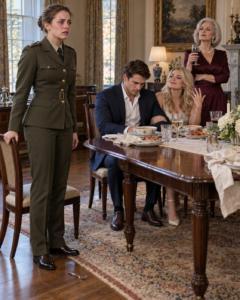
But instead, I walked into a brutal ambush right at my family’s dining table. The air turned freezing cold when Susan, my mother-in-law, raised her glass of wine and looked at me with pure contempt.
She did not beat around the bush. She stated bluntly, “I have convinced your husband to divorce you and marry Margaret, your own sister, because, realistically speaking, your sister is better, has more class, and deserves to be Logan’s wife more than you do.”
I looked at my husband. He did not even dare to lift his face, while my sister was stroking the diamond ring on his hand. They thought they could throw me out on the street like an expired item.
But they were wrong. They forgot that I am a soldier, and I never accept defeat.
Let me know where you are listening from, and please hit subscribe right now if you want to witness how I make them regret every single word they said today.
I pulled my old reliable pickup truck into the driveway, the tires crunching loudly against the pristine gravel. It stuck out like a sore thumb parked right next to a fleet of polished Mercedes and BMW sedans lining the front of the Hartwell estate.
This was the monthly Sunday dinner, a mandatory ritual for the Philadelphia mainline elite, a circle my husband’s family had belonged to for generations. I smoothed out the creases on my class A uniform, trying to look as presentable as possible.
I had driven 4 hours from Fort Drum without a single stop, fueled only by bad coffee and the desperate need to see my husband. But the moment the butler opened the heavy oak door, I felt the temperature drop.
There was no one there to greet me. No welcome home. No warm embrace.
Susan, my mother-in-law, was standing in the center of the grand living room, swirling a glass of chateau Margo. She looked me up and down, her eyes lingering on my uniform with the same expression one might use when looking at a bag of trash left on the curb.
“Oh, Jodie,” she drawled, her voice dripping with that polite upper-crust sarcasm that cuts deeper than a knife. “You still haven’t changed out of those laborers’ clothes. Margaret is wearing the latest piece from the Dior collection, you know.”
I swallowed the lump in my throat and followed her into the dining room. We took our seats at the long mahogany table. Logan, my husband, sat directly across from me.
I tried to catch his eye, to smile, to connect, but he was fascinated by his bowl of lobster bisque. He refused to look up.
Sitting right next to him was Margaret, my own flesh and blood, my little sister. She looked radiant, I had to admit. Her hair perfectly quafted, her skin glowing.
But then I saw her hand. She placed it deliberately, possessively, on my husband’s forearm.
The silence in the room was suffocating. The only sound was the sharp, dry clinking of silver cutlery against bone china. It sounded like skeletal fingers tapping.
Then Susan tapped her spoon against her wine glass. Clink, clink, clink.
“Attention, everyone,” she announced.
She did not look at me. Her eyes were fixed adoringly on Margaret.
“Today, this family needs to celebrate a new future. A future that actually befits Logan’s pedigree and ambition.”
My heart started hammering against my ribs. I felt a cold sweat prickling the back of my neck. And then she said it—the sentence that ripped my world apart.
“I have successfully convinced Logan to finalize the divorce with you, Jodie, and to marry Margaret. Because let us be realistic: your sister is better suited, has higher class, and simply deserves to be Logan’s wife more than you do.”
My fork slipped from my numb fingers. It hit the hardwood floor with a deafening crash that echoed through the silent room.
“What?” I whispered.
My voice was barely audible. I looked around the table, desperate for an ally. Uncle John, Aunt Sarah, people to whom I had sent handwritten Christmas cards every year, people I had cooked for.
They all looked down at their plates or turned their heads away. They knew. Every single one of the 20 people in this room knew.
I was the last to know. I was the fool in their twisted play.
Margaret, the sister whose college tuition I had paid for with my army wages so she wouldn’t have student debt, slowly lifted her left hand. On her ring finger sat a massive diamond, at least two carats.
It caught the light from the chandelier, mocking me. It was the exact style of ring Logan had once told me we could not possibly afford. It turned out he had the money. He just did not have the money for me.
Margaret smiled, a small victorious curve of her lips.
“Sis, you should be happy for us. You are always away playing soldier. Logan needs a real woman by his side, not someone who is married to the government.”
Tears stung my eyes, hot and acidic. I wanted to scream. I wanted to flip the table. I wanted to grab Logan by his collar and demand to know why he was such a coward.
But 10 years in the army had drilled something into my very marrow: discipline. You do not break formation. You do not cry in front of the enemy.
And that is what they were now. Not family. Enemy combatants.
I stood up, pushing my chair back. The wooden legs screeched against the floor, a harsh sound that matched the scream inside my chest.
“Congratulations,” I said.
My voice was cold, steady, even though my hands were trembling violently beneath the table.
“Congratulations on showing me exactly what upper class looks like.”
Susan let out a scoff, taking a sip of her expensive wine.
“Don’t be dramatic, Jodie. You are so military, so rough. Just sign the papers and leave quietly. Try to keep a shred of dignity.”
I looked at Logan one last time. He was still staring at his soup, a coward to the bitter end.
I turned on my heel, executing a sharp about-face. I walked out of that dining room with my back straight, chin up, maintaining the perfect posture of an officer.
But inside, as I marched toward the heavy front door, I was bleeding out. I stepped out into the night air, the heavy door clicking shut behind me with a sound of finality.
I was alone.
After that Sunday dinner from hell, a rational person would have filed for divorce the very next morning. But I was not rational. I was a soldier in denial.
I told myself that Logan was being manipulated by his mother. I told myself that my sister was just young and confused. In the army, we have a creed: I will never leave a fallen comrade.
And in my mind, my marriage was the battlefield. And Logan was the comrade I had to save.
3 days later, I took leave and drove to our suburban apartment. It was a nice place, a two-bedroom unit near the park that we had picked out together.
On the way, I made a detour to South Philadelphia, pulling up to the neon lights of Pat’s King of Steaks. I stood in line and ordered two cheese steaks, whiz with cheese whiz, and fried onions, just the way Logan loved them.
The greasy, savory smell filled the cab of my truck as I drove. I rehearsed my speech. I was going to remind him of our vows. I was going to fight for us.
I thought I was being a warrior. But as I walked up the steps to our unit, holding that paper bag stained with grease, I realized I was just a fool walking into a trap.
The front door was unlocked. My heart started to pound against my ribs, a heavy rhythmic thud. I stepped inside.
The familiar scent of our home, usually coffee and laundry detergent, was gone. Instead, the air was thick, almost choking, with the smell of expensive perfume. It was Dior. It was Margaret’s scent.
I walked into the living room and froze. My battle dress uniform, my BDU, which I had carefully hung on the back of a chair before leaving for the base weeks ago, was lying in a heap on the floor. It had been kicked into the corner like a dirty rag.
Scattered across the sofa were silk dresses and shopping bags. The bedroom door was a jar. I moved toward it, my boots heavy on the carpet.
I pushed the door open. The sight that met my eyes hit me harder than any physical blow I had ever taken in combat.
There, on the queen-sized bed that we had bought with our first savings, were my husband and my sister. But what made bile rise in my throat was not just the act itself.
It was the blanket.
They were tangled together under the patchwork quilt my grandmother had made for me. She had spent two years stitching that quilt by hand, sewing pieces of her old dresses and my grandfather’s flannel shirts into a pattern of stars.
She gave it to me on my wedding day, whispering that it would keep our marriage warm. Now it was being used to cover their betrayal.
They did not stop immediately. Margaret looked up, her hair messy, her lipstick smeared. She didn’t scream. She didn’t cover herself in shame.
She brushed a strand of hair from her face and looked at me with a gaze that was pure poison. It was a look of challenge.
Logan scrambled up, pulling the quilt—my grandmother’s quilt—up to his chest. There was no apology in his eyes. There was only annoyance, like I was a telemarketer interrupting his dinner.
“I told mom to tell you,” he said, his voice flat and unbothered. “What are you doing here, Jodie? Did you come to beg?”
I stood there, clutching the bag of cooling cheese steaks until my knuckles turned white.
“Why, Logan?” I choked out. “Of all the people in the world, why my sister?”
Logan let out a short, dismissive laugh.
“Look at yourself, Jodie. You are too rigid. Living with you is like living in a barracks. I need a woman who is soft, who knows how to host parties, who helps me network with the business crowd. Margaret makes me feel like a man. You—you just make me feel inferior.”
I know I’m not the only one who has felt this sting. If you have ever given your all to someone only to be told you were too much or not enough, please hit the like button right now. And in the comments, just write “I know” so I can see I’m not alone in this.
Before I could respond, a shadow moved in the doorway behind me. It was Susan. She had been in the living room the whole time, silently directing this stage play.
“The lawyers have finished the paperwork,” she said, her voice crisp. “The deed to this apartment is in Logan’s name. I know you paid 70% of the mortgage, dear, but legally it is his. You need to pack your personal effects and leave tonight. Do not make a scene. The neighbors are watching.”
Something inside me snapped, but it wasn’t a violent snap. It was the sound of a heavy chain breaking, setting me free. I did not cry. My tears had dried up in the dining room 3 days ago.
I dropped the bag of cheese stakes on the floor.
“Fine,” I said.
I grabbed my duffel bag. I went to the closet and took only what I could carry: my uniforms, my medals, and a few photos of my grandmother. I whistled for Buster, my old golden retriever, who was cowering under the desk, sensing the tension.
Before I left, I walked over to the vanity where Margaret was now sitting, calmly reapplying her lipstick in the mirror. I took a yellow sticky note from my pocket and a Sharpie.
I wrote three words. I stuck the note right in the center of the mirror, blocking her reflection.
“Watch me.”
I grabbed Buster’s leash and walked out. I didn’t look back at the bed. I didn’t look at the quilt.
I slammed the front door so hard the walls shook. That sound wasn’t an ending. It was the starting gun for the rest of my life.
I drove for 28 hours straight, heading west on the interstate until the flatlands of the Midwest gave way to the jagged snowcapped peaks of the Rocky Mountains. I chose Denver for a reason.
To most people, the mountains look like a vacation destination, but to me, they looked like Afghanistan. It was the only place on earth where I had felt truly useful, where the person next to me would die for me, not stab me in the back over a dinner table.
My entire life was packed into the bed of my pickup truck: $400 in cash, my emergency stash, a few boxes of military gear, and Buster, my golden retriever, who sat in the passenger seat with his head resting on my thigh.
Susan had moved faster than a sniper. She had frozen our joint bank accounts before I even hit the state line. Technically, I was now a homeless woman with a shiny captain’s rank that meant absolutely nothing in the real world.
I pulled into a Motel 6 off the highway. It was the kind of place where the neon sign flickered ominously and the smell of stale cigarette smoke was embedded into the wood paneling, but it was cheap.
I paid for a week up front, leaving me with barely enough to buy gas and food. That night, as the semi-truckss roared past on the highway, shaking the thin walls, I hugged Buster and tried not to think about the down comforter I used to sleep under.
34 days passed. They blurred into a gray haze of rejection and biting cold.
My separation pay and VA benefits were delayed in the bureaucratic machinery of the government. I had sent out 50 rs. I’d walked into office buildings with my shoes polished and my back straight.
The result was a perfect round zero. The civilian world was not what I expected. They put “support our troop” stickers on their bumpers, but they did not want to hire us.
I landed an interview for a human resources manager position at a midsize tech firm. The hiring manager was a man with soft hands and a condescending smile. He glanced at my military record, then looked at me with a wrinkled nose.
“Miss Lane,” he said, tapping his pen on the desk. “You have command experience, which is nice, but honestly, you seem a little too intense. My employees need nurturing, not orders. You might scare them. We are looking for someone a bit more normal, someone softer.”
Normal. That word cut me deeper than shrapnel.
I was intense because I had to be. I was hard because I had spent a decade making sure people like him could sit in their heated offices and judge me without fear of being blown up. I walked out of there holding back tears of rage.
By day 35, I hit the bottom. I had run out of the mini propane canisters I used to boil water. The Denver winter had set in, and the temperature inside my truck, where I spent my days to save motel electricity, was freezing.
My dinner that night was a packet of ramen noodles without hot water. I had to crush the dry block of noodles inside the wrapper, sprinkle the seasoning packet over it, and eat it like chips.
I sat on the edge of the motel bed, crunching on the dry, salty noodles. Buster rested his chin on my knee, letting out a low, hungry wine.
“I am sorry, buddy,” I whispered, my voice cracking.
I poured half of the dry noodles into my hand and let him lick them up.
“I promise tomorrow will be different.”
The cold seeped through the thin motel blanket that night. I lay there shivering, and for a split second, a traitorous thought entered my mind. I remembered the fireplace at the Hartwell mansion. I remembered the endless trays of food they threw away after parties.
If I called Logan, if I begged, maybe he would let me come back. Maybe I could sleep in the guest room.
But then the image of them in my bed flashed in my mind. The quilt. The smirk on Margaret’s face.
No. I would rather freeze to death in this motel room than trade my dignity for their warmth.
The next morning, I had one last shot. A marketing agency called Pinnacle Solutions had called me for an interview. It was a long shot, but it was all I had.
I got into my truck and turned the key. The engine sputtered. The gas gauge needle was buried below the red line, resting on empty.
Panic, cold and sharp, gripped my chest. I began tearing through the truck. I checked the glove box, the space under the seats, the pockets of my old uniforms. I gathered every coin I could find.
I stood at the gas pump nearest the motel, counting out my treasure: nickels, dimes, and pennies. My hands were red and numb from the cold.
“Come on, lady. Hurry it up,” a voice sneered behind me.
I turned to see a man in a pristine Mercedes SUV waiting for the pump. He looked at my faded jeans, my handful of dirty coins, and shook his head in disgust. He didn’t see a captain. He saw a bum.
The shame burned my face, hotter than fire. I wanted to throw the coins at him. I wanted to scream, but I didn’t.
I gripped the cold metal of the pennies until they dug into my skin. I looked up at the gray, unforgiving sky. I needed something. Not money, not food. I needed strength.
The words of Psalm 144:1 came to my lips. It was the verse we used to whisper before patrols.
“Blessed be the Lord, my rock, who trains my hands for war, my fingers for battle.”
This was my new war. The enemy wasn’t insurgents. It was hunger. It was pride. It was the world that wanted me to fail.
“I will not break,” I whispered to the gray sky.
I walked into the station and prepaid exactly $345. It put just enough gas in the tank to get me to the interview.
It was a one-way trip. I didn’t have enough gas to get back to the motel. If I didn’t get this job, I was stranded.
But a soldier doesn’t retreat.
I put the truck in gear and drove toward the city. I walked through the revolving glass doors of Pinnacle Marketing Solutions with an empty stomach and a pride that was held together by duct tape.
The lobby was an assault on my senses. It smelled of expensive espresso and ambition. The walls were floor-to-ceiling glass, revealing a view of the Denver skyline that I usually only saw from the parking lot of the motel.
The employees walking past me look like they had just stepped off a runway in New York. The men wore tailored suits that cost more than my truck. And the women wore heels so high I wondered how they didn’t break their ankles.
Then there was me. I caught my reflection in the polished steel of the elevator doors. I was wearing my only clean white button-down shirt and a pair of black slacks I’d bought at Target 5 years ago.
They were ironed to military perfection: sharp creases, no wrinkles, but the fabric was cheap and the cut was outdated. I felt like an alien who had crashlanded on a planet inhabited exclusively by the beautiful and the wealthy.
Jennifer, the HR assistant who had called me, met me at the reception desk. She gave me a onceover, her smile polite but slightly pitying.
“Don’t worry,” she whispered, leaning in as she swiped her badge to let me through the security gate. “Nathan Cross, our creative director, is a bit eccentric, but he told me specifically that he needs someone who doesn’t cry when he yells. He needs a new kind of order.”
She led me down a corridor that buzzed with activity. We stopped in front of a frosted glass door at the end of the hall. Jennifer knocked once, gave me a thumbs up, and practically ran away.
I took a breath, squared my shoulders, and opened the door.
If the lobby was a runway, Nathan Cross’s office was a bomb site. Sketches and storyboards were taped half-hazardly to the walls. The desk was invisible beneath mountains of paper, fabric swatches, and a pyramid of empty Red Bull cans.
A basketball hoop was mounted over the trash can, and the floor was littered with crumpled balls of paper. Failed ideas, I assumed.
Nathan was sitting behind the desk, leaning back in a leather chair, tossing a foam ball into the air and catching it. He didn’t look like a boss. He wore a graphic t-shirt under a blazer and Converse sneakers.
He looked tired, bored, and brilliant. He caught the ball, stopped, and looked at me. His eyes scanned my resume on his desk, then flicked up to my face.
“Pao,” he said.
He didn’t say hello.
“Public affairs officer, United States Army.”
“Yes, sir,” I replied instinctively.
He raised an eyebrow.
“Sir? We don’t do sir here, Jodie. This is advertising, not the infantry.”
He picked up my resume and waved it like a white flag.
“You spent 10 years writing press releases about convoys and IEDs. You managed crisis communications in war zones. Why are you here? We sell soda and dreams, not national security.”
His tone wasn’t malicious like Susan’s had been. It was skeptical. He was testing me.
“I am here because I need a job,” I said, my voice steady.
“Honest. I like that,” he said, tossing the resume back onto the pile. “But honesty doesn’t sell cars. Creativity does. And looking at you, no offense, but you look like you iron your socks.”
I felt the heat rise in my cheeks. But instead of shrinking away, I felt a familiar spark. It was the same feeling I got before a briefing.
I took two steps forward, entering his territory.
“You need order,” I said, pointing a finger at the disaster zone he called a desk. “You have brilliance in this room, Nathan, but it is buried under trash. You are drowning in chaos.”
Nathan paused, the foam ball hovering in his hand.
“I know how to tell a story that makes people care about life and death when bullets are flying,” I continued, my voice gaining that command resonance. “I know how to manage information when silence can get people killed. If I can sell the mission to a group of terrified villagers or a hostile press corps, then selling sugar water to teenagers is a piece of cake.”
The room went silent. The hum of the air conditioning seemed to get louder. Nathan stared at me for the first time.
He wasn’t looking at my cheap clothes or my stiff posture. He was looking at my eyes. He leaned forward, elbows on the desk, pushing aside a stack of papers.
“Okay,” he said softly. “Let’s say we have a pitch due tomorrow morning. The copyriters are crying in the breakroom. The graphic designers are threatening to quit. And the client is screaming for a revision. It is total panic. What do you do? Do you curl up and cry? Do you quit?”
I didn’t blink. I didn’t hesitate.
“I establish a chain of command,” I said. “I clear the room of non-essential personnel to stop the panic from spreading. I break the objective down into hourby-hour deliverables. I assign tasks based on individual strengths, not job titles.
“And we do not sleep. We do not eat. And we do not stop until the mission is complete. I once pulled a 48our shift coordinating a rescue operation. Your deadline doesn’t scare me, Nathan.”
A slow grin spread across Nathan’s face. It wasn’t a smirk. It was a genuine wide smile. He laughed, a loud barking sound that made him look 10 years younger.
“Damn,” he said, shaking his head. “I think you actually mean that.”
He stood up and extended a hand over the pile of Red Bull cans.
“You are hired, Captain. You start immediately. But I’m warning you right now: nobody in this building is going to salute you.”
I gripped his hand. His shake was firm, warm, and real. For the first time in months, a man was looking at me with respect.
Not because of what I could give him in bed or what I could buy him, but because of who I was.
“I can live with that,” I said.
I walked out of the pinnacle building 10 minutes later with an employment contract in my hand. The wind in Denver was biting cold, whipping my hair across my face.
But for the first time since I left Philadelphia, the cold didn’t hurt. It felt fresh. It felt like a new beginning.
I treated Pinnacle Marketing Solutions less like an advertising agency and more like a battalion in need of reorganization. Within a week, the chaos that Nathan called the creative process was dismantled and rebuilt.
I introduced standard operating procedures for everything from file naming conventions to client communication channels. At first, the resistance was palpable.
I would walk past the breakroom and hear hushed whispers. They called me the warden or GI Jane when they thought I was out of earshot. They rolled their eyes when I cut off their rambling hour-long brainstorming sessions exactly at the 30-minute mark because they were going in circles.
But then something miraculous happened. For the first time in the company’s history, the team finished their task before the sun went down.
It was a Tuesday afternoon. I had streamlined the workflow on Trello and cut out the unnecessary middleman approvals. At 6:00 sharp, the office was clearing out.
A young graphic designer named Mike stopped by my desk. He looked nervous, holding a small paper bag.
“Hey, Jodie,” he said, shifting his weight. “I just—I wanted to say thanks.”
He placed a glazed donut on my desk. It was from the good bakery down the street, not the stale ones from the vending machine.
“Because of the new schedule, I’m actually going to make it home for my daughter’s birthday dinner. I haven’t made a family dinner on a week night in 2 years. You are—you are pretty cool, boss.”
He called me boss, not ma’am, not captain, and definitely not warden. I watched him leave, feeling a warmth in my chest that had nothing to do with the coffee I was drinking.
By the second week, I wasn’t just managing the flow. I was part of the fight. We were stuck in a conference room trying to crack a campaign for a new line of heavyduty pickup trucks.
The creative team was floundering. They were pitching ideas about shiny trucks driving through pristine city streets, driven by models with perfect hair, stopping for lattes.
I listened for 20 minutes, my patience thinning like ice in spring. Finally, I stood up and walked to the whiteboard.
“Stop,” I said.
The room went quiet.
“You are selling this wrong. This truck isn’t for a guy who worries about scratching the paint. It is for the guy who wakes up at 4 in the morning when it is still dark and cold. It is for the guy whose hands are permanently stained with grease and oil.”
I picked up a marker.
“Do not show me a shiny truck. Show me the dents. Show me the mud caked in the wheel wells. Show me the scratches on the bedlininer. Those aren’t flaws. Those are metals. That is the truth. That is what we are selling. Honor in the dirt.”
Silence hung in the air for a beat. Then Nathan, who had been slouching in his chair, sat up straight. His eyes were wide, sparking with that manic energy he got when an idea landed.
“That’s it,” he whispered. “Run with that. Exactly that.”
We landed the account 3 hours later. The client loved the medals angle. I was riding high on the adrenaline of the win.
I went back to my desk, feeling a sense of purpose I hadn’t felt since I left the service. My phone buzzed against the hard surface of the desk.
I picked it up. A notification flashed on the screen. It was an email from Margaret Hartwell.
Subject: Good news for you.
My stomach dropped. Against my better judgment, I opened it. There was no text at first, just an image.
It was a grainy black-and-white ultrasound photo, a fetus 12 weeks old. Below it was another photo, a nursery being set up. In the center was a handcarved Italian crib, the kind that cost more than my truck.
I recognized the brand because Logan and I had looked at it once years ago and decided we should save money instead.
Then came the text.
“We are finally going to be a real family, sis. Mom is over the moon. Please just sign the divorce papers so we can handle the birth certificate properly. We don’t want any complications for the baby.”
The air left my lungs. The office sounds—the typing, the laughter, the coffee machine—faded into a dull roar.
I stood up and walked stiffly to the women’s restroom. I made it into a stall just as my body betrayed me. I gripped the porcelain sides of the toilet and dry heaved until my ribs achd.
There was nothing in my stomach but bile and rage. That was my money buying that crib. That was my husband.
And that—that was the baby I had prayed for. The baby Logan said we weren’t ready for yet.
I stayed there for 10 minutes, shaking. Then the soldier kicked back in. Mission first.
I stood up, flushed the toilet, and went to the sink. I splashed freezing cold water on my face, watching the red my eyes in the mirror.
“You will not cry,” I hissed at my reflection. “Do not let them win.”
I dried my face with a rough paper towel and walked back out. Nathan was standing by my desk. He wasn’t working. He was just standing there, guarding my space.
He didn’t ask where I had been. He didn’t ask why my eyes were red. He simply pointed to a fresh steaming cup of black coffee he had placed right next to my keyboard.
“Whoever upset you,” Nathan said, his voice low and unusually serious, “I will fire them.”
I let out a weak, watery chuckle.
“They don’t work here, Nathan.”
He shrugged, leaning against the partition, his eyes locking onto mine with an intensity that surprised me.
“Well, then,” he said, “maybe I will just buy their company one day, and then I will fire them.”
He meant it as a joke. A ridiculous, impossible joke to make me smile. But as I wrapped my cold hands around the hot coffee cup, his words didn’t fade away.
They echoed. By their company.
I looked at the screen where the ultrasound photo was still open. I looked at Nathan, and for the first time, I didn’t see an end.
I saw a target.
The most defining moment of my career did not happen on a battlefield in Kandahar. It happened in a glasswalled conference room in Denver exactly 30 minutes before the biggest meeting of the year.
We were prepping for Morrison Industries. This wasn’t just a client. They were a whale.
Landing this account would put Pinnacle on the map nationally. Nathan was pacing the room, running through his slide deck, manic energy radiating off him.
Then, mid-sentence, he stopped. His face went ashen gray. He doubled over, clutching his right side, and hit the floor with a terrifying thud.
Panic exploded in the room. Someone screamed. Jennifer from HR was hyperventilating.
I dropped to my knees beside him. His skin was clammy, and he was groaning in agony. I recognized the signs immediately. Acute appendicitis.
“Call 911,” I barked.
10 minutes later, the paramedics were wheeling Nathan out on a gurnie. The sirens wailed, fading into the distance like a dying hope.
The room fell into a stunned silence. The creative team looked like lost children. Mike, the graphic designer, slumped into a chair, head in his hands.
“That’s it,” he muttered. “We have to cancel. We are dead in the water without Nathan. Morrison is going to eat us alive.”
I looked at the clock on the wall. 20 minutes until arrival. I looked at the terrified faces around me.
And then I thought of Susan. I thought of Logan. I thought of every person who had told me I was too rigid, too hard, too much.
If I canled this meeting, I was proving them right. I would be the failure they expected me to be.
I walked over to the coat rack and grabbed my navy blue blazer. I slipped it on, buttoning it up. It wasn’t just a jacket. In that moment, it was armor.
I smoothed the lapels, checked my reflection in the darkened monitor, and turned to the team.
“Listen to me,” I said, my voice cutting through the panic. “We are not cancelling. We are not retreating. We know this pitch. We know the strategy. Everyone, take your stations. We are going to fight.”
Right on Q, the double doors swung open. Mr. Morrison walked in. He was a mountain of a man in a $3,000 suit, flanked by three assistants who looked terrified of him.
He had silver hair, a deep tan, and the kind of arrogance that only comes from decades of unchecked power. He reminded me instantly of the men at the country clubs in Philadelphia, men like my father-in-law.
He stopped at the head of the table, not bothering to sit. He scanned the room, frowning.
“Where is Nathan?” he demanded.
His voice was a low rumble.
“I don’t have time to waste with the B team.”
His eyes swept over Mike, over Jennifer, and then landed on me. He looked me up and down, dismissing me in a single glance. To him, I wasn’t a director. I wasn’t a captain. I was furniture.
“You there?” he said, pointing a thick finger at me. “While we wait for the actual leadership to show up, be a sweetheart, and go get me a cup of coffee. Black, light on the sugar.”
The room froze. I could feel the blood rushing to my face, hot and stinging.
It was the dining table all over again. It was Susan handing me her coat like I was the maid. It was the world telling me to know my place.
But the Jodie who had walked out of that dining room crying was gone. The woman standing here had survived winter in a truck. She had built a team from chaos.
I didn’t move an inch. I locked my knees and stood at attention. My posture, rigid steel.
“Mr. Morrison,” I said.
I used my command voice. It is a tone you learn in officer training. Deep, resonant, projecting from the diaphragm, designed to be heard over the roar of helicopter blades. It is not a yell. It is a force of nature.
“Nathan is in emergency surgery. My name is Jod Lane. I am the director of operations, and I am leading this pitch.”
Morrison blinked, taken a back. He opened his mouth to interrupt, but I didn’t let him.
“You have two choices right now,” I continued, stepping closer to him, invading his command space. “Choice one, you can walk out that door and lose the most aggressive, effective marketing strategy this market has ever seen to your competitors.
“Or choice two, you can sit down, get your own coffee if you need it, and give me 10 minutes. I’m going to show you how to increase your revenue by 20% in the next quarter. The choice is yours.”
The silence that followed was heavy enough to crush a tank. The air conditioning hummed. Mike looked like he was about to faint.
I know so many of you have been in this exact spot: underestimated, disrespected, and pushed to the edge. If you are rooting for Jod right now, please hit that like button. And in the comments, I want you to write, “I am not a quitter,” if you have ever had to stand tall when someone tried to make you feel small.
Morrison stared at me. His eyes narrowed, assessing the threat. He looked for fear. He found none.
Then, slowly, a grin spread across his face. It wasn’t a nice smile, but it was a respectful one. He pulled out the chair at the head of the table and sat down heavily.
“All right,” he chuckled, leaning back. “You got guts, lady. I haven’t been talked to like that since basic training. You have 10 minutes. Go.”
I didn’t use the clicker. I didn’t look at the screen. I knew every number, every metric, every tactical advantage by heart.
I delivered the pitch with the precision of an air strike. I didn’t sell him a dream. I sold him a victory.
When I finished exactly 10 minutes later, I stopped and looked at him. Morrison stood up slowly. He didn’t look at his assistants.
He started clapping. A slow, rhythmic clap.
“Damn,” he said. “You are tougher than any of the empty suits I hire. Where do I sign?”
An hour later, I was in the hallway calling Nathan. The adrenaline was finally fading, leaving my hands shaking slightly.
“Hello.”
Nathan’s voice was groggy, sounding thick from the anesthesia.
“It is done,” I said, leaning my forehead against the cool glass of the window. “Morrison signed. We got the account.”
There was a long pause on the other end, then a weak, drugfueled laugh.
“Jennifer texted me,” Nathan rasped. “She said, ‘You staged a coup.’ She said you looked like you were about to execute him for treason. You scared the living daylights out of a billionaire, Jodie.”
“I just established order,” I replied, smiling.
“You are not an assistant, Jodie,” Nathan whispered, his voice drifting off as the nurses came to check on him. “You are not a manager. You are a general. Remind me never to get on your bad side.”
I hung up the phone. I looked out at the Denver skyline, bathing in the golden light of the afternoon sun. I wasn’t just surviving anymore. I was conquering.
Two weeks after the Morrison contract was signed, Nathan walked into my office and closed the door. He wasn’t holding a new brief or a client complaint. He was holding a cardboard box.
“I am resigning,” he said, placing the box on my desk. “I am tired of making money for people who don’t know the difference between a type face and a target audience. I am starting my own agency, and I am not doing it without you.”
I stared at him, stunned.
“You want me to be your employee?”
Nathan shook his head, a mischievous glint in his eye.
“No, Jodie, I don’t want to be your boss. I want to be your partner. 50/50. Cross lane creative.”
We set up shop the very next day in the most cliche yet perfectly American way possible—in his garage.
It was the dead of winter in Denver. The garage was drafty, smelling of gasoline and sawdust. We pushed his old Mustang to the driveway to make room for two folding tables and a whiteboard we bought from Staples.
For the next 6 months, that freezing garage was my whole world. We worked 16-hour days. Our diet consisted almost entirely of cold pepperoni pizza and cheap Kors light beer because we were pouring every cent of profit back into the business.
We argued constantly. We fought over fonts, over strategy, over which clients to pitch. But for the first time in my life, I wasn’t fighting to defend my existence. I was fighting to build it.
One night, after a particularly grueling session where we cracked a campaign for a local brewery, the adrenaline faded into exhaustion. We were sitting on the concrete floor, leaning against the cold wall, sharing a six-pack.
I don’t know why—maybe it was the fatigue or the beer—but I told him everything. I told him about the dinner in Philadelphia. I told him about the quilt. I told him how Logan had called me too rigid and too hard.
I expected Nathan to look uncomfortable. Most civilians do when you unload that kind of trauma.
Instead, he reached out and covered my hand with his. His grip was firm, grounding.
“They were blind, Jodie,” he said softly. “They threw away a diamond because they were too stupid to realize it wasn’t just a rock. They wanted a decoration. I want a partner.”
That was the moment the ice around my heart finally began to melt. Winter turned into spring and then back to winter again. Cross Lane Creative was growing.
We moved out of the garage and into a loft downtown. One snowy evening, we had just closed a massive deal with a tech startup.
The office was empty, the staff having gone home to celebrate. I was staring out the window at the falling snow, feeling a sudden wave of vulnerability.
“Am I too much?” I asked, the old ghost of Logan’s voice whispering in my ear. “Am I too aggressive, Nathan?”
Nathan walked over and stood beside me. He didn’t try to hug me or shush me. He reached up and tucked a loose strand of hair behind my ear, his fingers lingering on my jawline.
“You are hard,” he admitted, his voice low and rumbling. “But that hardness, it is the most beautiful thing I have ever seen. It is a wall, Jodie. It protects the things that matter.
“I don’t want you to soften up. I want to be the guy standing right behind that wall with you, handing you the ammunition. I want to reload for you.”
He leaned in, and our first kiss didn’t taste like fireworks or fairy tales. It tasted like cheap beer, exhaustion, and absolute safety. It was the kiss of two soldiers finding each other in the trenches.
18 months later, we were in a quarterly review meeting. Just the two of us.
“Okay, let’s look at the projections,” Nathan said, sliding a thick bound report across the mahogany conference table. “Flip to the last page. I think the long-term forecast is interesting.”
I flipped through the spreadsheets and graphs, sipping my coffee. When I turned to the final page, I froze. There were no numbers.
There was just a single line of text in bold Helvetica font.
“Proposal for permanent merger. Nathan and Jodie.”
My breath hitched. I looked up. Nathan was no longer in his chair. He was down on one knee on the office carpet.
He wasn’t holding a velvet box. He was holding a simple platinum band that looked strong enough to survive a war.
“I don’t want a trophy wife,” Nathan said, his eyes locking on to mine with that intense focus I loved. “And I know you don’t need a savior, but I need a teammate for life, captain. I need someone to watch my six. Do you accept this mission?”
Tears spilled over my cheeks, hot and fast. I laughed, a sound that bubbled up from the deepest part of my soul.
“Roger that,” I choked out. “Mission accepted.”
We got married 3 weeks later at the courthouse. No 200 guest list, no lobster bisque, just our team from the office. Jennifer from HR as my maid of honor and Buster wearing a bow tie.
As we stood on the courthouse steps, Nathan holding my hand and Buster barking at a squirrel, I looked at the small group of people cheering for us. They were misfits, creatives, and workaholics.
None of them shared my DNA. But looking at them, I realized the truth that Susan and Logan never understood.
Family isn’t about whose blood runs in your veins. Family are the people who are willing to bleed with you.
I squeezed Nathan’s hand. I had lost a battle in Philadelphia, but I had won the war. I had my own army now.
Time is a funny thing. When you are suffering, a minute feels like a lifetime. But when you are winning, 6 years can go by in the blink of an eye.
I stood on the balcony of our penthouse apartment, wrapping my silk robe tighter against the crisp morning air. The view was breathtaking: the jagged snowcapped peaks of the Rocky Mountains stretching out against a sky so blue it looked painted.
My life was unrecognizable from the woman who had shivered in a Motel 6 parking lot. Cross Lane Creative had exploded.
We had grown so fast that Media Vance, a global media conglomerate, had acquired us in a deal that made headlines in ad age. I stayed on as the CEO of the western region. Nathan was the chief creative officer.
We had money. Real money, not the leveraged credit card debt my ex-husband used to call wealth.
I walked back into the kitchen, the smell of freshly ground espresso filling the air. Nathan was already at the island reading a thick dossier. He looked up, his expression unreadable.
“Morning, General,” he said, sliding a cup of coffee toward me. “You might want to sit down for this one. Corporate just sent over the due diligence report for the East Coast expansion.”
I took a sip of the espresso, leaning against the marble counter.
“Is it the Philadelphia acquisition? I thought that was a done deal.”
“It is,” Nathan said, tapping the folder. “We are looking at acquiring Meridian Consulting. They are an old school firm on the main line. They are bleeding cash, on the verge of chapter 11 bankruptcy. Their client list is good, but their management is a disaster. Corporate wants us to clean house.”
Meridian Consulting. The name rang a bell. It was one of those stuffy old money firms that Logan used to brag about wanting to work with back when he was trying to be a big shot.
“So, what is the problem?” I asked, reaching for the file.
“Page 42,” Nathan said quietly. “The personnel audit list of underperforming assets recommended for termination.”
I flipped open the heavy binder. My eyes scanned the rows of data: salaries, performance ratings, tenure, and then my heart actually skipped a beat.
There, near the bottom of the list, were two names I hadn’t spoken aloud in 6 years.
Logan Hartwell, junior consultant.
Margaret Hartwell, part-time administrative associate.
I stared at the paper, blinking to make sure I wasn’t hallucinating.
“Logan is a junior consultant?” I asked, my voice flat. “He’s 40 years old.”
“Keep reading,” Nathan said. “I had legal pull their background checks.”
I turned the page, and the story of their last 6 years unraveled before me like a tragic comedy. It turned out that Logan’s boutique firm, the one he started with my money, had imploded less than 2 years after I left.
Margaret had burned through their capital on vacations, cars, and that expensive Italian nursery. They had lost the house. The bank had foreclosed on it 4 years ago. They were renting a small townhouse now.
Their credit scores were in the tank. Susan, my mother-in-law, had co-signed three different loans to keep them afloat, dragging her own finances down with them.
And now Logan was working an entry-level job at Meridian, making a fraction of what he used to earn, with performance reviews that read, “Lacks initiative, resistant to feedback, arrogant.”
And Margaret, the woman who needed to be pampered, she was working part-time filing papers to help pay the rent.
The irony was so sharp it almost cut me. I, Jodie Lane, the woman they had thrown out like trash because I wasn’t classy enough, was the CEO of the company that was about to buy their employer.
Technically, as of next week, I would be their boss.
I felt a bubble of laughter rise in my chest. It wasn’t a happy laugh. It was dark. It was the laugh of a predator who just realized the prey has walked right into the trap.
“Jodie.”
Nathan reached out, covering my hand. His eyes were full of concern.
“If this is too much, we can kill the deal. I can tell corporate the liabilities are too high. We don’t have to deal with them. I don’t want you to have to see them.”
I looked at the photo of Logan attached to his file. He looked tired. His hairline was receding, and there was a heaviness to his face that hadn’t been there before. He looked defeated.
I closed the folder slowly, savoring the sound of the heavy paper settling.
“No,” I said.
My voice was calm, smoother than the silk I was wearing.
“We are not killing the deal. This is a sound business decision. Meridian has assets we can use.”
I took another sip of my espresso, feeling the caffeine hit my bloodstream, mixing with the adrenaline.
“Proceed with the acquisition, Nathan. Sign the papers today.”
Nathan watched me carefully.
“And the personnel list? Do we fire the underperformers immediately?”
I smiled. It wasn’t my usual smile. It was cold. It was terrifying.
“Not yet,” I said. “We need to announce the merger first. We are hosting a gala at the Philadelphia Museum of Art to introduce the new leadership team, right?”
“Yes.”
Nathan nodded slowly.
“Next Saturday.”
“Perfect,” I said. “Make sure every employee at Meridian receives a mandatory invitation, especially the junior consultants and support staff. I want them there. In fact, mark the Heartwells as VIPs. Put them in the front row.”
“Jodie,” Nathan warned, a grin tugging at the corner of his mouth. “What are you doing?”
I walked to the window, looking out at the mountains that I had conquered.
“I am giving them exactly what they wanted,” I whispered. “They wanted to see what real class and success look like. I am going to show them.”
The Philadelphia Museum of Art stands like a Greek temple at the end of the Benjamin Franklin Parkway. To the tourists running up the 72 stone steps, it is the place where Rocky Balboa raised his fists in triumph.
To the old money of the mainline, it is their sanctuary, the place where they come to display their wealth and whisper about who is in and who is out.
Tonight, the great stair hall was bathed in golden light. A string quartet played soft classical music that floated up to the high ceilings.
I stepped out of the limousine, the cool night air hitting my skin. I wasn’t wearing a uniform tonight. I was wearing a floorlength emerald green gown.
It was silk, custom fitted, and cost more than the entire wedding budget Logan and I had scraped together years ago. But the most important detail was the back. It was completely open, plunging low.
For years, I had hidden the scars on my back, shrapnel marks from an IED explosion in Kandahar, because Logan said they were unsightly. He said they made me look damaged.
Tonight, I wore them like diamonds. They were part of my story, and under the crystal chandeliers, they shimmerred against my skin.
I took Nathan’s arm. He looked dashing in a tuxedo, but his eyes were fixed on me with pure adoration.
“Ready to storm the castle, General?” he whispered.
“Ready?” I replied.
We walked up the grand staircase. Heads turned. Whispers rippled through the crowd like a wave.
“Who is she? Is that the new CEO? Look at that dress.”
We entered the main hall, and I scanned the room with the precision of a sniper. It didn’t take long to find them. The Heartwells were standing in a corner near the bar, huddled together like sheep in a storm.
They looked small. Susan was wearing a dress I’d seen her wear a dozen times before. Margaret, once the golden child in Dior, looked tired.
Her dress was a season out of style, looking cheap under the museum lights. Logan was nervously checking his watch, sweating in a suit that looked a size too tight.
I squeezed Nathan’s hand, signaling the advance. The click-clack of my stilettos on the marble floor was a rhythmic drum beat of impending doom.
Susan was the first to spot me. She blinked, squinting through her glasses. Then recognition hit her like a physical slap.
Her mouth fell open. The expensive beaded clutch she was holding slipped from her fingers and clattered loudly onto the stone floor. Logan spun around, nearly knocking over a waiter’s tray of champagne.
I didn’t stop until I was right in front of them. I towered over them in my heels.
“Hello, Susan. Logan,” I said.
My voice was smooth, cool, and utterly devoid of fear.
“It has been a long time.”
Susan stared at me, her eyes darting from my face to my dress, then to Nathan. Her brain couldn’t process the image. In her mind, I was still the discarded daughter-in-law, the homeless veteran.
“Jodie,” she stammered, her face draining of color. “What? What are you doing here? Are you—are you working the event? Are you the help?”
It was such a perfect, predictable insult. The old Jod would have been crushed. The CEO, Jod, just smiled.
Before I could answer, Nathan stepped forward, sliding his arm possessively around my waist.
“Allow me to make the introductions,” Nathan said, his voice carrying clearly over the music. “This is Jod Lane. She’s my wife, my partner, and the co-founder of Crosslane Creative.”
He paused for effect, letting the words sink in.
“She is also the new regional CEO of Media Vance,” Nathan continued, locking eyes with Logan, “which makes her the owner of the parent company that just acquired Meridian Consulting. So, technically speaking, she is your boss.”
The silence that followed was deafening. Logan looked like he was going to be sick. Sweat was beating on his forehead.
“You,” Logan choked out, his voice trembling. “You are the new owner.”
I looked him in the eye, smiling with pity.
“That is correct, Logan, and I have been reviewing the personnel files. I hope your performance report for next month shows some improvement. I hear your billable hours are significantly below the company standard, and you know I have zero tolerance for incompetence.”
He turned a shade of gray I’d never seen on a human being before. Just then, the music faded. The spotlight shifted to the podium at the front of the room.
It was time for the keynote speech.
“Excuse me,” I said, brushing past Margaret without even looking at her. “I have a company to run.”
I walked to the stage, the heavy silk of my dress flowing behind me. I stepped up to the microphone and looked out at the sea of faces, hundreds of Philadelphia’s wealthiest and most powerful people.
And right in the front row, paralyzed in their VIP seats, were the Heartwells.
“Good evening,” I said, my voice amplified through the speakers, commanding absolute attention. “Tonight marks a new chapter for Meridian Consulting. We are trimming the fat. We are prioritizing merit over legacy.”
I pressed a button on the clicker. The massive screen behind me lit up. It displayed the new organizational chart for the company.
At the very top, in a large blue box, was my name: Jodie Lane, CEO. At the very bottom, in a section highlighted in red, labeled “probationary under review,” were two names: Logan Hartwell and Margaret Hartwell.
A gasp went through the room. It was subtle, but it was there. Everyone could see it.
Margaret stood up halfway, her face crumpled in desperation. She forgot where she was. She forgot the crowd.
“Jodie,” she cried out from the floor, her voice shrill and desperate. “Sis, please. We are family. You have to help us.”
I looked down at her from the podium. I let the silence hang for 3 seconds.
“Family?” I asked into the microphone, my voice echoing off the high stone walls. “No, Ms. Hartwell, you are a part-time associate on a temporary contract. And if you want to keep your job to feed your child, I suggest you sit down and focus on your work instead of riding on someone else’s coattails.”
I leaned in closer to the mic, my eyes hard as flint.
“In my company, there is no room for traders. There is only room for soldiers.”
I stepped back. The room erupted into applause. It was thunderous.
They weren’t clapping for my cruelty. They were clapping for the power.
I looked down at the front row one last time. Logan had his head in his hands. Susan was weeping silently into a napkin. Margaret was staring at the floor.
They were destroyed. Not by a weapon, not by a lawsuit, but by the sheer undeniable weight of my success.
The valet brought our rental car around to the front of the museum steps. It wasn’t a limousine this time, just a sleek black sedan. I was done with the show. I was done with the performance.
The adrenaline that had fueled me through the speech was beginning to eb, leaving behind a bone-deep exhaustion. As Nathan tipped the valet and opened the passenger door for me, a figure emerged from the shadows of the stone pillars.
It was Susan. Without the ambient lighting of the gala, she looked frail. The arrogance that had once stiffened her spine like a steel rod was gone, replaced by a slump of defeat.
Her makeup was smudged, and she was shivering in the night wind. She hurried toward the car, wrapping her knuckles against the passenger window.
“Jodie,” she called out, her voice muffled by the glass. “Jody, please, just a minute.”
I hesitated. Part of me wanted to tell Nathan to just drive, but the soldier in me needed to verify that the threat was neutralized. I pressed the button, and the window slid down with a quiet hum.
“Jodie,” Susan breathed, clutching her shawl tighter. “We need to talk. I know. I know things were said in the past. I know I was harsh, but the family is struggling. The loans, the baby. If you could just offer Logan a grace period or maybe a severance package.”
I looked at her. I really looked at her. For years, this woman had been the monster in my nightmares.
But now, under the harsh street lights of Philadelphia, she was just an old, bitter woman who had bet on the wrong horse.
“Mrs. Hartwell,” I said.
I didn’t call her mom. I didn’t call her Susan. I gave her the formal title of a stranger.
“You were right about one thing 6 years ago.”
She blinked, a flicker of hope sparking in her eyes.
“I was?”
“Yes,” I said softly. “You said I was too hard. You are absolutely right. But what you didn’t understand is that my hardness is not a flaw. It is a wall. It is a perimeter I built to protect myself. And that wall does not have a door for people like you anymore.”
“Jodie, please,” she whispered, reaching for the door handle.
“Do not contact me again,” I said.
My voice was calm, devoid of anger.
“If you do, you will be hearing from my legal team, not family.”
I pressed the button. The window rolled up, sealing me inside the warmth of the car. I watched her reflection fade in the side mirror as we drove away.
A small gray figure left behind in the cold.
We drove back to the Ritz Carlton in silence, but it was a comfortable silence. When we got to our suite, the first thing I did was kick off my shoes.
The Christian Lubboutan heels, with their famous red bottoms that signaled status and power, clattered into the corner of the room. They were beautiful, but they hurt like hell.
I peeled off the emerald gown, leaving it in a heap, and pulled on one of Nathan’s oversized hoodies and a pair of sweatpants.
“Room service is here,” Nathan called from the living area.
He hadn’t ordered champagne. He hadn’t ordered caviar or truffles to celebrate our victory. On the low coffee table sat a silver serving tray holding two large steaming bowls of pot roast.
It was the ultimate American comfort food. Chunks of tender beef that fell apart with a fork, carrots cooked until they were sweet, and a mountain of buttery mashed potatoes drowning in rich brown gravy.
We didn’t bother with the table. We sat on the plush carpet, leaning back against the sofa, eating with spoons.
The warmth of the food spread through my chest, chasing away the last of the museum’s chill. It tasted like safety. It tasted like home.
Nathan reached over and wiped a smudge of gravy from the corner of my mouth with his thumb.
“So,” he asked quietly, “how does it feel? Do you feel vindicated? Do you feel happy about it?”
I paused, a spoonful of potatoes halfway to my mouth. I thought about Logan’s terrified face. I thought about Margaret’s desperate plea.
“I don’t feel happy about their suffering,” I said, realizing it was the truth. “And I don’t feel the need to gloat.”
“No?” Nathan asked.
“No.”
I shook my head.
“I feel relief. In the army, after a long deployment, when you finally drop your rucks sack, that 50 lb bag you have been carrying on your back for months, there is this moment of weightlessness. That is what this is. I realized tonight that I don’t hate them.
“Hate takes energy. Hate means I still care.”
I looked at my husband, my partner.
“I am just indifferent. They are so small now. Their miserable reality is punishment enough. I don’t need to add to it.”
Nathan smiled and clinkedked his spoon against mine.
“To weightlessness,” he said.
The next morning, I woke up early, before the sun had fully risen. I stepped out onto the hotel balcony. Below me, Philadelphia was waking up.
The city that had once been the graveyard of my self-esteem was now just a city. The streets where I had cried in my truck were just concrete and asphalt. They held no power over me anymore.
The sun crested over the Delaware River, painting the sky in shades of gold and pink. I looked down at my hand resting on the railing.
Next to the diamond engagement ring Nathan had given me, I wore a simple gold band. I took a deep breath of the cool morning air.
I am Jodie Lane. I am a soldier. I am a CEO. But most importantly, I am a woman who saved herself.
If you are listening to this story right now, sitting in your car or your kitchen, feeling like the world is closing in on you, listen to me. Do not let them define you. Do not let them tell you that you are too much or not enough.
Do not let the pain break you. Take that pain, forge it in the fire of your resilience, and turn it into a weapon.
Build your wall, protect your peace, and one day you will look back at the people who tried to destroy you, and you won’t feel anger. You will just keep driving, and you won’t look in the rearview mirror.
If there is one lesson I want you to take away from my journey, it is this. You do not owe your loyalty to people who constantly disrespect you, even if they share your last name.
We often stay in toxic situations because we are afraid of the unknown. Afraid of starting over with nothing. But I learned that starting over is just another word for freedom.
True dignity isn’t about the title on your business card or the price of your dress. It is about what you refuse to tolerate.
You have the power to edit your life story. Do not be afraid to cut out the characters who are holding you back. Your piece is worth more than their approval.
Now, I want to hear from you. Have you ever had to walk away from a family member to save your own mental health? Or perhaps you are currently finding the strength to draw that line?
Please share your thoughts in the comments below. Your story might be the exact encouragement someone else needs to read today.
If my victory brought you a little bit of joy and hope, please hit that like button and subscribe to the channel. We are building a community of survivors here, and I don’t want you to miss the next story.
Until next time, stay strong and keep your head.