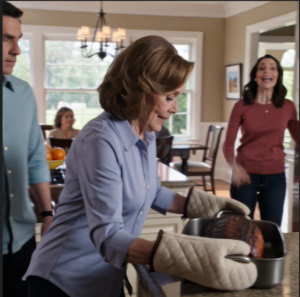
My Daughter-in-Law Said, “Eat the Leftovers, Audra.” I Walked Out With My Prime Rib—Then She Pani…
My daughter-in-law pointed me toward leftover pasta while claiming the prime rib I had spent hours preparing was “for my family.” My son stood beside her, staring at the floor. For four years, my pension and savings had helped pay for their life. Now, in front of her parents, I was being told exactly where I belonged—and it wasn’t at their table.
I had been awake since five that morning.
The night before, I had rubbed the prime rib with cracked pepper, sea salt, fresh thyme from my kitchen windowsill, and the Dijon mustard my late husband, Robert, always insisted on. At dawn, I took it out of the refrigerator and began preparing the slow roast.
By the time I drove forty minutes from Barry to New Market, its scent filled my Subaru.
I was bringing dinner to my son’s house. That was how I still thought of these invitations: a chance to spend time with Alec and his family, with something good I had made for all of us.
Alec answered the door looking slightly hunted. He kissed my cheek, took the heavy pan, and disappeared toward the kitchen without quite meeting my eyes.
Then I saw the dining room.
Tilda had brought out her cream embroidered linen, the set she once told me cost more than my monthly hydro bill. Crystal glasses stood beside silver candleholders. White and blush roses filled the center of the table.
Her parents were already seated.
Raymond, a retired investment broker, looked comfortable at the head of the table. Sheila wore a cashmere wrap and the expression of someone accustomed to being the most important person in the room.
They were the guests of honor.
Apparently, I was the caterer.
Tilda intercepted the roasting pan near the kitchen doorway. She smiled brilliantly at her parents, then turned toward me with the same pleasant ease someone might use to discuss the weather.
“There’s leftover pasta in the fridge. Some chicken soup, too. Help yourself. This roast is for my family.”
Alec did not move.
He looked down at the hardwood floor and shifted his weight from one foot to the other.
Not one word.
My son was standing close enough to hear every syllable. He had carried in the food himself. Yet he let his wife tell me that the dinner I had cooked belonged to a family that somehow did not include me.
For four years, since Robert died, helping them had become part of my life so gradually that I had stopped noticing how much I carried.
At first, Alec accepted help occasionally. Then he began depending on it.
Tilda complained about their cell bill, so I added them to my family plan: nearly $350 a month charged to my Visa.
Alec mentioned expensive car insurance, so I helped cover their two vehicles. More than $400 every two months.
Then came the monthly transfers for what Tilda called “the shortfall.” Somehow, that shortfall never shrank. It had crept toward $800.
Two years earlier, I had contributed $20,000 to their basement renovation. They called it a loan. They never mentioned paying it back.
I paid for my granddaughter Isla’s horseback riding lessons. I bought most of her school clothes because Tilda’s wallet always seemed to be missing when we reached the till.
When their credit card would not cover a family trip, Alec called eleven days before departure.
I paid for that, too.
These were not gifts from money I would never miss. They came from my pension and savings, the resources supporting my own life after losing my husband.
Alec was thirty-eight, with a good job in financial services. Tilda worked, too. Both were capable adults, yet my support had become an expectation.
And money was only part of what they expected.
I picked Isla up from school, drove her to lessons, and kept her overnight whenever they had plans.
I once gently suggested that she call me Nana, as she called her other grandmother. Tilda looked at me as though I had suggested something absurd.
At family dinners, I brought the main course and learned not to take up too much of the conversation.
I had become their cook, their backup plan, their ATM.
Now I stood in their kitchen being offered leftovers while her parents waited for my roast.
I had been a school principal for twenty-two years. I had handled grieving children, difficult parents, and staff meetings that left everyone exhausted. I knew how to keep my voice steady.
I also knew when silence made a stronger point.
So I opened the refrigerator.
There was old pasta in a glass container, orange oil pooled at the bottom. A tub of Greek yogurt. Half a head of lettuce softening at the edges.
I looked at what she had offered me.
Then I turned around.
Tilda’s hands were already reaching for the roasting pan when I picked it up and held it against my chest.
“I see,” I said.
My voice was perfectly level.
Raymond and Sheila looked mildly uncomfortable. I nodded politely to them.
Then, with the dinner still in my hands, I turned toward the side door.