My Brother-in-Law Billed My Widowed Mother for a Casket My Father Had Already Paid For
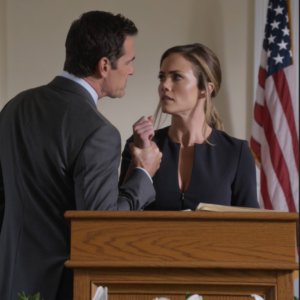
My brother-in-law’s hand closed around my wrist while I was still three steps from the lectern.
“You don’t speak at all if you won’t read what I wrote,” he said, close enough that I could smell the mints. “You’ve been back in this town 11 days, Sienna. You didn’t pay for one thing in this room.”
He said it in the voice he uses on families. The low, warm one that carries to the fourth row on purpose. [snorts]
Then Dale Whitlock walked me down the center aisle of his own chapel, past 60 people who had driven in to say goodbye to my father, and not one of them stood up.
My mother did try. Ruth Torrance had been a widow for 4 days. She got halfway out of the front pew with her purse still hooked over her arm, and my sister put a hand flat on her shoulder and pressed her back down into the wood.
My brother Neil looked at his shoes like they had just started talking to him. A woman near the aisle made a small sound that could have been sympathy or could have been a laugh she caught too late.
There had been a page on that lectern before Dale put his own there. Two pages, actually, torn along the top where my father had ripped them out of the notebook he kept in the kitchen drawer, and they stopped in the middle of a sentence because he had run out of time to finish it.
My mother carried them into the chapel in her purse. She had asked me that morning in the hallway, in the voice of a woman who has not slept, whether I would read what Arthur had started.
Dale took them off the lectern before the service. He set them face down on the credenza behind the flowers, and he put down a typed page instead, and the typed page opened with a paragraph thanking Whitlock Family Memorial for its generosity in donating the arrangements.
We had already been build for the arrangements. I did not know that yet.
I only knew that my father’s last handwriting was lying face down behind a spray of white liies while a man in a charcoal suit read out his own advertisement.
I did not pull my arm back. I did not say anything at all.
In the vestibule, when he let go and straightened my sleeve for me like a father fixing a child, I asked the young man in the borrowed suit at the guest book for two things: an itemized statement of goods and services, a general price list.
I said it quietly, the way I say it at work, as if I were reading it off a form, because I was.
The young man’s ears went red. He said he’d have to ask Mr. Whitlock. I said that was fine and that I’d wait and that the rule says the statement goes to whoever is paying, and my mother was the one paying.
Then I picked up the typed page Dale had left on the lect turn on my way past, folded it into my coat pocket, and went and sat in my car in the second row of the lot with the heater off.
I had pressed the side button on my phone twice in my pocket before he got to the second sentence. In this state, one person in a conversation is enough, and I was one person in that conversation.
Here is why I let him walk me out. My mother had been a widow for 4 days. She was six steps from my father’s casket.
Whatever I did in that room, she would have to sit in it. And then she would have to come back to that room for the rest of her life because there is exactly one funeral home in Bellwood, Ohio, and my sister’s husband owns it.
So I sat in the car with my hands in my lap and my father’s second best coat over the passenger seat, and I did not cry. And after a while, I took the folded page out of my pocket to look at what I hadn’t been willing to read.
The back of it wasn’t blank.
I’m Sienna Torrance. I’m 30 years old. I audit contracts for a chain of assisted living homes for a living, which is a job nobody asks about at parties.
And for the next few hours, I’m going to tell you exactly what was printed on the back of that page and what it ended up costing every person in that chapel.
If a story like this is why you’re here, go ahead and follow along. And if you’ve got a minute, tell me in the comments what you would have done when he took your wrist. I’d genuinely like to know. Some of you are going to be kinder than I was.
And before I go one step further, I want to give you the first piece of it because I don’t think you should have to wait. Those two boring pieces of paper I asked a nervous kid for in a vestibule with my sleeve still crooked are the reason this story has an ending.
The statement came 3 days later in an envelope my sister’s husband slid across a conference table himself, and line 11 of it was a casket: $12,400.
My father paid cash for that casket in March of 2019 to the man who was now charging my mother for it.
He’d printed his eulogy on the back of something out of the office recycling, the way you do when nobody is going to see it. [snorts] It was a photocopy of a contract.
Somebody’s name in the purchaser box, 78 years old, an address on Fenner Street, a line for the total paid in full, and under that a line labeled “date deposited to trust.”
And that line was empty.
I looked at that empty line for a long time in the parking lot of my father’s funeral.
Three days later, in a room with six chairs, my father’s attorney stopped in the middle of the third page, put her finger down on the paper and said there was one final section. And Dale, who has never in his life let a silence sit, asked her to skip it.
Harriet Bole did not skip it.
She was 60some years old, wore reading glasses on a chain, and had done my parents will in 2011 and their trust paperwork after that. And she had the particular patience of a woman who has watched a lot of families behave badly in her conference room.
She looked at Dale over the glasses. She said the section was there because Arthur put it there and that she would read what he wrote.
The final section was four sentences long.
It said that in March of 2019, Arthur and Ruth Torrance had entered into prepaid funeral contracts with Whitlock Family Memorial, paid in full, his for $14,900 and hers for $9,700.
It said the money for those contracts was required by law to be held in trust at a financial institution. It directed that before any funeral expense be paid out of his estate, the current statement of that trust account be obtained and read aloud to his family.
Then the last sentence—he’d written it in the same flat voice he used to talk about weather and taxes. He wrote that he had asked twice and had not been shown it.
Nobody said anything.
My mother had her hands folded on her purse. Neil was on his second cup of coffee. My sister Karen was looking at the window, and my sister has a very still face, and I have known that face since she was 16 years old, and it was the face she makes when she already knows the answer to a question.
Dale laughed. That’s the part I want you to have.
He laughed the way you do at a grandfather who has said something charming and out of date, and he said, “Dad was a worrier. Everything’s exactly where it should be.”
Then he slid an envelope across the table to my mother and said, “We might as well get the unpleasant part over with.”
And inside the envelope was a bill: $19,180.
Line 11 was a casket, $12,400, a hardwood model with the brand name spelled out.
My father bought his casket in March of 2019 and paid for it in cash from the sale of his truck because he did not want his daughters standing in a showroom making that decision on the worst week of their lives.
He told us at Christmas that year. He told us like it was a joke, tapping the table.
“All taken care of.”
I put my hand on the envelope before my mother could pick it up, and I said I’d take it home and go through it.
And Dale said in front of everyone, “Si, you’ve been back 11 days.”
It had been 14 by then. He liked the number, so he kept it.
I said, “That’s about right.”
I took the envelope, and in the car, I did the only thing I could do that afternoon, which was to copy one line off the back of my father’s eulogy into my phone: a name in a purchaser box, an address on Fenner Street, a total paid in full, and under it a box for a date that nobody had ever filled in.
Her name was Opel Vogle. She was 78 years old and she was still alive.
You should know what my father was because everything after this only hurts if you know.
Arthur Torrance ran the parts counter at a farm equipment dealership for 31 years. And after he retired, he still filled in on Saturdays because he could not stand a phone ringing with nobody on it.
He was the man other men called when a form came in the mail that they did not understand.
He kept a green metal document box under the bed, the kind with a handle and a little lock that never worked. And inside it, in labeled envelopes, was every important piece of paper our family had ever produced: birth certificates, the deed, the cemetery lot, Neil’s discharge papers, Karin’s marriage license.
When I was nine, he started letting me sort it.
He’d sit on the floor with his back against the bed and hand me envelopes, and I would put them in order, and he’d say in front of my mother that I was the keeper of the papers.
That was my whole personality until I was about 15. It is still, if I’m honest, my entire personality.
In March of 2019, he sold his truck and he and my mother sat down at a desk at Whitlock Family Memorial with the man who had married his oldest daughter, and they prepaid their own funerals down to the register book.
He was proud of it. He said it the way men his age say it, which is to say he made it about somebody else.
He said, “Now you girls won’t have to do a thing.”
Karen was 29 then and running the office there. Dale was the one who stood up at the county chamber lunch and talked about serving families in their worst hour.
Everybody’s grandmother in that town went out through his front door. He coached Neil’s kid in fall ball. [snorts] He was, in every way the town measured such things, the successful one.
I moved to Columbus in 2019. I did not go home much. That is a fact. And I am not going to dress it up.
My sister told people I thought I was better than Bellewood. And my father told people I had a good job with benefits. And both of those were the same sentence said by two different people.
I came home on the 13th of August because a nurse called me and told me the truth in the way nurses do, gently and completely. And I sat in a chair beside my father for a week while he stopped being able to answer me.
He never told me what he had asked twice for. I found that out the same way I find everything out. I asked for a copy.
Harriet Bole takes calls on Fridays until noon. I called at 9.
I told her I had a question that wasn’t about my father’s estate. And I read her the empty box off the back of the eulogy page, and I asked her what a prepaid funeral contract actually is.
She was quiet for a second, and then she got that particular tone lawyers get when you’ve asked them a question they’ve been waiting to be asked.
She said that in this state, when you hand a funeral home money years before anyone dies, that money does not belong to the funeral home. She said 90 cents of every dollar has to go into a trust account at a bank, in writing, with the bank as trustee.
She said the funeral home is allowed to keep 10 cents of it to cover its trouble, and the other 90 sits there earning whatever it earns until the day of the funeral, and on that day the home files a claim and the bank pays it out. She said the seller files a report with the state board every year listing what it sold.
I said, “So there’s a bank.”
She said, “There’s supposed to be a bank.”
I did the arithmetic on the back of the envelope with the bill in it. My parents paid $24,600 in March of 2019. [snorts] $22,140 of it should have been sitting in an account with my father’s name attached to it on the day he died.
The estate had just been built $19,180 for a funeral, including a casket he already owned.
Harriet asked me what I wanted to do. I said I wanted my mother to sign a records request because my mother is the surviving purchaser on both of those contracts, and a purchaser can ask a bank what’s in her own trust account.
Harriet said she’d have it ready Monday.
Then I drove to my parents house to get the green box. It was under the bed where it had been since 1998.
It was open and it was empty.
Dale had come by that morning. My mother told me this while she was making coffee she didn’t want, in the small proud voice she uses when she is explaining that somebody has been good to her.
He’d brought a banker’s box, and he’d said the estate paperwork all needed to be in one place for the lawyers, and he’d taken it. All of it: the deed, the insurance, the cemetery lot, the envelope in my father’s handwriting that said “truck funeral 2019.”
My mother said, “He’s saving us the trouble, honey.”
I stood in the doorway of my parents’ bedroom looking at a green metal box with nothing in it and the little broken lock hanging open, and I want to tell you that I said something.
I put the lid down. That’s all I did. I put the lid down so my mother wouldn’t come in and see it that way.
Then I asked her in the kitchen whether she still had her own copy of anything from 2019. She said Arthur kept all that. She said Arthur kept everything.
She was right. He did. He kept everything.
And every year at Thanksgiving he made a copy of the important pages and mailed them to me in Columbus in a flat envelope with too much postage on it because his youngest was the keeper of the papers and he was a man who believed in redundancy.
I had a file box under my desk 4 hours away with my parents’ 2019 prepaid funeral contracts in it.
I didn’t tell anyone. I drove back Sunday night and I got it. And I drove back Monday morning with it in the trunk.
And my mother signed the records request at Harriet’s office at 10 with a pen from the cup on the desk. And I mailed it that afternoon from the post office on Second Street, certified, with the little green card.
Nine business days. That’s what the bank tells you.
I put the date in my phone the way I put audit deadlines in my phone. And then I went back to being the daughter who had been walked out of her own father’s funeral because for nine business days that was the only useful thing I could be.
The statement came in an envelope with a window on the 11th of September, exactly when they said it would, which is the kind of thing you notice when nothing else in your life is arriving on time.
Greenfield Savings and Trust, account titled Whitlock Family Memorial Prend Trust. Attached, per the request, was the subac account ledger for the depositors named in the authorization: Torrance Arthur R and Torrance Ruth E.
Deposit history: none.
Not $1, not in 2019, not in 2020. 90 cents on 24,600, and the account had never seen any of it.
The account itself had held money once. There was a balance history on the second page, and it went down in a stairstep the way a bathtub drains. 400, 320, 96. And the last line said the account had been closed on the 18th of February, 2022, with a final balance of 0 and no cents.
I sat on the floor of my apartment with my back against the couch, [snorts] which is a thing I hadn’t done since college, and I read a bank statement four times.
Here’s what I want you to understand about my job. I read contracts for assisted living facilities. What I do all day is compare what a company promised in writing to what a company actually did and then write a sentence about the difference.
It is the least glamorous work in the world, and it has made me completely unfit for family life because I cannot stop doing it at dinner.
So I did not think that night about my sister’s husband. I thought about a closed account with a stairstep balance, and I thought, “That money went somewhere, and it went somewhere in 2021.”
The second thing I asked for was free. Every state licensing board keeps a public file on the people it licenses, and anybody can ask for it, and almost nobody ever does.
I filled out the form on the 1st of September, the day after the request went to the bank. Whitlock family memorial, license number, all prior filings, all annual pre-needed reports.
It came back in 4 days and cost me $9 in copy fees, and it beat the bank by a week.
The 2024 annual report was one page. There is a line on it that asks how many pre-needed contracts the establishment sold during the reporting year. And the number written in that box was zero.
And under it was a certification that the information was true and complete. And under that were two signatures: Dale Whitlock, licensed funeral director; Karen Whitlock, office manager.
Pren sales license number in her own handwriting. The C looped the same way she loops it on birthday cards.
My sister’s handwriting.
I put the page down on my kitchen counter, and I stood there with both hands flat on either side of it for what felt like a long time. And then I did what I have done every single time in my life that something has hurt too much to look at directly.
I made a copy.
Fenner Street is six blocks of small square houses with ramps built onto half the porches.
I went on a Saturday morning with the eulogy page in a manila folder, and I want to be honest about why. I could have mailed it. I could have thrown it away.
I went because I had a bank statement with a stairst step on it and no idea yet what the steps were, and because somewhere in my head I had already decided that if a thing has happened once, it has happened more than once.
Opel Vogle answered the door in a cardigan with a tissue in the sleeve. And when I said whose daughter I was, she took both my hands and told me she was sorry about my dad and that she had seen the notice in the paper and that she would have come, but she doesn’t drive after dark anymore.
She made me sit. She made me take a cookie off a plate that had been sitting out since somebody else’s funeral.
I told her I had come across a copy of one of her documents by accident and thought she’d want it back. I did not say where.
I put the folder on her coffee table and turned it so she could read it.
She patted it and said, “Oh, that’s the funeral thing.”
And then she got up and came back with a shoe box because women of a certain generation keep the important papers in a shoe box. And God bless every one of them.
She had two contracts in that box. The first was from 2019, $9,400 paid in full in one check from the sale of a car. The second was dated the 22nd of July 2026, 5 weeks before I was sitting on her couch, and it was for $14,200.
And it said in a box near the top that it superseded all prior agreements.
I asked her, as neutrally as I have ever asked anything, what had happened in July. She said Dale came by and explained that prices had gone up and that her old plan wouldn’t cover things anymore. And she said it the way you’d repeat something a doctor told you.
Then she said the sentence I have thought about every day since.
She said, “He sat with me all night at the hospital when my husband went. He didn’t have to do that.”
I looked at a 78-year-old woman on a plastic covered couch who had paid for her own funeral twice.
I did not tell her.
Understand me. I had a bank statement for two people—my parents—and no legal right to hers. And if I had sat in that living room and said the words out loud, I would have been a stranger accusing the only man in town who had sat with her, and she would have called Karen within the hour, and I would have burned the only thing I had.
So, I asked her to do one thing. I asked her to keep both contracts together in that shoe box, and not to sign anything else, and to call me first if anyone asked her to.
She said, “Are you in some kind of trouble, sweetheart?”
I said, “No.” I said, “My father had left instructions about paperwork and I was just following them.”
Which was the truest sentence I said all week.
She walked me to the door and told me my father used to order her a part for her late husband’s mower every spring and would never take the markup.
I got in my car and sat there in front of her house with my hands at 10 and two, and I did not cry there either.
Karen found me at the grocery store on Wednesday. She came down the aisle with a cart and her purse in the child’s seat, and she did not raise her voice because we are not a family that raises voices in the Kroger.
She said people had told her I’d been to Fenner Street. She said people had told her I’d been to the county office.
She said, “Mom is barely holding on and you’re playing detective.”
I said I was closing out dad’s paperwork.
She said, “Dale has taken care of this family for 13 years.”
Then she said, “You show up for 11 days and suddenly you’re the responsible one.”
I looked at my sister. She had our mother’s chin and a good coat and the kind of tiredness that has nothing to do with sleep. And I thought about a certification line with her looped C on it. And I thought about the number in the box above it, which was zero.
I said, “Karen, do you know where the trust account is?”
And my sister, who has never in her life needed a second to answer a question, took one.
Then she said, “Dale handles the bank.”
And she pushed her cart past me and around the end cap, and I stood there in front of the coffee with a basket on my arm.
That was the 16th of September. She had known for days that I’d asked the county for a file, and in 3 weeks, she had not once asked me what I was looking for.
3 days later, they came to my mother’s kitchen with a pen.
They came at 4 in the afternoon, which is when my mother is at her worst, and I think they knew that. Dale brought a folder. Karen brought a coffee cake, and behind them in a windbreaker came Gideon Puit, who has sold insurance to everyone in that county out of the back of a Buick for 30 years and who was at my confirmation.
My mother put out plates. She has never in her life let three people stand in her kitchen without plates.
Dale sat where my father sat.
He said this was the easy part. He said that when a family goes through probate, the lawyers eat the estate alive, and that there was a simpler way, and he slid two pages across the table and put his own pen on top of them like a paper weight.
I read them upside down, which is a skill you pick up.
The first page was a family settlement agreement. It said the heirs agreed to distribute the estate outside of court, and it named Dale as the person who would handle it, and it said the funeral account would be paid first and in full.
The second page was a release, four lines. It said that Ruth Torrance, on behalf of herself in the estate, released Whitlock Family Memorial and its agents from any and all claims arising from any contract, past or present.
Gideon leaned in and said kindly, “The claims approved, Ruthie. The check gets cut this week, so that’s 15,000 off the top. You’re really only looking at the balance.”
I said, “What policy?”
He said the final expense policy, the one he wrote for Arthur in 2019, assigned straight to the funeral home so the family never has to touch it.
So my father had bought his funeral in 2019 with the money from his truck, and he had also insured it, and the insurance had paid the funeral home in August, and the funeral home had sent my mother a bill for $19,180.
Three times on one dead man.
I didn’t say any of that.
I said, “Mom, don’t sign anything today.”
And that is when Dale put his hand flat on the table.
He said, “Then we should probably talk about the $38,000.”
He said it to my mother, not to me. He said that in May and June, somebody had taken $38,000 out of Arthur’s savings account in cash, in withdrawals under the reporting limit, and that he had the statements and that a man that sick did not get himself to a bank 11 times.
He said the estate would have to account for it in probate. He said the court would want to know which of Arthur’s children had his card and his PIN.
Then he looked at me for the first time and said, “You were the one sitting in that chair, Sienna.”
I said, “I was 4 hours away until the 13th of August. Every one of those withdrawals is before that.”
He did not blink.
He said, “I know. So, somebody drove him.”
That is the sentence that did the damage, and it was not aimed at me at all.
My mother said my name once, just my name with a question mark on it.
I have been in rooms where people lied about money for a living. I have never once had the ground go out from under me the way it did in my mother’s kitchen because I did not know what he was talking about.
And because my mother had stopped looking at anybody in that room, and because I could see her doing the arithmetic that every mother does, which is, “What will it cost me to keep both of my daughters?”
She reached for the pen.
She said, “Give it to me, honey. I’ll just sign it and we’ll be done.”
Her hands were shaking. She had been a widow for 4 weeks.
My sister was watching the coffee cake. Gideon was looking out the window at the bird feeder my father hung in 2016.
I put my hand over my mother’s hand on the table, and I did not take the pen away from her because it was hers to take. And I said the only thing I could think of that was both true and slow.
I said, “Mom, sign it next Sunday. Give me the week to read it. Dad would have read it.”
Dale sat back. He smiled at me the way you smile at somebody who has finally come around.
And he said, “Next Sunday’s fine.”
Then he said to my mother, “See, she’s just being thorough. That’s her way.”
They left at 5:40. My mother went to lie down.
I washed four plates and put them in the rack. And I stood at the sink in the dark for a while. And then I went out to my car and sat in it in the driveway with the dome light on and wrote three lines in the notes app on my phone.
Next Sunday. Asked him for the whole file. Everything dad signed.
Then I called Harriet Bole at home and asked her one question: whether a person selling prepaid funeral contracts in this state has to answer to anybody.
She said, “Every year, in writing, under signature.”
I said, “Then I’d like to be there on Sunday, and I’d like you to be there, too, and I’d like him to know you’re coming.”
On Monday, I asked for one more thing, and it was the last thing I asked for as a daughter instead of as an auditor.
My mother was his widow, and a hospice agency releases a chart to the surviving spouse. She signed for it.
It came on a Thursday in a brown envelope with a sunrise printed on it. I read the nursing notes on my lunch break in a parking lot.
July 22nd: admitted to home hospice. July 25th: oriented to person only. July 28th: non-responsive to verbal stimuli, comfort measures.
August 2nd, 3rd, fourth, fifth—the same four words typed by four different nurses: non-responsive to verbal stimuli.
He died on the 20th of August at 4 in the morning with my mother holding the hand that had written the last unfinished sentence in the kitchen drawer.
I put the chart in the file box in my trunk, and then I drove to Whitlock Family Memorial and I told my sister’s husband that he was right.
I want to be careful here because this is the part people ask me about.
I told him I was tired. That was true.
I told him I had been going through dad’s papers because it is the only thing I know how to do when somebody dies and that I had gotten carried away and that Karen had been carrying this family while I was in Columbus. Also true, in the way that a knife is a piece of metal.
I said my mother would sign that Sunday.
He came around the desk. He put his hand on my shoulder and he said, “That’s all I ever wanted, kiddo.”
Then he gave me the tour.
He walked me through the selection room and told me the arrangement conference has a flow to it and that families do better when they aren’t given too many choices.
He showed me the new sign quote pinned to his corkboard because he was adding two words to the front of the building and he had two bids on it. He told me the second location out on Route 9 would break ground in the spring.
At the door, he said he’d wave 2,000 off the balance as family and that I should tell my mother it was his idea. I said I would.
Then I asked him for the one thing I actually came for. I said my mother had gotten it into her head that she wanted to see dad’s signature one more time before she signed anything. And could he bring everything dad ever signed with him on Sunday, the whole file, so she could see it was all clean?
He laughed.
He said, “Si, there’s nothing in that file but a man buying a casket.”
I said, “Then it’ll be a short Sunday.”
I got in my car and drove out past the cemetery, and I did not feel triumphant.
I want you to know that I felt like something cold had been poured into me and had not warmed up yet, and it did not warm up for 6 weeks.
He came on Sunday at 2, and he brought the file, and he brought the black binder from the office because he wanted my mother to see how organized he was.
Harriet Bole was already at the table when he walked in, with her reading glasses on the chain and a legal pad in front of her, and something moved across his face for about a second and a half.
He recovered. He always recovered.
He said, “Well, if we’re doing it with lawyers—”
Harriet said she was there at Ruth’s request, on the clock, so let’s be efficient.
He put the file on the table. The 2019 contract was there, the one I already had a copy of in my trunk.
Under it was a document I had never seen, and it was dated the 3rd of August, 2026, and it was a new pneed agreement for $18,400 in the name of Arthur R. Torrance, with a box checked for a bronze casket, and it was signed.
Under that was a one-page cancellation of the 2019 agreement. Same date, same signature.
My father’s signature is a scroll with a hook on the A that he made with his whole arm. And I have seen it on 900 pieces of paper since I was 9 years old.
And the thing on those two pages was a very good try.
The 3rd of August. Nonresponsive to verbal stimuli. Comfort measures.
The witness line on the new agreement said G. Puit.
Harriet asked one question. She asked whether the new agreement had been funded, and Dale said the estate would settle it. And Harriet wrote that down word for word, and I watched her write it.
My mother said she needed one more week.
Dale said, “Take two, Ruthie. Take all the time in the world.”
Then he stacked his copies. And he left the office copies on the table because he was so sure. And he took the black binder home under his arm and told me on the porch that he was glad we’d cleared the air.
It was back on the shelf in his office by Monday. [snorts] He was not a man who could work a week without it.
He drove off in a white Suburban with the funeral home’s name on the door. I stood on my mother’s porch with a page in my hand that said my father had signed a contract 6 days after he stopped being able to hear anyone say his name.
And I did not file anything that week.
That was the strangest week of my life. And I have thought a lot about why.
It was because for 5 days I was the only person in Bellwood who knew what was going to happen. And the man it was going to happen to spent those 5 days being more himself than he had ever been.
On Tuesday the sign painters came. I drove past on my way to my mother’s, and there was a lift truck parked on the sidewalk and two men in white coveralls laying out letters on brown paper.
And by Wednesday afternoon, the front of the building said Whitlock Family Memorial and Sons.
He has a daughter. June is 12.
That same evening, he called my mother and told her that a house that size was too much for a woman alone and that they had been talking and that she should come stay with them and let them list it before the market turned.
He asked her to leave a key under the planter so Karen could come measure.
My mother told me this on the phone in a small voice, and then she said, “He’s just trying to help.”
And then she stopped and didn’t say anything for a while.
And then she said, “Si, do you think your father was upset with me?”
I said, “No.” I said, “Dad wrote that section because he was upset with the bank.”
That was not entirely true, and it was the kindest available sentence. And I said it and I would say it again.
On Wednesday, my phone rang at 10 9 in the morning, and it was a number I didn’t know, and it was Opel Vogle.
She said, “You told me to call you first.”
He had been to Fenner Street at 8:30. He had a folder. He told her that with the new location coming, the older plans were being converted and that there’d be a form and that he’d come back Friday with it.
I asked her what she said. She said she told him her daughter-in-law handles her papers now, which was a lie. And I could hear in her voice that she was proud of it.
I said, “Mrs. Vogle, don’t sign anything Friday. Put the folder in the shoe box with the other two. If he leaves you anything in writing, keep it.”
She said, “He texted me a picture of the form.”
I sat down on the edge of my bed in an apartment in Columbus with my work laptop open on the pillow beside me and I said, “Don’t delete that.”
Here is what I want you to sit with. I could have stopped him on Tuesday. I had the bank statement on Tuesday.
If I had walked into that building on Tuesday afternoon and put it on his desk, he would have had a week to move money, to build a paper trail, to have Karen backdate a deposit slip, to talk to Gideon, to get my mother’s signature on that release while I was driving back to Columbus.
So, I let him paint his sign. I let him text a photograph of a form to a 78-year-old woman on Fenner Street.
Every hour he spent being certain was an hour of somebody else’s evidence.
I filed on the 1st of October. I did it from a table in the county law library because I wanted a copier, and it took 4 hours, and I want to tell you exactly what went because this is the part where people expect a scene and what actually happens is a stack of envelopes.
To the state board of imbalmer and funeral directors: a complaint form with nine attachments.
The 2019 pre-needed agreement, paid in full. The bank’s certification that the trust account for those depositors had never received a deposit and that the account itself was closed in February of 2022 with a zero balance.
The agreement dated the 3rd of August 2026 and the cancellation dated the same day. 16 pages of hospice nursing notes with July 28th highlighted.
The 2024 annual report to that same board certifying under signature that the establishment had sold no preede contracts that year. The invoice to the estate for $19,180 with line 11 circled.
The assignment of a $15,000 policy and a voice memo four minutes long, recorded in a vestibule on the 24th of August, in which the license director named on all of it can be heard telling the person being build that she had not paid for one thing in that room.
To the probate court, three things: my mother’s application to be appointed personal representative, which she was entitled to as the surviving spouse; an objection to the person nominated in the older will; a motion to compel a full inventory of the estate, including the contents of a green metal document box removed from the house on the 28th of August.
And the next morning, which was the morning he had told her he would be back, I drove across town to Fenner Street and knocked on a door.
I did not tell Opel Vogle that she had been robbed.
I gave her one page, which was a blank complaint form and a phone number for the board. And I said that if she ever wanted somebody official to look at what was in her shoe box, that was who looked at it, and that it was free.
She held the page in both hands the way she’d held mine.
She said, “Will it get Dale in trouble?”
I said, “It’ll get somebody to read your papers.”
She called them on Monday. I know that because 6 days later, a woman named Marsh, an investigator for the board, called me and asked whether I had put another complainant up to it.
I told her the truth, which was that I had handed a woman on Fenner Street a blank form and a phone number and had not told her what to write on it.
That was the moment I understood that one family is a dispute and two families is a pattern.
Two families is what opens an audit.
The Bellwood Chamber of Commerce holds a lunchon on the second Thursday of October in the fellowship hall of the Methodist Church. [snorts] And that year they gave my sister’s husband a small glass award for community service.
I know what he said because it ran in the county paper on Saturday with a photograph. He said that a funeral home is not a business. It is a trust.
He said families hand you the worst day of their lives and you hold it for them. He said his father-in-law had passed in August and that serving your own family teaches you what the work is really about.
He held up a piece of glass in a room with 110 people in it 7 days after I mailed the envelopes.
My mother had the clipping on her refrigerator when I got there Sunday. She’d put it up because it had a picture of the family in it. And she is a woman who puts pictures of the family on the refrigerator.
I left it there.
Investigator Marsh drove into town on the 15th of October in a gray sedan with a state plate. She did not call ahead.
That is not a dramatic detail. It is just how those visits work.
She served a records order on the establishment at 10:00 in the morning and asked for the pneed file cabinet, the trust ledger, and every annual report for 6 years. And she was there until the building closed.
Karen called me at 20 to midnight. She was crying so hard I could not understand the first 30 seconds. Then I could.
She said, “What did you do?”
I said I’d ask the bank for a statement.
She said, “You have blown up my entire life over a bill.”
I said, “Karen, there was never any money in the account.”
And my sister said the sentence that I have never been able to get all the way out of my head because she said it fast, like it had been sitting behind her teeth for 4 years.
She said, “It’s a timing thing. Everybody does it. You put it in when the funeral comes.”
Then she stopped because she heard herself.
There was a long silence on the phone. I could hear a television in the next room and I could hear my niece’s dog.
I sat on my kitchen floor with my back against the dishwasher.
I said, “Karen, whose name is on the annual report?”
She hung up.
The board’s summary suspension came on the 21st of October. It is a two-page order and it is written in the flattest language you have ever read.
And the operative sentence is that the establishment is immediately prohibited from selling, soliciting, or accepting any funds under a pre-need funeral contract pending the outcome of the disciplinary proceeding, on the grounds that continued sales present an immediate danger to the public.
It gets posted on the board’s website. Anybody can look it up. It is the same website that a 100 families in that county check when they are deciding who to trust with their mother.
Underneath the order was a number, and the number came out of the audit, and it was the reason the order said immediate danger.
74 families. 1 million20,000 taken in on pren contracts since 2019 against a trust account that closed in February of 2022 with a zero balance.
Marsh walked me through it on the phone in the parking lot of my office because she said complainants are entitled to know the scope. [snorts]
The ledger in that black binder had two columns. One column matched the annual reports and had 30ome names in it. The other column had everyone.
Some of those 74 families had already buried somebody. Whitlock family memorial did those funerals and build the estates, and the estates paid. And nobody ever asked where the 2019 money went because who asks?
Some of those families were still alive and still paying monthly on installment plans, $40 and $60 at a time, on a plan that had nothing behind it.
The money went into a building. It went into a lift truck and a selection room remodel and a down payment on 14 acres out on Route 9. And it went into seven years of being the man who stands up at the lunchon.
I asked Marsh one question.
I asked, “What happens to the people still paying?”
She said the trust recovery fund covers a fraction and the rest is restitution, and restitution depends on what’s left when the receiver is done selling things.
She told me the voice memo was the one she played twice.
Then she said, “Miss Torrance, most of these come to us 5 years too late. This one came with the bank statement already attached.”
I said my father asked for it twice.
She said, “Then he’s the one who filed it.”
My sister came to my mother’s house on the last Sunday in October with her coat buttoned wrong. She sat in the chair by the window, which is where she has sat since she was a teenager, and she did not take the coat off.
And my mother made coffee that nobody drank because that is what my mother does with her hands.
She said, “They want me to give a statement.”
She said the board had sent her a letter about her own license, the pre-needed sales license with her number on it, the one she got in 2019 because Dale said one of them had to have it and he was busy.
She said, “I never looked at the second column.”
I asked her who wrote the second column.
She looked at the floor and said, “I did. He’d give me the numbers and I’d write them in.”
That is what my sister did for seven years. She wrote down what a man handed her, and she signed a certification once a year that said it was true and complete, and she did not read the box above her own name.
I have thought about whether that makes her a victim. I have decided that it makes her a person who chose comfort seven times in a row, once a year, with a pen, and called it loyalty, and that those are not the same thing, and that she will be paying for it either way.
She said, “June asked me if we’re going to be poor.”
And my mother—my mother, two months a widow, whose husband’s last written sentence stopped in the middle—got up and went around the table and put her hand on Karen’s head like she was six.
I went out on the porch. I am not made of stone. I just have somewhere else to put it.
Neil came out after me. My brother is 38 and he has my father’s hands and none of his nerve, and he stood there for a while looking at the driveway.
He said, “I should have stood up at the funeral.”
I said, “Yes.”
He said, “I keep telling myself I didn’t know.”
I said, “You didn’t. That’s not the part.”
He asked what he could do, and I told him the truth, which was that the receivers’s office was going to need somebody local to call 74 families and tell them what happened, and that most of them were over 70 and that they would want to hear it from someone whose name they knew.
He did that for 10 weeks, three nights a week at a folding table. [snorts] He got yelled at by people who had known him since he was a baby.
He never asked me for credit for it and I am giving it to him now.
The attorney general’s consumer protection section filed in November, and the court appointed a receiver over the business the same week.
A receiver is not a dramatic thing either. It is a lawyer from two counties over who gets the keys, changes the locks, freezes the accounts, and starts making a list.
She listed the lift truck. She listed the 14 acres on Route 9, which had a mortgage on it. She listed the new sign, which had been up for 6 weeks.
The town did the rest without being asked.
Two churches quietly moved their referrals to the home in the next county. The hospital chaplain stopped handing out the brochure.
A woman I went to high school with told me her family had pulled her grandmother’s arrangements, and it had taken 40 minutes on the phone, and she had cried the whole time. Not because of the money, but because that man had carried her grandfather’s casket.
Gideon Puit called me in the middle of all this. He wanted to meet at the diner on Route 9.
He bought me a coffee and told me he had been in this business a long time and had a clean record, and that he had been thinking, and that he might be able to remember some things about who told him to sign what. And he asked whether, if he did, I might be willing to tell the board that the family didn’t want to see him hurt.
I said, “Mr. Puit, I’m not the board.”
He said, “Si, I’ve known you since you were a baby.”
I said, “You witnessed a signature on the 3rd of August.”
He stopped stirring his coffee.
I said, “The chart says he was nonresponsive on the 28th of July. Four nurses wrote it. So, either you watched my father sign that page or you didn’t.”
He said he’d been handed a stack. He said he signed a lot of things. He said, in a voice I had heard him use at church, that this had gotten away from everybody.
I paid for my own coffee.
On the way out, I gave him investigator Marsh’s direct line on a napkin and told him she was the one who decided what a clean record was worth.
He called her. It didn’t save him, but it did move things faster, and it put his name on a statement about who filled out that August agreement and where the blank was when he signed it.
The Department of Insurance took his license in December. They ordered every commission on every policy written into that scheme charged back, which after 7 years came to a number with a comma in it he could not pay.
And his errors and omissions carrier denied him coverage on the grounds of fraud, which is the standard exclusion and which he had explained to other people for 30 years.
The last thing they voided was his own final expense policy. The one he had written on himself in 2013 and paid on every month since.
The man who sold 74 people a funeral that wasn’t there is now one of the 74.
The probate hearing was on the 19th of November at 9 in the morning in a courtroom with a radiator that knocked.
My mother wore the navy dress. Neil drove her. I sat on the aisle with a file box on the floor between my feet because I have never in my life been able to walk into a room without one.
Dale came with a lawyer from the city, and he still shook hands on the way in. He shook the baiff’s hand.
That is not a small thing, and I want you to hear it. With a suspension order posted on a state website with his license number on it, he came into that courtroom and worked the room like a wedding.
His lawyer went first, and he went straight at me. He said the objection was a family dispute dressed up as a fraud case.
He said there was a question about $38,000 withdrawn from the deedent savings in the spring. That a man that ill did not drive himself to a bank 11 times. And that the court ought to be careful about who it hands an estate to.
The judge asked whether there was a bank record. There was.
Both sides had subpoenaed the same one, which happens more than you’d think. 11 withdrawals between the 5th of May and the 9th of June. All of them in person at the second street branch.
All of them handed across the counter to Arthur R. Torrance himself on his own identification by the same two tellers. And every single one of them on a day when I was 4 hours away in Columbus.
The judge looked at Dale’s lawyer for a moment and then moved on, and that was that.
The accusation had lived for two months and died in 90 seconds, but it left the real question standing in the middle of the room. And it stood there for another two weeks because a 68-year-old dying man had taken $38,000 out of a bank in cash, and nobody in his family knew what he did with it.
Then Harriet put in the exhibits: the 2019 agreement, the bank’s certification of no deposits, the order of the state board, and then two pages side by side—a pneed agreement signed on the 3rd of August, and a hospice nursing note from the 28th of July with four words on it.
She read the four words out loud: “Non-responsive to verbal stimuli.”
She read the date on the signature line. The radiator knocked. Somebody in the second row said something under their breath.
The judge removed Dale as the person nominated to serve, appointed my mother as personal representative, and granted the motion to compel a full inventory, including the return of one green metal document box removed from the residence on the 28th of August.
He also referred the file on his own motion to the county prosecutor.
Dale caught me in the hallway by the water fountain, and for the first time since the chapel, he did not have the voice. He had the other one.
He said, “You know what you are doing to a 12-year-old girl?”
He said his daughter had a room in that house and a horse she rode on Saturdays and a mother who was going to have to explain a website to her.
He said, “You could have come to me. We could have handled this in the family.”
I said, “You handled it in the family for seven years.”
He said my name, and then he said, “Arthur would be ashamed of you.”
I had been waiting 12 weeks for him to say something about my father. And it turned out I had nothing loud in me at all.
I said, “He asked you twice.”
Then I did the only thing I did in this entire story that I did not have to do.
I told the receivers’s office two things in writing that afternoon. The first was that under no circumstances should anyone serve or inventory anything at June’s school, and that if the horse was leased in the business’s name, the family should be given time to place her somewhere before it was listed.
The second was that there was a watch in the inventory of that green box, a Timex with a cracked crystal that my father wore to work for 19 years, and that when the estate was distributed, I wanted it released to June Whitlock, who used to sit in his lap and wind it.
The receiver wrote back one line. She said she’d flag it.
I never told my sister. She’ll hear it here probably, and she can do what she wants with it.
He had one move left, and he made it on the 2nd of December, and it was the worst thing he did in the entire seven years.
He wrote to the families. 74 letters on the letterhead of a business that was under a receiver, in an envelope with the funeral home’s return address that half those houses had been getting Christmas cards from since the ‘9s.
I have a copy. Opel Vogle brought hers to me in a Ziploc bag because she said she didn’t want to get her fingerprints on it. And I did not laugh because she was closer to write than she knew.
The letter said that recent reports about Whitlock Family Memorial arose from a private family dispute following the death of the writer’s father-in-law. It said the establishment had served this community for two generations and that every family would be taken care of.
It said the writer had personally directed his attorney to preserve all arrangements.
And on the second page, there was a line for a signature under a paragraph saying the undersigned family was satisfied with the services they had received and did not wish to participate in any proceeding.
He asked 74 people he had robbed to sign a statement saying they didn’t want to be part of it.
22 of them signed it.
I want to be fair to them. They were old. They were scared. Some of them had already buried a husband out of that chapel and could not survive the idea that it had been a lie.
And a signature is cheaper than grief.
22 of them mailed it back in the envelope he provided. And every one of those envelopes went into a file at the prosecutor’s office, and the 22 names on them became 22 people who had to be interviewed.
Opel Vogle did not sign it.
She sat at my mother’s kitchen table with her coat on and told investigator Marsh, and later, a man from the prosecutor’s office, that Dale Whitlock came to her house on the last day of September with a folder, that he came back on the 2nd of October after she told him no, and [snorts] that he sent her a photograph of a form that first morning, and that she still had it on her phone because her granddaughter had shown her how to keep a picture from going away.
I sat in that room while a woman in her 70s scrolled with one finger and turned the screen around.
Marsh told me later, in the flat way she says everything, that the letter was the reason the case moved from an economic crimes queue to a grand jury before Christmas.
A man taking money is a case. A man asking his victims to sign a waiver after a suspension order is a man with a state of mind.
Karen gave her statement on the 4th of December. She did it against the advice of Dale’s lawyer in a conference room with her own attorney, a woman from legal aid, and she brought the second column with her: a spiral notebook she had kept at her desk since 2019 with the real deposits written in pencil.
She had kept it because she is our mother’s daughter and our mother writes everything down.
They gave her a nonprosecution agreement on the fraud counts contingent on testimony, and they took her pre-need sales license, and the receiver put a lean on the house on Pearl Street that had a down payment in it that came out of a trust account in 2021.
She called me after. She didn’t cry this time.
She said, “I gave them the notebook.”
I said, “Okay.”
She said, “You’re not going to say anything else?”
And here is the thing I had learned by December that I did not know in August. There is a version of me that could have gotten on that phone and been magnificent. I had 15 weeks of sentences saved up.
I said, “June’s watch is going to come to her out of the estate. It’s Dad’s Timex. I asked for it.”
My sister made a sound and hung up on me for the second time that year.
The receiver called a meeting for the 8th of December at 7 in the evening in the hall at the county fairgrounds because it was the only room in the county that seated 200 people and because 160 of them were coming.
She sent a notice to every family in the ledger. She sent one to Dale Whitlock too because a party is entitled to notice.
I found out later that his lawyer told him not to go.
He came anyway.
The hall at the fairgrounds has a stage at one end with a curtain that doesn’t close all the way and folding chairs in rows of 12. They filled it.
People came in coats and sat with their hats in their laps. There were three walkers along the back wall and a man with an oxygen cart. There were adult children in from out of state who had taken a day off work.
And there were four or five people who had come because it was the biggest thing to happen in Bellwood in a decade. And every one of them went quiet when the receiver stood up.
She explained it in nine minutes without one adjective. What a pren trust is, what the ledger showed, what the recovery fund would cover, which was a percentage and not a large one, what the sale of the assets might return, what each family should bring to the claims table set up along the wall.
Then she said that the establishment’s records were incomplete and that the only complete list of who had paid was in a notebook and that the person who kept the notebook had asked to read the names.
My sister stood up.
She was wearing the coat, and she had the receivers’s copy of the spiral notebook, and she stood at a microphone in front of 160 people, most of whom she had grown up with, and she read 74 names and 74 amounts out loud.
It took 19 minutes.
She got through it. Her voice went at name 40some, and she stopped and drank water and started again.
Nobody helped her. Nobody yelled.
A woman two rows ahead of me put her face in her hands when her mother’s name got read, and the man beside her put his arm around her. And the reading went on.
That is my sister’s sentence. She served the first 19 minutes of it in that room, and she will serve the rest of it every time she runs into one of those names at the pharmacy for the next 30 years.
Dale came in at name 60. He came in through the double doors at the back in a good coat with his hands out, and he started talking before he was all the way in the room.
He said, “Folks, folks, if I could just have two minutes to explain what’s actually happening here.”
The voice, the low, warm one that carries to the fourth row.
The receiver said into the microphone that he was welcome to stay and observe as a party, but had no standing to address the meeting, and that if he spoke again, she would ask for assistance.
He said, “These are my families.”
And a deputy who had gone to school with my brother walked up the center aisle and put a hand on his arm and walked him out.
160 people watched him go down the aisle and out the double doors. Not one of them stood up.
I did not feel what I thought I was going to feel. I have replayed it since, and I know what I was supposed to feel, and I did not feel it.
What I felt, sitting on a folding chair with a file box between my feet, was that this was the first time in 4 months that anybody in that county had let a woman finish reading a page out loud.
Then it was my turn, and I only had three pieces of paper.
I walked them up to the claims table and handed them to the receivers’s clerk in front of the room because the meeting was on the record and I wanted them on it.
The first was a written revocation signed by Ruth Torrance of the family settlement agreement dated the 19th of September, which she had never signed and now never would.
The second was a signed refusal of the release with the four lines of it attached.
The third was a victim restitution declaration listing what my parents paid in March of 2019, what was build to the estate in August of 2026, and what a $15,000 insurance policy had already paid out on a man who had bought his own casket in cash.
The clerk stamped all three and gave me back the copies.
That was the last thing I put on a table. Everything after it belongs to my mother.
She waited until the house was empty. Neil had driven the last car load of folding chairs back, and my mother came into the kitchen with her purse, which she had carried into that meeting and sat on her lap for 2 hours, and she took out two pages torn along the top out of a spiral notebook.
She said, “I’ve had these since August.”
They were the pages Dale took off the lectern. She had picked them up off the credenza while everyone was filing out to the cars, and she had put them in her purse, and she had not shown them to me or to Neil or to Harriet Bole for 106 days.
My father’s handwriting gets smaller when he is trying to be exact.
He wrote, “Ruthie, I have to put this down on paper because I say it wrong out loud.”
He wrote that in March, a woman named Lanim came up to the parts counter and told him she’d paid for her husband’s funeral twice, once in 2017 and once when he died, and that she wasn’t complaining. She just wondered if that was how it worked.
He wrote that he told her he’d find out. He wrote that he asked Dale and Dale said it was a bookkeeping thing on the bank’s end.
He wrote that he asked again in April and got the same answer with a different face on it and that he then drove to Greenfield Savings and sat down with a young man and found out the trust account had been closed for 2 years.
Then he wrote the sentence that took my legs out.
He wrote, “So now I know, and I have been sitting on it for 3 months like a man sitting on a stove.”
He took $38,000 out of his savings in 11 trips because he could not stand to walk into a bank and take out a number that looked like a story.
He paid the Lannam family back. He paid one other family back, a man from the machine shop whose mother went in 2020.
He handed it to them in envelopes and told them it was a refund from the pre-arrangement fund and he made them take it. And both of those envelopes went to people who to this day do not know where that money came from.
He wrote, “I keep getting to the part where Karin is 36 years old and I stop.”
That is the whole thing. That is why a careful man with a ledger in his head sat on a stove for 3 months instead of calling the state. [snorts]
He could not be the man who put his own daughter in front of a grand jury. And he could not be the man who let it keep happening. So he did the only thing left, which was to make it somebody else’s turn after he was gone.
He went to Harriet Bole in June and had her add four sentences to his will, and he told her to read them out loud in front of the family whether anybody wanted her to or not.
He wrote, “I am putting it where I cannot take it back.”
And under that, in the smallest writing on either page, he wrote, “I am leaving his name on as the one to serve. If I struck it off, he would know I had been to the bank and he would have all winter to fix his books. Let him keep it. It will be the first thing they take off him.”
The last line on the second page stops in the middle.
It says, “Whatever comes back to us, the ones who already buried somebody get paid before we do. And if it falls to anybody, it should fall to the one who—”
That is it. That is where the pen stopped, on the 21st of July, the day before the hospice nurse came.
I sat at my mother’s kitchen table and I could not make a sound.
My mother said, “He told me how it ended.”
She said, “He said, ‘Sienna will know what to ask for.’”
I have been walked out of a room in front of 60 people. I have been called a woman who has been back 11 days. None of it landed anywhere near where that landed.
And then my mother told me the other thing, and it is the reason I will never again in my life assume I know why a woman is signing something.
She had known about the withdrawals since April. She was the one who drove him to the bank twice.
So when Dale sat in her kitchen on the 19th of September and said the words $38,000 and looked at me, my mother understood in about 4 seconds that the only way to explain those withdrawals to a court was to explain what her husband had found out and that explaining it meant putting her older daughter’s signature on a certification in front of a judge.
She reached for that pen to buy one daughter out of an accusation and to keep the other one out of a courtroom.
She said, “I was going to sign it and be the one who was tired. I’ve been the one who was tired for 41 years, honey. It’s a good job.”
Then she told the receivers’s office in writing on the 11th of December that any restitution owed to the estate of Arthur Torrance should go to the pool for the families who had already buried someone and be paid to them first and that she would take whatever was at the end of the line.
She sold the house in March. 39 years.
She lives in two rooms over the flower shop on Second Street with the green metal box on a shelf where she can see it.
The grand jury returned the indictment on the 18th of December. 15 counts: misappropriation of pren trust funds; theft from persons in a protected class, which is what the statute calls people over 65 and which accounted for most of the ledger; forgery; tampering with records for the annual reports; securing writings by deception for the letter with the signature line on the second page.
The green metal box came back to us in January through the inventory in a plastic bin with a receivers’s tag zip tied to the handle.
Almost everything was still in it. The deed, the lot, Neil’s discharge papers, the envelope in my father’s handwriting that said “truck, funeral 2019,” which had the 2019 contract in it, and a receipt for a truck.
And at the bottom, under all of it, a business envelope with four words on the front in the same careful block letters he used on parts orders for 31 years.
“Sienna, keep the papers.”
There was nothing inside it. He never got to put anything in it. He had labeled it in June and set it at the bottom of the box, the way you set out a coffee cup the night before.
I keep it in my desk. I am not going to tell you what I do with it.
My mother went to the cemetery office on a Tuesday in January with Neil driving and Harriet Bole in the back seat, and she amended a deed.
My parents bought a sixspace family lot in 1996 on a rise near the fence line, and in 2013 they assigned two of those spaces to my sister and her husband as a wedding present because that is what people in that town do instead of a honeymoon fund.
My mother had one space transferred back. Not Karen’s one.
It took 40 minutes and a notorized signature and a fee of $90. And the woman at the counter, who has worked there since before I was born, did not ask one question.
Then on the 6th of January, the day after the arraignment, my mother asked Neil to stop the car at the bottom of the courthouse steps.
She got out in her navy coat and walked up to my sister’s husband while his lawyer was still buttoning his overcoat, and she handed him a cemetery office envelope, and she said this, and I was 6 ft away, and this is all of it.
She said, “Arthur bought six spaces on that hill in 1996. You had one of them. I took it back on Tuesday.”
He started to say her name.
She said, “I’ve already paid the county for yours. It’s done. That’s the last thing I’ll ever do for you. And I did it so nobody could say I didn’t.”
Then she turned around and got back in the car.
He stood on the sidewalk holding an envelope from a cemetery office in a town where he had buried 400 people, and he did not have anything in the voice, and he never spoke to any of us again.
He pled in April. Nine counts with an agreed restitution figure of $880,000, which is a number that exists on paper and will be collected at the rate the receiver can sell things and the rate a man can work.
The state board revoked his license permanently on the 2nd of March. It is a oneline entry with a date on a website that anybody can look up, and it is the entry that will come up when he is 60 and applies to manage anything anywhere.
The plea barred him from ever serving as a fiduciary again. The judge wrote that into the sentence himself.
The last hearing I attended was the restitution hearing in April, and my mother sat in the second row with her purse on her lap while a judge read out a schedule of payments to 74 families in the order the receiver had been able to verify them.
And the first name he read belonged to a woman on Fenner Street.
8 months after my father’s funeral, the letters came off the front of the building.
The receiver sold it in the spring to the family that runs the home in the next county, and they took the sign down on a Thursday, and the paint underneath was a different shade of white.
So for a while you could still read the shape of the old name and the two words he added in September. By June the sun had evened it out.
Here is where everybody ended up.
Dale Whitlock lives in a rented half of a duplex two counties over and works at a building supply, and a portion of what he earns goes onto a schedule that will outlive both of us.
He cannot hold a license or a trusteeship in this state. He has no arrangements. There is nobody in the business who would write them for him, and he has no money to fund them if there were.
And he is 56 years old before the restitution schedule comes off the books.
Karen spent the winter at a folding table in a borrowed office with the receivers’s clerk and the spiral notebook, reconciling seven years of a ledger she had written herself, unpaid because it was in her agreement.
She lost her license, the house on Pearl Street, and the version of her life where she was the daughter who stayed.
She works at the pharmacy counter on Second Street. Now she fills prescriptions for nine of the names.
We talk. It is not good. It is not nothing.
She asked me in February why I sent the file to the board instead of coming to her.
And I said, “Because you’d have told him.”
And she looked at me for a second and then said, “Yes.”
And that was more honest than anything either of us said for 15 years.
Gideon Puit sold the Buick. He works intake at a dealership out on Route 9, which means he sits at a desk 12 minutes from a field with 14 acres and a steak in it that nobody bought.
Neil made 74 phone calls, then made 140 more when the claims table needed follow-ups. And he drove our mother to every hearing, including the ones she didn’t need to attend.
He stood up at the January meeting when a man accused the receiver of dragging her feet and said, “She’s the only reason my mother’s getting anything.”
He would tell you he did the minimum. He didn’t.
June Whitlock is 13. The horse got placed with a family outside Zanesville who send photographs.
She has my father’s Timex with the cracked crystal. And I am told she wears it on the last hole of the strap, and I am told she knows where it came from. And I have decided not to need anything else out of that.
Opel Vogle got paid in the first round because hers was the only claim in the file that came in with photographs and because a widow on Fenner Street had said no to a man with a folder twice.
She used part of it to make her arrangements properly with the family in the next county. And in May she made me drive out so she could show me the paperwork, and she put her finger on the last line of the second page.
“Date deposited to trust,” and a date in blue ink 4 days after she signed.
She said, “That’s supposed to be there, isn’t it?”
I said, “Yes, ma’am.”
And my mother has a folder now.
It started because the state puts out a pamphlet, four pages about what to ask for when you pre-arrange a funeral. And my mother got one at the courthouse and read it a dozen times.
Now she goes with people: a woman from her church, a man from the machine shop, a couple from the Lannam family who never did find out where those envelopes came from.
She sits in the arrangement conference in her navy coat with her purse on her lap, and she waits until the flow of it starts. And then she says in the politest voice you have ever heard that before they go any further, she’d like two pieces of paper: the general price list and the trust deposit receipt with the date on it.
She has done it nine times. She keeps the copies in a folder in a green metal box on a shelf in two rooms above a flower shop.
And last week she told me she is going to ask the senior center whether she can come talk on a Tuesday. That is her whole life now at 65, and she says it is the first job she has ever had that nobody assigned her.
We went up to the hill on the anniversary in August. The sycamore at the fence line had come all the way back, and the grass had knitted over the seam, and there are five spaces on that lot with our name on the stone and one that will stay empty on purpose.
My mother put her hand flat on the top of the stone the way she used to put it on the top of our heads.
She said, “He asked twice, Arthur.”
Then she said, “I asked nine times.”
If you are still here, thank you. I know that was long, and I know some of it was hard, especially if you have ever sat in a room where a man used a warm voice on your mother.
I want to leave you with the only thing I actually learned, and it is not about revenge, because I never once raised my voice at that man, and I never once had to.
It is this. Every dishonest arrangement in the world depends on nobody asking for the copy.
Not the confrontation, not the lawsuit. The copy, the plain, boring, free piece of paper that you are entitled to and that nobody ever requests because requesting it feels rude and because the person handing it to you has known your family for 30 years.
My father asked for his twice and got told it was a bookkeeping thing. He was four months from dying and he still drove to the bank himself.
So ask when it’s awkward. Ask for the price list, the statement, the deposit receipt, the itemized bill. If somebody has been good to your family for 20 years, they will not mind at all.
Have you ever been the person in your family who asked the awkward question and had everyone else look at you like you were the problem? Tell me about it in the comments. I read them and I promise you, you were not the problem.
Thank you for staying with me. I’ll see you in the next