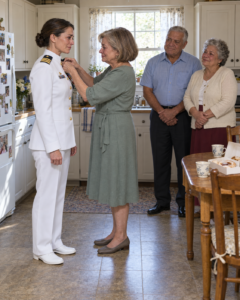
‘Just Send Pictures,’ Mom Said of My Promotion—Then Her Admiral Boss Called Her From My Ceremony
Phân cảnh 1: Twenty-Two Steps to the Stairs
The hall held 300 people, and every one of them was standing when the side door opened. I walked in wearing service dress white. The coat was pressed so stiff that it creaked at the elbows.
My old shoulder boards were still on. The new ones were in a small blue box on a table at the front of the stage, next to a flag and a glass of water nobody would drink.
The aisle was 22 steps long. I had counted it the night before during the rehearsal because counting is what I do when I am nervous. 22 steps from the side door to the stairs.
The front row on the left was reserved for family. The protocol office had printed four white placards and set them on four folding chairs. I had typed the names myself: Diane Coburn, Kelsey Ser, Jeff Ser, and a fourth name that nobody in my family knew I had typed.
I passed the first chair. Empty. I passed the second. Empty. The third was empty, too. The placard on it said Jeff Ser, and it leaned a little to one side, as if someone had bumped it while setting up, and nobody had come to straighten it.
I did not slow down. I kept my eyes on the stairs, but the fourth chair was right beside the steps, and I could not help seeing it.
It was not empty. An old man sat there in a dark gray suit, very straight, his hands folded on a printed program. He was 74 years old. His hair had gone completely white since the last time I had seen him in person.
On the lapel of his suit was a small silver pin that most people in the room would not recognize, and every sailor in the room would. He looked up at me and nodded once.
The program on his knee was open to the page with my biography. My name was circled in blue ink. He had circled it twice.
I climbed the stairs. I took my place beside the flag. I faced 300 people, and I did not look at the empty chairs again.
That man had worked beside my mother every weekday for 21 years. He had signed her paychecks. He had sent flowers when my father died.
His photograph was the only military picture on my mother’s refrigerator in Somerville, South Carolina. She showed it to every guest who came into her kitchen.
And before the reception was over, he was going to take out his phone and call her. He was going to call her three times in 5 minutes, standing in the front row of my ceremony while she sat at a birthday brunch 6 hours away.
My mother was about to learn in one phone call what she had refused to hear for 12 years.
But let me back up a little. Anders the dozen men in from the sand.
4 days earlier, on a Tuesday, I called my mother on my lunch break. I sat in my car in the parking lot of the Surface Force Atlantic headquarters building on Naval Station Norfolk. It was 11:50 in the morning.
I knew she would be at her desk because my mother has eaten lunch at her desk at 11:30 every day since 2004. She answered on the second ring.
“Ashley River Marine Systems, Admiral Eller’s office.”
“Mom, it’s me.”
“Oh, Natalie.”
Her voice changed.
Phân cảnh 2: A Keyboard Clicking Mid-Sentence
It always did. It went from the warm office voice to something flatter.
“Is something wrong?”
“Nothing’s wrong. I have news.”
“I only have a minute. He’s got a board call at noon.”
“I was selected for promotion. The ceremony is this Saturday here in Norfolk. 10:00. I’d like you to come. I’d like all of you to come.”
There was a pause. I heard her keyboard. She was still typing while I talked.
“Saturday,” she said. “This Saturday?”
“Yes.”
“Natalie, Saturday is Kelsey’s birthday.”
“I know. I’m sorry. The date was set by the Admiral’s staff. I didn’t pick it.”
“We have the brunch at the harbor. I booked it in June. 22 people.”
The keyboard stopped.
“It’s 6 hours each way, honey.”
“I know how far it is.”
“6 hours for a ribbon. Just FaceTime us. It’s Kelsey’s birthday, Nat. 38 only happens once.”
“So does this.”
I regretted it as soon as I said it. My mother made a small sound, the sound she made when I was 12 and had talked back.
“Don’t do that,” she said. “Don’t make it a competition. You always make it a competition.”
“I’m not making it anything, Mom. I’m inviting you.”
“And I’m telling you we can’t. I’ll put it on the calendar. You can send us the video.”
I heard a man’s voice in the background, deep and calm. She covered the phone and said, “Yes, sir. Coming.” And then she came back to me.
“I have to go. He needs the board packet.”
“Okay.”
“Congratulations, honey. Really.”
She hung up before I could answer. I sat in the car for a long time. The air conditioning ticked. A group of sailors in blue working uniforms crossed the lot, laughing about something.
An hour later, my phone buzzed. A text from my mother: “just send pictures.” That was all. Three words and a period.
I want to explain something about my family because otherwise none of this makes sense. My father, Frank Coburn, was a high school chemistry teacher who loved the Navy more than anything in the world except my mother.
He never served. His eyes kept him out in 1976, and he carried that like a stone in his pocket for the rest of his life.
When I got into the Naval Academy in 2000, he cried in the driveway. When I was commissioned in May 2004, he wore a tie with little anchors on it that he had bought for the occasion and never wore again.
My mother came to that ceremony, too. She took pictures. She told me I looked tall.
My father died of a heart attack in February 2011. He was 54. He died on a Sunday afternoon in his reading chair with a book about the battle of Midway open on his chest.
After that, something in my mother closed. I don’t blame her for grieving. I blame nobody for grieving. [snorts] But the grief took a shape in our family, and the shape was this: Kelsey stayed.
Kelsey lived 15 minutes away. Kelsey came to Sunday dinner. Kelsey sold houses in Somerville and knew everybody at church. Kelsey was the daughter who showed up, and I was the daughter who left.
Somewhere in those first years, my mother started telling people that I counted boats in an office in Norfick. I heard her say it at my cousin’s wedding. I heard her say it at my father’s memorial on the one-year anniversary. I heard her say it at Thanksgiving to Kelsey’s new in-laws.
And Kelsey laughed and said, “She’s basically a secretary with a sword.”
I didn’t correct them. I had stopped arguing with my mother the year my father died. Arguing with her felt like arguing with the empty reading chair.
The refrigerator in my mother’s kitchen tells the whole story if you know how to read it. There are photographs of Kelsey’s wedding. Kelsey’s house. Kelsey’s dog.
There is a photograph of my mother at a company Christmas party in 2016, standing beside a tall white-haired man in a navy blazer. She has her hand on his arm. She is smiling in a way I have not seen her smile at me since I was a child.
Underneath it, in her handwriting on a strip of tape, it says “the admiral.”
She has worked for him since 2004. Retired Vice Admiral Graham Ellery. 34 years in the Navy. Three stars, a destroyer captain in his day, and later a fleet commander.
After he retired, he became the chief executive of a marine engineering company in North Charleston. And my mother became his executive assistant. And in 21 years, she has never once been late.
She is proud of him the way my father was proud of the Navy: completely, without reservation.
And there is one thing about the admiral that my mother does not know. He knows me. He has known me since 2013. He knows exactly what I did with my career, and he knows exactly what happened in the spring of that year.
And for 12 years, he has kept a promise I asked him to keep.
The last time I saw it happen was Thanksgiving, 10 months before the ceremony.
Phân cảnh 3: A Gold Balloon Shaped Like a Number
Kelsey hosted that year. She had a new house in a development called Carolina Oaks, with a kitchen island the size of a small boat and a wine refrigerator she showed to everyone who walked in.
Jeff’s parents drove down from Colia. His father was a retired insurance executive with a golf tan. His mother wore pearls to carve a turkey.
I got there at 2:00. I wore a long-sleeved sweater the way I always do at family events. It was 74° outside.
We were eating pie when Jeff’s father turned to me.
“Diane tells us you’re in the Navy.”
“Yes, sir.”
“What do you do up there?”
Before I could answer, my mother laughed and touched his arm.
“Oh, Natalie counts boats in an office in Norfolk. Don’t get her started, Hal. She’ll tell you about paperwork for an hour.”
Kelsey was pouring coffee.
“She’s basically a secretary with a sword,” she said.
And everybody laughed, including Jeff’s mother, who laughed with her hand over her pearls. Jeff didn’t laugh. I noticed that. He looked at his plate.
“That’s not quite it,” I said. “I’m on a staff that manages the readiness of the surface ships on the east coast, the destroyers and cruisers.”
“Readiness?” Jeff’s father repeated, nodding, the way people nod at a word they have decided not to understand. “So logistics?”
“Some of it.”
“Well, somebody has to do it,” he said kindly, and turned back to his pie.
My mother squeezed his arm.
“Now my boss,” she said, “my boss commanded a whole fleet. Three stars. You should hear the stories he tells. He gives this speech about a fire on a ship, a lieutenant who went down into an engine room. And I swear to you, every time I type it up, I get goosebumps.”
“Every time you type it?” Kelsey said. “How many times has he given that thing, Mom?”
“Oh, dozens, maybe 40. He changes a word here and there, and I print it fresh.”
I put my fork down very carefully.
“That sounds like a good speech,” I said.
“It’s a wonderful speech,” my mother said. “That’s what real service looks like.”
I excused myself and went out to Kelsey’s back porch and stood there in the warm November air for 11 minutes. I know it was 11 because I timed it. I have always timed things.
When I came back in, they had moved on to football, and nobody asked where I had been.
That night, driving back to Norfolk, I almost called the admiral. I almost said, “Sir, please, just this once, tell her.”
I had his number. I had had it for 11 years. I didn’t call.
I had made the promise to myself, not just to him. I wanted my mother to be proud of me without being told to be. I wanted her to ask.
I thought, one day she will ask what I actually do, and I will tell her, and she will hear it from me. In 11 years, she never asked.
That Tuesday night, I took a heavy cream envelope out of my desk drawer. Inside was the fourth invitation. I had printed it on the good paper.
On the envelope, I wrote his home address on Wapoo Creek in Charleston. Not the office. Never the office. My mother opens the office mail.
I wrote a short note and folded it inside.
“Sir, I would be honored if you would administer the oath. I have seated you beside my mother. I hope that is all right. Natalie.”
I drove to the blue mailbox on Collie Avenue at 10:00 at night and held the envelope over the slot for a long time. Then I let it go.
In the bestication or process, long meditation read.
Saturday, September 13th, 2025. I woke at 4:50, 10 minutes before my alarm, the way I have woken for 21 years. I made coffee. I ironed the white coat a second time, even though it didn’t need it.
I set the old shoulder boards on the kitchen table, the three gold stripes with the star on the black background, and I looked at them for a while. I had worn those boards for 6 years. I had worn the ones before them for five.
Every set of them had a story, and my mother knew none of the stories.
At 7:15, I tried her on FaceTime. It rang 11 times. Nobody answered.
At 7:40, I tried again. The call rang out. A minute later, a text came through: “Getting ready for brunch. Crazy morning. Send pics later!!”
Two exclamation points. I remember that detail because my mother never uses exclamation points. She says they are for teenagers.
She used two that morning, and I understood that she was happy and that her happiness that day had nothing to do with me.
At 8:00, while I was pinning my ribbons to the coat, my phone rang. It was Jeff.
Jeff Ser is 40 years old. He is an electrical contractor. He married my sister in June of 2013 and has spent 12 years trying to be decent in a family that does not always make room for decency.
We have never been close. He had never called me before in his life.
“Natalie. Hey, it’s Jeff.”
“Jeff, is everyone okay?”
“Everyone’s fine. They’re doing hair.”
He lowered his voice. I could hear a blow dryer somewhere behind him.
“Listen, I just wanted to say congratulations.”
Phân cảnh 4: Four Lines on the Back Page
“I looked it up, what the promotion is. That’s a big deal.”
“Thank you.”
“I told Kelsey maybe we could drive up after brunch, get there by the reception, maybe. She said that was crazy.”
He paused.
“She said it’s her day.”
“It is her day, Jeff. It’s okay.”
“It’s not okay.” He said it quietly. “I’m sorry. I should have pushed harder. I just wanted you to know somebody in this family knows what today is.”
I stood in my kitchen with a ribbon rack in my hand, and I did not trust my voice for a second.
“Thank you, Jeff,” I said. “That means more than you know.”
“Send me a picture, okay? Just me. I’ll show her later when she’s in a better mood.”
After we hung up, I finished with the ribbons. The Navy and Marine Corps metal ribbon sits near the top of the rack. It is navy blue, gold, and scarlet. Most people have never seen one.
I straightened it with my thumbnail, and then I rolled down the sleeve of my undershirt over my right forearm the way I do every morning out of habit, even on days when the coat will cover everything anyway.
The scar runs from my wrist to just below my elbow. It is shiny and pale, and it pulls a little when I make a fist.
My mother has never seen it. Not once in 12 years. I have worn long sleeves to two Christmases a year, to Kelsey’s wedding, to my father’s memorials, to every Fourth of July. She never asked why I was always cold.
I drove to the base at 8:30. The protocol officer met me at the side entrance of the hall. Her name was Lieutenant Priya Nandakumar, and she was 27, and she had organized something like 40 ceremonies in the past year, and she carried a clipboard like it was a weapon.
“Good morning, ma’am. Everything is set. The official party is confirmed. Rear Admiral Whitfield is on her way. [snorts] Your guests on the reserved list, are they here yet? I can have someone walk them in.”
“No,” I said. “They’re not coming.”
She looked at the clipboard.
“All four, ma’am?”
“Three of them aren’t coming. I don’t know about the fourth.”
She was a good officer. She didn’t ask. She just nodded and wrote something small next to the list.
“Ma’am, do you want me to pull the placards? Sometimes that’s easier.”
I thought about it. I thought about 300 people walking past three empty chairs with my family’s names on them. I thought about what my father would have said.
“Leave them,” I said.
“Yes, ma’am.”
At 9:15, I checked my phone one more time in the green room behind the stage. Kelsey had posted to her Instagram story.
I don’t know why I looked. I think part of me wanted to see my mother’s face.
The first picture was a table by the water in Charleston, a long white tablecloth, 22 place settings, a gold balloon shaped like the number 38. The second picture was my mother and Kelsey with their cheeks pressed together, both holding mimosas.
My mother was wearing the green dress she had bought for Kelsey’s wedding 12 years before. The caption said, “38 and thriving. Brunch with the only daughter who shows up.” Under it, three laughing faces.
I read it twice. Then I turned the phone face down on the table and did not pick it up again until after the ceremony.
I want to be honest: it hurt. It hurt the way a burn hurts after the first shock wears off, when the nerves wake up and start telling you the truth.
But I have learned something about hurt over the years. It doesn’t need to be answered. It just needs to be carried to the end of the day. So I carried it.
At 9:55, Lieutenant Nandakumar opened the side door for me.
“They’re ready for you, ma’am.”
The hall was full. 300 people: sailors from my staff in their dress uniforms, officers I had served with on three ships, a row of chiefs near the back, families of the other officers on the program, a few retirees in blazers with ribbons pinned to their pockets.
The room smelled like floor polish and coffee. Everyone stood when I walked in.
That is just protocol. It is not about the person. I have stood for a hundred people I barely knew.
22 steps. The first placard said Diane Coburn. The chair was empty. The second said Kelsey Ser. The third said Jeff Ser. The placard leaning.
The fourth chair. I had typed the fourth placard myself. It said, in the same plain black letters as the others, “Vice Admiral Graham Ellery, United States Navy, retired.”
He was there. He had driven up from Charleston that morning.
Phân cảnh 5: A Cracked Phone With Large Print
I found out later that he had left his house at 3:30 in the dark, alone, without a driver, and had not told a single person where he was going.
He wore a dark gray suit. He sat perfectly straight. He held the program open on his knee, and when I passed, he looked up and nodded to me once, the way a captain nods to an officer of the deck when the ship is in good hands.
My name on the program was circled in blue ink. He had circled it twice.
I took the stairs. I took my place. I did not look at the empty chairs again.
And clear, dead, I know many model.
A promotion ceremony in the Navy has an order to it, and the order does not change for anybody. First, the colors.
A color guard of four sailors marched down the center aisle with the national enen and the Navy flag, and the room held a salute while a petty officer from the band sang the national anthem without any music at all. She had a clear, high voice that filled the hall right up to the steel beams in the ceiling.
Then, the invocation. The chaplain was a Lutheran commander from the Carolinas with a soft accent. He prayed for the ships at sea and the families at home.
He said, “For those who could not be here today and for those who are here in their place.”
I don’t think he meant anything by it. It was just a line he used. But I felt it land somewhere under my ribs.
Then the reading of the promotion certificate. A senior chief from my staff stepped to the microphone and read it in a loud, flat voice, the way chiefs read everything.
“To all who shall see these presents, greeting, know ye that reposing special trust and confidence in the patriotism, valor, fidelity, and abilities of Natalie Vance, I have nominated, and by and with the advice and consent of the Senate, do appoint her.”
He read the whole thing. It takes about a minute. It is the same words for every officer in the Navy, and it still makes the hair on my arms stand up, even the arm with the scar.
I stood at attention through all of it. And during all of it, I watched the front row without moving my eyes. That is a skill they teach you your first summer at the Naval Academy. You learn to see the whole room while looking at one fixed point on the far wall.
Three empty chairs. One man reading.
Rear Admiral Sharon Whitfield presided. She had been my commander for two years. She is not a warm speaker, and she knows it, and she does not pretend.
She stood at the podium and read my biography the way it was written in the program, without any adjectives.
“Commander Vance graduated from the United States Naval Academy in May 2004 with a degree in mechanical engineering. She has served aboard three destroyers and one cruiser. She served as the engineer officer of USS Caro from 2012 to 2013.
“She has served on the staffs of destroyer squadron 22 and commander naval surface force Atlantic. Her personal awards include the meritorious service medal, the navy and marine corps medal, and the navy and marine corps commenation medal.”
300 people listened politely. Most of them did not know what the Navy and Marine Corps medal is. It is awarded for heroism that does not involve direct combat with an enemy. It is not a medal people talk about. That suits me fine.
On the back page of the program was a short section called acknowledgements. Every officer being promoted writes one. Mine was four lines long.
“To the crew of USS Carol, who taught me what a ship is.
“To Master Chief Raymond Toiver, who taught me what a chief is.
“To my father, Frank Coburn, who taught me to love the Navy before I ever saw it.
“And to my mother, Diane Coburn of Somerville, South Carolina, who taught me to never be late.”
I had written that last line in August when I still thought she might come.
I watched Admiral Ellery turned the page. I watched him read it. His hands stopped.
It was a small thing. Nobody else in the room saw it, but I saw it because I was facing him and because I had spent 21 years learning to notice when a senior officer’s hands stopped moving.
He read the last line. Then he read it again. Then he looked at the empty chair to his right, the one with my mother’s name on it. He looked at it for a long time.
Then he looked up at me. He knew.
In 12 years, he had never connected the two things. He knew the lieutenant from main engine room 2 as Natalie Vance, my married name, the name I kept after my divorce, because it was the name on every set of orders I had ever received.
Phân cảnh 6: A Hose at the Bottom of the Trunk
He knew his assistant, Diane Coburn. He knew, because she had told him many times, that Diane had an older daughter in Norfolk who pushed paper for the Navy.
He had never put those three things on the same table. He put them on the same table now.
Admiral Whitfield turned to him.
“It is Commander Vance’s request that her oath of office be administered by Vice Admiral Graham Ellery, United States Navy, retired. Admiral.”
He stood. He walked up the stairs slowly, one hand on the rail. He stopped beside me, and then, instead of taking his place for the oath, he turned to Admiral Whitfield.
“Admiral, with your permission, I’d like two minutes before the oath.”
It was not on the program. Admiral Whitfield looked at me. I did not know what he was going to say. I nodded anyway.
“2 minutes, sir,” she said.
He stepped to the podium. He didn’t take any notes out of his pocket. He didn’t need them. He put both hands on the sides of the podium and looked out at 300 people.
“I have given a speech about leadership in something like 400 rooms,” he said. “Boardrooms, wardrooms, graduations, the Naval War College. A few of you here have heard it. It’s about an engineering casualty aboard a destroyer in the Arabian Sea on the 9th of March, 2013.”
The hall was very quiet. At the back, a chair creaked.
“At 14 minutes past 2 in the morning, a fuel oil line failed in main engine room 2. Fire. Nine sailors were in that space. The ladder to the upper level was burning.
“The standard procedure, the one we all learned, was to evacuate what you can, seal the space, and flood it with suppressant. The engineer officer was a lieutenant, 30 years old. She had the authority to seal that space.”
He paused.
“She didn’t seal it. She went down the escape trunk with a hose team and a breathing apparatus. And for 14 minutes, she held that fire back with her own body while her sailors came up past her one at a time.
“All nine came out. Nine. She came out last. The report says she went back in once. The report is wrong.”
He looked toward the back of the hall. In the last row, a heavy man in a navy blazer with a gray beard slowly stood up. He was 61. His hands were shaking.
I had not known he was there. I had sent him the invitation, too, and he had never answered it. Master Chief Raymond Toiver.
“She went back in twice,” the admiral said. “The second time was for that man.”
People turned in their seats to look at him. The Master Chief did not sit down.
“I chaired the Navy’s independent review of that fire,” the admiral went on. “I interviewed that lieutenant for 6 hours. At the end of it, she asked me for one thing. She asked me never to use her name when I told the story.
“She said it was nine sailors, not one lieutenant. So, for 12 years, I have told it 400 times, and I have called her the lieutenant in main engine room 2.”
He turned his head and looked at me.
“I have never once said her name because she asked me not to. Today I’m going to disobey a lieutenant.”
Somebody in the chief’s row laughed quietly. It was a warm sound.
“Nine sailors. 14 minutes. Lieutenant Natalie Vance.”
He stepped back from the podium. For a moment, nobody moved. Then the chiefs in the back row stood. Then my staff stood.
Then everyone was standing, and I stood there in my white coat with my hands at my sides, and I did not know where to look. So I looked at the one thing in the room I could not stand to look at.
Three empty chairs.
The admiral saw where I was looking. He did not follow my eyes. He just stepped beside me, raised his right hand, and waited until I raised mine.
“Repeat after me,” he said.
His voice was completely steady.
“I, Natalie Vance, do solemnly swear.”
“I, Natalie Vance, do solemnly swear.”
I said the whole oath. I have said it five times in my life. I have never said it more slowly.
The rest happened the way it always happens. Admiral Whitfield read the order. A senior chief handed the admiral the small blue box.
He took out the new shoulder boards, four gold stripes on black, and he stood there holding them for a moment while the photographer crouched in the aisle.
Normally, a family member pins them on. A mother, a husband, a child. That is the tradition. The protocol office had written it into the script weeks before with my mother’s name in the blank.
The admiral looked at the empty chair one more time. Then he unbuttoned the old board on my left shoulder himself, with his own old fingers, slowly, the way you would handle something that might break.
Admiral Whitfield did the right side. They buttoned the new ones on at the same time.
“Captain Vance,” Admiral Whitfield said. “Congratulations.”
The room applauded. I shook hands. I said the things you say.
I thanked my staff and my old shipmates, and I thanked the crew of KO, and I thanked Master Chief Toiver by name, and he stood in the back row with his big arms crossed and his chin up and tears running down into his beard.
Phân cảnh 7: A Manila Folder on the Porch Steps
I did not mention my family. There was nothing to say that would not have sounded like an accusation, and I have never believed that a promotion ceremony is the place for one.
He can set it into the ground to use a setter. I imagine to the right.
The reception was in the lobby outside the hall. Sheetcake, coffee, and steel urns, punch in a glass bowl that nobody touched.
There is always a line to shake hands with the person being promoted. I stood at the head of it for 35 minutes.
The admiral did not get in the line. He stood off to the side near a window with a paper cup of coffee he never drank, and he watched me, and he waited.
When the line finally thinned, he walked over. Up close, he looked older than he had on stage. The skin around his eyes had gone soft and creased.
“Captain,” he said.
“Sir, thank you for coming. Thank you for all of that. You didn’t have to.”
“I had to.”
He held up the program. It was folded open to the back page, to the acknowledgements. He put one finger under the last line.
“Diane Coburn of Somerville.”
“Yes, sir.”
“My Diane.”
“Yes, sir.”
He looked at me for a long time without saying anything. Then he said very quietly, “21 years that woman has sat outside my door. 21 years. She knows how I take my coffee. She knows my grandchildren’s birthdays.
“She typed that speech. You understand me? She typed it. Every draft.”
“I know, sir.”
“You knew.”
It was not a question.
“You’ve known since the review.”
“Since the second day of the review, sir. I saw her name on the cover letter, prepared by D. Coburn, and I remembered the photograph on her refrigerator.”
“And you said nothing to her or to me.”
“No, sir.”
“Why?”
I had rehearsed this answer for 12 years, in my car, in the shower, on the bridge wing of three ships at night. It came out simpler than I had ever rehearsed it.
“Because I wanted her to be proud of me because I was hers, sir, not because you were.”
He closed his eyes for a second. When he opened them, he took his phone out of the inside pocket of his suit coat. It was an old phone with a cracked corner and the font set very large.
“Sir,” I said. “You don’t need to do that.”
“Captain, with respect, you have given me my last order today. I disobeyed the first one already.”
He pressed a name at the top of his favorites. I saw it on the screen: Diane, Office Cell.
It rang. We both heard it ring through the little speaker. Four times. Five. Six. Then her voicemail, her office voice.
“You’ve reached Diane Coburn, executive assistant to Vice Admiral Graham Ellery. I’ll return your call as soon as possible.”
He hung up without leaving a message. He looked at his watch. He dialed again. It rang out.
Around us, the reception was still going. A lieutenant from my staff was cutting the sheetcake. Someone’s toddler was running in circles around the punch bowl.
Master Chief Toiver had made his way to the front of the lobby and was standing a few feet away, very still, listening.
The admiral dialed a third time. His jaw was tight. Six rings. Voicemail.
“It’s Saturday,” I said. “She’s at a brunch. It’s loud. She probably can’t hear it.”
“She can hear it,” he said. “Diane has answered my calls at 3:00 in the morning. She answered my calls the week her husband died. She answered when she had the flu.
“She is looking at that phone right now and deciding that whatever I want on a Saturday can wait until Monday.”
He was right. I found out later exactly how right he was.
At the brunch in Charleston, at a long table by the harbor, my mother’s phone lay face down beside her plate. It buzzed at 11:42. It buzzed at 11:44. It buzzed at 11:46.
Kelsey reached over and turned it over and read the name out loud to the whole table.
“Oh my god, Mom, it’s the Admiral on a Saturday. Tell him you’re off the clock.”
Everyone laughed. My mother laughed too.
She said, “Three times, though. That’s not like him.”
She said, “He’s probably lost his reading glasses again.”
She turned the phone back over. Three missed calls in 5 minutes.
The fourth time, he didn’t use the office cell. He called her personal number.
Phân cảnh 8: Tea at Midnight in a Brick House
The one I did not know he had. The one she had given him the week my father died in 2011 and told him to use only for emergencies.
She picked up on the first ring. I could hear the brunch through the phone. Glasses. A woman laughing. Music. Something from the8s. Too loud.
“Admiral. Is everything all right? Are you all right?”
“Diane, it’s Graham.”
He didn’t put her on speaker. He didn’t have to. He kept his voice low and even, and I heard every word.
“Where are you?”
“I’m at Kelsey’s birthday at the harbor. Sir, what’s wrong? Did something happen at the office?”
“Nothing happened at the office.”
“Then what is it? You scared me half to death. Three calls.”
He looked at me. He looked at the new shoulder boards. He looked at the program in his other hand.
“Diane,” he said. “I am standing next to your daughter.”
There was nothing on the line for a moment but the8s song.
“Kelsey’s right here, sir,” my mother said slowly. “She’s sitting next to me.”
“Your other daughter?”
Another silence. The music on her end seemed to get quieter and then quieter again, and I understood that she was walking away from the table, through a door, out onto some deck or sidewalk by the water.
“Natalie,” she said.
Her voice had gone thin.
“Why is Natalie with you? Where are you?”
“I’m in Norfick, Diane, at her promotion. I’ve been here since 10.”
“You’re—”
She stopped.
“Sir, I don’t understand. How do you even know Natalie?”
The admiral closed his eyes again. When he spoke, it was gentle. It was the gentlest thing I ever heard a flag officer say.
“Diane, do you remember the speech? The lieutenant in main engine room, too.”
“Of course, I remember it. I typed it.”
She stopped. She did not finish.
“Diane,” he said. “It’s her.”
I heard my mother make a sound I had never heard her make. It was not crying. It was smaller than crying. It was the sound of somebody who has missed the last step on a staircase in the dark.
The admiral held the phone out to me. I took it. I held it to my ear.
I could hear her breathing, fast and shallow. I could hear seagulls behind her and traffic. And somewhere far off, my sister calling, “Mom, Mom, the cake is coming out.”
“Hi, Mom,” I said.
That was all I said. I didn’t say anything else. I didn’t need to. 12 years of words were sitting in my chest, and not one of them needed to come out right then.
“Natalie,” she whispered. “Natalie, why didn’t you tell me?”
I thought about the Tuesday phone call. The keyboard clicking while I talked. The text: “Just send pictures.”
“You didn’t ask, Mom,” I said. “I’ll send pictures.”
And I handed the phone back to the admiral, and I walked across the lobby to Master Chief Toiver, and I let him hug me, which in 21 years of service I had never once let a master chief do.
Each make atmath.
By 1:30, the lobby was empty. The caterers had taken the urns. Lieutenant Nandakumar had collected the placards from the front row and stacked them on the edge of the stage, face up, with my mother’s name on top.
She didn’t say anything about it. She just left them there for me.
The admiral and the master chief and I sat in the front row of the empty hall. The admiral sat in my mother’s chair. I don’t think he noticed.
“Tell me the part I don’t know,” he said. “To you said the report was wrong.”
The master chief rubbed his big hands together. He was a machinist’s mate by trade. He had spent 30 years in engine rooms. He retired in 2018 and now ran a small engine repair shop outside Virginia Beach.
He was not a man who told stories.
“The report says she went back in once, sir,” he said.
Phân cảnh 9: A Placard Left on an Empty Chair
“That’s because nobody else was alive down there to see the second time except me, and I was unconscious when I got interviewed the first time. And by the time I could talk, the report was signed.”
“Go on.”
“9th of March. Oh, 214. I was the top watch in Maine, too. The fuel line let go over the number two main engine, and it just—”
He opened his hands.
“It just lit like somebody opened a door to the sun. The upper ladder was gone in about 40 seconds. We had nine people on the lower level. We had one way out, the escape trunk, and the escape trunk was right under the fire.”
I sat very still. I have heard this story many times in my own head. I had never heard it in someone else’s voice.
“The procedure says if the space is lost, you seal it and you flood it,” the master chief went on. “We all knew that. The officer of the deck on the bridge was already asking for permission.
“And the chief engineer comes down the escape trunk with a hose team behind her and a breathing mask on, and she keeps that fire off the trunk with a hose for 14 minutes. 14 minutes, sir. Sending people up past her. 1, 2, 3, counting out loud. I could hear her counting.”
“Eight,” I said quietly. “I counted eight.”
“Eight,” he agreed, “because the ninth was me, and I was on the deck behind the number two engine with a broken ankle and a lung full of smoke.
“Everybody was out. She could have come up. The hose team was yelling for her, and she handed the nozzle to a secondass, and she went back into the dark, and she found me by my boots. Dragged me 40 feet, 220 pounds of me. That’s how she got the arm.”
The admiral looked at my right sleeve.
“The report says one entry,” he said.
“The report was written by people who weren’t there, sir, begging your pardon. Including you.”
“Including me,” the admiral said. “Yes.”
I remember what the burn center in San Antonio smelled like: antiseptic and something sweet. I was there five weeks. My husband then, Daniel, flew out and stayed the whole time.
He was the one the Navy called because he was my next of kin. He was the one who called my mother.
She did not come. I don’t say that to make her a villain. Kelsey’s wedding was in June, and my mother was in the middle of it. Caterers, flowers, a dress fitting.
When I finally called her myself, three weeks in, when I could hold a phone again, I told her there had been a fire aboard the ship, and I had been hurt, but I was going to be fine.
She was quiet for a moment. Then she said, “Well, honey, you chose boats.”
Then she asked if I would still be able to be in the wedding because the bridesmaid’s dresses were sleeveless.
I was in the wedding. I wore a long-sleeved wrap over the dress. It was 91° in Charleston. Kelsey told me I looked like a nun.
In October of that year, the Navy convened an independent review of the Carol Fire. The chief of naval operations asked a retired three-star to chair it because a retired officer has no career left to protect.
I was called to testify on the second day. I walked into a conference room in Norfolk and sat across a long table from Vice Admiral Graham Ellery.
The cover of the binder in front of him said at the bottom in small type, “prepared by D. Coburn.” I knew the handwriting on the sticky notes inside it. I had known that handwriting my whole life. I had watched it write my name on my lunch bags.
I testified for 6 hours. At the end of it, when the recorder was off, the admiral said, “Lieutenant, I want to use this. Not the report. I mean, I want to tell people what you did. Young officers need to hear it.”
And I said, “Sir, please don’t use my name. It was nine sailors, not one lieutenant.”
He looked at me for a long moment and said, “All right. You have my word.”
I never told him why I was really asking.
Now, 12 years later, in an empty hall, he took off his glasses and rubbed his eyes with his thumb and forefinger.
“I’ve been standing next to her mother for 21 years,” he said.
“I know, sir.”
“She cried the first time she typed it. Did you know that? She came into my office with the draft, and she was crying, and she said, ‘Sir, I hope that young woman’s family knows what they have.’”
I did not know that. I had not known that. I looked down at my hands.
“Captain,” the Master Chief said very gently, “your phone.”
It was buzzing on the chair beside me. I turned it over. Seven missed calls from my mother. Four texts from Kelsey, one from Jeff.
I read Jeff’s first. It said, “She just left. Walked out in the middle of the cake. Took her keys. I think she’s driving to you.”
The first of the video. Daughter.
Kelsey’s texts came in order, and I read them in order.
“Where are you?”
“Mom just walked out of my birthday. On my birthday.”
“Natalie, seriously, you planned this. You always have to make it about you every single time.”
“Congratulations, you win.”
I read them standing in the parking lot beside my car in my white uniform, with the new shoulder boards catching the afternoon light. I read them twice. I did not answer them.
There was nothing I could write that she would read the way I meant it.
I did answer Jeff.
“Thank you for telling me. Please make sure she stops for gas and coffee. She won’t want to.”
He wrote back one word: “Already did.”
The admiral and the Master Chief walked me to my car. The admiral had a 6-hour drive home ahead of him, and he refused to let anyone drive him. The Master Chief offered twice.
The Admiral said, “Raymond, I commanded a fleet. I can command a Buick.”
Before he got in, he turned to me.
“She’s going to come to your door tonight,” he said. “Whatever she says, Captain, listen to it all the way to the end before you answer. She’s a woman who has never once in 21 years finished a sentence she was ashamed of. Let her finish this one.”
“Yes, sir.”
“And Natalie.”
It was the first time in 12 years he had used my first name.
“Your father would have worn the tie.”
I didn’t ask how he knew about the tie. I think my mother must have told him. Sometime in the last 21 years, in some quiet moment outside his door, I think she told him more about me than she ever told me.
I went home. I live in a small brick house in the Gent neighborhood of Norfolk, with a porch that faces west and a crepe myrtle that drops pink petals on the steps from July through September.
I hung the white coat on the back of the bedroom door. I put on jeans and a t-shirt. For the first time in 12 years, I put on a short-sleeved shirt with no plan to cover it. Then I sat on the porch and waited.
My mother called 11 more times that afternoon. I didn’t answer. That was not cruelty.
I knew that if I answered, she would start explaining over the phone while driving on Interstate 95, and she would say the wrong things in the wrong order, and we would both hang up worse than before.
The admiral was right. Some sentences need to be finished face to face.
At 9:40 that night, headlights turned onto my street. Her car is a silver sedan she has driven for 9 years. It came down the block very slowly, the way you drive when you are reading house numbers in the dark.
It stopped at the curb. The engine turned off. For almost 2 minutes, nobody got out. Then the door opened, and my mother stepped out onto the sidewalk.
She was still wearing the green dress from Kelsey’s brunch. It was wrinkled from 6 hours in the driver’s seat. Her hair had come loose on one side.
She was holding her purse in one hand and a thick manila folder in the other, pressed against her chest, the way a school girl holds books.
She stopped at the bottom of the porch steps and looked up at me. She looked at my face. Then her eyes went down to my right arm, bare in the porch light, and stayed there.
“Hi, Mom,” I said.
“Natalie.”
Her voice cracked on the second syllable. She didn’t come up the steps.
“Natalie, I went to the office.”
“What?”
“Before I got on the highway, I drove to the office. I have a key.”
She held up the folder.
“I needed to see it. I needed to see if I was remembering it right.”
She came up two steps and held the folder out to me with both hands. I took it. It was heavy.
Inside were printed pages, dozens of them. Each one was a version of the same speech. The title at the top of each first page was the same: “The lieutenant in main engine room 2. Remarks by Vice Admiral Graham Ellery, United States Navy. Retired.”
And then a date and a place. The Naval Academy. November 2013. A shipyard in Mississippi. A college in Ohio. The Naval War College. A Rotary Club in Mount Pleasant. A graduation. A graduation. A graduation.
“41,” my mother said. “I counted them in the parking lot. I keep a copy of every speech he gives. I have a whole drawer. 41 times I typed that speech. I fixed his commas. He always puts the commas in the wrong place.”
She was crying now, not loudly. Her face was just wet.
“The first time I typed it, I cried at the part about the ladder,” she said. “I cried about a stranger. I went into his office, and I told him, ‘I hope that young woman’s family knows what they have.’”
“He told me,” I said.
“I cried about a stranger, Natalie, and the whole time it was you.”
I turned the pages. On one of them, in the margin in my mother’s handwriting, was a small pencled note next to the paragraph about the second trip down the trunk. It said, “Brave girl.”
I closed the folder.
“You didn’t have to know it was me to be proud of me, Mom,” I said. “That was the whole thing. That’s all I ever wanted: for you to ask.”
She tried to say something and couldn’t. Her knees seemed to give a little, and she sat down on the top step of my porch, right there in her green dress, with her purse in her lap.
She sat down because her legs would not hold her anymore. I sat down beside her.
We sat there for a long time. The crepe myrtle dropped a pedal onto the folder. A car went by with its windows down, playing something with a lot of bass.
“Can I see it?” she finally asked.
She was looking at my arm. I held it out to her in the porch light, palm up.
She did not touch it at first. She just looked at it, the whole length of it from the wrist to the elbow, the way you would read a page you were afraid of.
Then she put two fingers on it very lightly, the way she used to check my forehead for a fever when I was small.
“Does it hurt?”
“Not anymore. It pulls when I make a fist.”
“All those long sleeves,” she said. “Every Christmas. Kelsey’s wedding. I thought you were just always cold.”
“I know.”
“I never asked.”
“I know, Mom.”
We’re where Setter and Allent family fine.
We went inside a little after 10:30. I made tea. My mother sat at my kitchen table and looked around at my kitchen as if she had never seen it before, and I realized she hadn’t.
She had never been to this house. I bought it in 2020. I had invited her to Thanksgiving here twice. Both years she went to Kelsey’s.
At midnight, over the second cup of tea, she started talking, and I did what the admiral told me. I let her finish.
“When your father died,” she said, “I thought I was going to die, too. You know that. You were there for the funeral, and then you went back to your ship, and Kelsey stayed.
“Kelsey came over every day. She brought me soup. She slept on the couch for a month.”
“I know. I’m glad she did.”
“And you were so far away. And your father—”
She stopped and pressed her lips together.
“Your father loved you so much, Natalie. The Navy, the academy. He used to talk about you at dinner like you were a ship he’d built.
“I’m not proud of this. I was jealous of my own daughter. He had this whole world with you that I was never part of. And then he was gone, and you were still in it, and I wasn’t.”
I didn’t say anything. I put my hand around my mug and held it.
“So, I made it small,” she said. “Do you understand? I made your world small. Counting boats. Paperwork. If what you did was paperwork, then he didn’t love something I couldn’t understand.
“And then when you got hurt, when Daniel called me and said burn center, I was in the middle of the wedding, and I didn’t go.”
Her voice broke badly on the word go.
“I didn’t go, Natalie. My daughter was burned, and I stayed home and picked out napkins. And every year after that, it was easier if you were small. Because if you were small, then I didn’t miss anything that mattered.”
The kitchen was very quiet. The refrigerator hummed.
“That’s the truth,” she said. “That’s the whole ugly truth. I’ve been telling people you count boats for 12 years so I wouldn’t have to know what I missed.”
I waited the way the admiral said. I waited to make sure she was finished. She was finished.
“Mom,” I said, “this was never about the ribbon. I don’t care about the ceremony. I’ve been promoted five times. I’ll probably never be promoted again. It was never about the boards on my shoulders.”
I turned my right arm over on the table between us.
“It was about being erased by the person I most wanted to see me.”
“I know.”
“Kelsey called me a secretary with a sword at Thanksgiving in front of people, and you laughed.”
“I know. I know I did.”
“And on Tuesday, when I called to tell you, you were typing while I talked.”
She closed her eyes.
“I was typing his board packet,” she said. “I was typing his board packet while my daughter told me she’d been made a captain in the United States Navy, and I told her to send pictures.”
We sat there. It was nearly 1:00 in the morning.
“What happens now?” she asked. “At the office Monday. What do I say to him?”
“I don’t know, Mom. I think you tell him the truth. He’s good at hearing it.”
She drove home on Sunday afternoon. She called me on Monday at 11:30 from her desk on her lunch break.
“He called me into his office at 9:00,” she said.
Her voice was steady, but I could hear that she had been crying earlier.
“He closed the door. He’s never closed the door with me in 21 years. I thought he was going to fire me. I had a box in my car. I brought a box, Natalie.”
“What did he say?”
“He said, ‘Diane, sit down.’ And I sat. And he said, ‘I’m not going to fire you. You’re the best assistant I ever had, and I’ve had 11, and three of them were lieutenant commanders.’ And then he said—”
She laughed a little wetly.
“He said, ‘You don’t owe me an apology. You owe her a trip.’ And he said I’m to take Friday off. And every Friday she asks for, for as long as I work for him.”
“Mom,” I said, “what about Kelsey?”
She was quiet for a long moment. I heard the office door close on her end.
“She won’t talk to me,” she said. “She says I ruined her birthday. She says I chose you.”
“You didn’t choose me. You just came.”
“I know. I told her that. She said, ‘You never drove 6 hours for me.’ And I said, ‘Kelsey, honey, you live 15 minutes away.’”
My mother made a sound that was half a laugh and half something else.
“That did not help.”
“No, I don’t imagine it did.”
“She thinks you set it up. The admiral, the seat. She thinks you did it to shame me.”
I looked at the placards Lieutenant Nandakumar had left on the stage for me. I had brought them home. They were on my desk, the four of them, in a neat stack.
“I did put him beside you, Mom,” I said. “That part’s true. I thought if you were sitting next to him when he heard my name, you’d finally see it. I didn’t think you’d leave the chair empty.”
“Neither did I,” she said quietly. “Until I did.”
“Tell Kelsey the truth then. All of it. Tell her I wanted you there. Not him. You.”
“I’ll try. She said she’s not ready to hear it.”
“Then tell her when she is.”
Gail Fenwick, the office manager, had seen my mother come out of his office. My mother told me that, too. Gail hugged her in the copy room and said, “Honey, I always wondered why that speech made you cry so hard.”
And and and and and and. And end. And end and end.
She came back 3 weeks later, on Sunday, October 5th. She drove up on the Friday, the first of the Fridays the admiral had given her, and she stayed at a hotel near the base because she said she did not want to be a burden.
On Sunday morning, she came to my house with a box of pastries from a bakery in Charleston that she had carried in her lap for 6 hours so they wouldn’t get crushed.
Master Chief Toiver came, too. So did his wife, Bernardet, a retired Navy nurse with a laugh you could hear from the end of the block.
I had asked them to be there. I wanted someone in the room who had been in main engine room, too. And I wanted someone in the room who could keep my mother talking if the silence got too long.
We did it in my kitchen. There was no hall, no program, no 300 people, just the four of us and the pastries and the September light that was already turning into October light through the window over the sink.
I put the white coat on. My mother had asked me to. She said, “I want to see it the way I should have seen it.”
The new shoulder boards were already on, but I took the left one off and handed it to her.
“There’s a tradition,” I said. “A family member pins them on. The admiral did it for you. I think he’d want you to have a turn.”
She held the board in both hands. She looked at the four gold stripes. She ran her thumb over them.
“Your father would have worn the tie,” she said.
“That’s what the admiral said.”
She looked up, surprised. Then she smiled. A small, sad smile.
“I told him about that tie years ago at a Christmas party. I told him about my husband and his anchor tie. I must have told him about you then, too.”
She shook her head.
“I must have told him about you a hundred times, Natalie. I just never told him anything true.”
She buttoned the board onto my left shoulder. Her fingers were not steady. It took her three tries.
The Master Chief did not help her, and he did not look away. And when she finally got it, he said very softly, “Well done, ma’am.”
Then she stepped back and looked at me, and she started to cry again. And this time, she didn’t stop to wipe her face.
“I’m sorry,” she said. “I’m going to say it right, the way I practiced it in the car. I’m sorry I told people you counted boats. You didn’t count them. You were bringing them home.
“I’m sorry I didn’t come to San Antonio. I’m sorry I made you wear long sleeves in July. I’m sorry I typed that speech 41 times and never once asked my own daughter what she did for a living.
“And I’m sorry about Tuesday. I’m sorry I was typing.”
It was specific. That was what mattered. It was not a general sorry, the kind you say to make a moment end. It was a list, and every item on it was something I had carried. And she named everyone.
“I accept it, Mom,” I said. “I do. But I need to tell you something, and I need you to hear it all the way through.”
“All right.”
“You don’t get to tell my story anymore. Not to Kelsey’s in-laws. Not at church. Not to anyone. You get to hear it. If someone asks what I do, you can say, ‘Ask her.’ And then you can listen to what I say. That’s the deal.”
She nodded. She nodded several times.
“Ask her,” she repeated. “I can do that.”
Bernardet Toiver put a hand on my mother’s back and said, “Diane, I have been married to a chief for 36 years. Asking is the whole job. Come sit down and have a pastry and ask me anything.”
My mother laughed through her tears and sat down and asked Bernardet about the nursing school she went to. And the Master Chief winked at me over her head.
I want to be honest about what this cost because I think stories like mine are sometimes told as if everything gets fixed at the end. Not everything got fixed.
Kelsey did not come to my kitchen that day. She did not come the next month or at Thanksgiving, which my mother spent with me in Norfolk for the first time.
Kelsey told my mother that I had humiliated her on her birthday on purpose. She told her that I had invited the admiral to make a point. She said I had taken her mother away from her in front of 22 people in the middle of the cake.
In November, she blocked my number. I wrote her one letter on paper and mailed it to the house in Carolina Oaks.
I told her I was sorry the day had hurt her. I told her I had not planned for it to happen that way, and that was true. I told her that the thing I had wanted most in my life was for our mother to see me, and that I understood better than she might think what it feels like to watch our mother look past you.
She never answered it.
Jeff still texts me now and then. A picture of the dog. A picture of a sunrise over the marsh.
Once in February, a picture of Kelsey from behind, sitting on their back porch, with a message that just said, “She kept your letter. It’s in her nightstand. Give it time.”
So, I am giving it time. But I got my mother back, and I lost my sister, and I will not pretend that the first thing does not cost the second.
Both things are true. I have learned to carry two true things at once. The Navy taught me that. So did the fire.
On the refrigerator in my mother’s kitchen in Somerville, there are two photographs now where there used to be one. The first is still her and the admiral at the Christmas party, with the strip of tape that says “the admiral.”
The second is me in my white coat in my kitchen, with my mother standing beside me holding the left shoulder board. Under it, on a new strip of tape in her handwriting, it says, “Captain Natalie Vance. Ask her.”
And resident of the states.
In June of 2026, I took command of a destroyer squadron in Norfolk. A squadron is a group of ships. Mine is six destroyers. Every one of them has a main engine room, too.
I have walked down into every one of them on my first week aboard and stood there in the heat and the noise and looked at the escape trunk and said a quiet thank you that I never say out loud.
The change of command was on a pier under an awning, with the ships morowed behind us and the flags snapping in the wind off the Elizabeth River. There were 200 people in white folding chairs. The front row on the left was reserved for family.
My mother sat in the first chair. She wore a navy blue dress, and on the collar she wore a small gold anchor pin that had been my father’s, clipped from the end of the tie he wore to my commissioning.
Beside her sat Vice Admiral Graham Ellery, retired, in his dark gray suit. Beside him sat Master Chief Raymond Toiver and Bernardet.
Jeff came alone and sat at the end of the row, and when I caught his eye, he raised his hand a few inches off his knee and put it back down.
There was one more chair in that row with a placard on it. Kelsey Ser. It was empty. I had asked the protocol office to leave it that way.
I will keep leaving it that way at every ceremony for as long as I serve, not as a reproach, as a door that stays open.
When the ceremony was over, and the crowd had moved toward the reception tent, my mother came and stood beside me at the edge of the pier. The wind was pulling at her hair.
“Can I ask you something?” she said.
“Always.”
“What’s it like down there in the engine rooms? I’ve typed about it 41 times, and I’ve never asked you what it’s like.”
So I told her. I told her about the heat and the sound like standing inside a jet engine and the smell of fuel oil and hot steel and the way the whole ship hums up through the soles of your boots.
I told her about the young sailors who stand watch down there at 3:00 in the morning when the rest of the ship is asleep. I told her about the nine.
She listened to all of it. She did not look at her phone once.
If my story has taught you anything, I hope it is this: you do not have to announce who you are to be worth something. The truth has a way of arriving on its own, in its own time. Sometimes through the one person you never expected to carry it.
The strongest thing I ever did was not in that engine room. It was letting the truth arrive on its own and being there with my arms open when it finally did.
And if there is someone in your life whose world you have made small because it was easier than admitting what you missed, it is not too late to ask them. It is never too late to ask.
If this story moved you, please share it with someone who needs to hear it today. Maybe someone who has served. Maybe someone who has been overlooked by the very people who should have seen them first.
I would love to hear from you in the comments. Has someone in your family ever looked past what you did? Or have you been the one who finally asked? Tell me your story. I read them.
And if you would like more stories about courage, justice, and hope, please subscribe so you never miss the next one.
Thank you for listening, and thank you for staying with me until the end. It means more than I can say.
The end.