“GET THIS JANITOR OUT!” My Daughter’s Boss Shouted, Then All 11 Directors Stood Up Together…
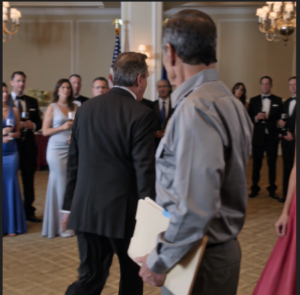
“Security! Get this janitor out of my gala before he embarrasses the firm.”
The man in the tuxedo threw a dirty napkin at my chest in front of 200 guests. And I knew I had about 30 seconds before the whole room understood what that napkin was going to cost him.
I didn’t raise my voice. I didn’t argue. I wiped my hands, picked up my coat, and turned toward the glass doors, because there was something about me and about that building that not one person in that ballroom had ever been told—not even my own daughter.
In a moment, you’ll hear why 11 people stood up at once, and why the man who humiliated me never saw it coming.
Welcome back to Dignity Vault, friends. Grab a warm drink, settle in, and let’s walk through tonight’s story together.
Before we begin, if you’ve ever been looked down on for the work you do or the clothes you wear, this story was written for you. If it speaks to you, tapping that subscribe button takes just 1 second, and it helps our little community of good people keep growing.
A like helps, too. And I’d love to hear in the comments where you’re listening from tonight, because I read every single one.
Now, let’s go back to the beginning of that evening—to a quiet night in a very tall building and a mop bucket that squeaked down an empty hallway.
The wheel on my cleaning cart had squeaked for 2 years, and I never once oiled it. It would have taken me 30 seconds. But in a 40-story tower at 1:00 in the morning, with every desk empty and every light dimmed to a low amber, that little squeak was the only voice that ever answered me.
And I had grown strangely fond of it. It told me where I was. It told me I was still moving.
My name is Raymond Cole. I’m 67 years old. And for the past 2 years, I have worked the night shift as a custodian in the downtown tower where my daughter works by day.
I wore a gray uniform shirt with the name Ray stitched over the pocket and a pair of work boots I’d resold twice. I carried my dinner in a steel thermos that smelled faintly of coffee and the cedar of an old lunchbox. And I had my reasons for all of it, though I wasn’t ready to explain them to anyone—least of all to her.
Sarah died on a gray Tuesday in March, after four long years of an illness that took her a little at a time. I held her hand through most of those years, and I would not trade a single hour of it. But when it was over, the house went silent in a way I can’t describe to anyone who hasn’t lived it.
Her reading glasses were still on the nightstand. Her handwriting was still on the grocery list, stuck to the refrigerator. I kept the milk she liked in the door of that refrigerator for 3 weeks after the funeral, and I couldn’t tell you why.
I sat in her chair for weeks, and slowly I understood that I wasn’t living so much as waiting. I had spent most of my life in rooms with long tables and heavy decisions: contracts, negotiations, men who measured each other by their cuff links. I was good at it, and it had cost me a great deal of time I could never get back.
So, when the grief finally pushed me out of that house, I didn’t go back to the boardroom. I went looking for something honest, something I could do with my hands.
One night, I walked into the lobby of that tower, found the night supervisor, a gentle, heavy-set man named Delroy Pratt, and told him I was a retired man who needed work to keep busy, which was true.
He looked at my face for a long moment, and then he handed me a mop. He never asked me a single question I didn’t want to answer, and I’ve loved him for that ever since.
There is a kind of peace in manual work that I wish more people understood. A floor is either clean or it isn’t. A trash binge is either empty or it’s full.
Nobody lies to you at 3:00 in the morning with a mop in their hands, and nobody tries to buy you either. The first night I finished a full floor, I stood at the elevator and looked back at the long, gleaming hallway behind me, and I felt something I hadn’t felt in months.
I felt finished. For the first time since Sarah passed, I slept through the night.
I have one daughter. Her name is Naomi, and she is 28 years old, with her mother’s stubborn chin and her mother’s way of going quiet right before she says something brave.
She works as a junior associate at Ashford Grayson, a law firm that fills floors 31 through 34 of that tower. She believed—and I let her believe—that I was a retired man living on a modest pension who took a night job to keep from going stir crazy.
It worried her. Every Sunday at dinner, she would look at the calluses on my hands and say, “Dad, please let me help you with money.”
And every Sunday, I would smile and say, “I’m fine, sweetheart. Eat your potatoes.”
What Naomi didn’t know was that her law school tuition had been paid in full 3 years earlier by a scholarship she believed she had won on merit. There was no committee. There was only a quiet fund named for the street where Sarah and I raised her and a lawyer who sent the checks without ever mentioning my name.
That same fund had paid out year-end bonuses at her firm for 6 years, the kind that keep good young people from leaving. I never told her.
I had watched too many children grow up in the shadow of a parent’s money and never learn whether they were loved or simply useful. I wanted Naomi to build her own ladder. I only wanted to make sure the rungs would hold.
That ladder, however, ran straight through a man named Preston Whitlock. He was 52, the senior partner over Naomi’s practice group. A tall man with a tailored suit for every day of the week, and a laugh that never reached his eyes.
He had a talent I’ve seen in a thousand men like him. He could make a person feel small in a single sentence, then make a joke so that everyone else had to laugh along.
Naomi told me about him in pieces, the way you tell someone about a toothache. He had taken credit for her brief on a major case. He had made a young legal assistant cry in front of a full conference room for misspelling a client’s name.
Four associates had left in two years, and he called each of them weak.
“He told me last week that partner track isn’t for everyone,” Naomi said one Sunday, pushing her potatoes around her plate. “He said people should remember where they come from and where they belong.”
I set down my fork. “And where did he say you belong?”
She tried to smile. “Somewhere below him, I think.”
I said nothing, but I remember thinking that a man who needs everyone beneath him must be standing on very thin ground.
I had met Preston Whitlock myself, though he would never have remembered it. It was a Tuesday night in November, a little after 11:00. He was working late, and I came through his office with my cart.
He didn’t look up from his screen. He snapped his fingers twice, the way you’d call a dog, and said, “The bin in the corner has been full since 6:00. Do your job.”
“Yes, sir,” I said.
I emptied it. I wiped the desks cuts around his elbow, and he never once lifted his eyes. He didn’t know my name. He didn’t know I had walked those same halls before he was out of law school.
I picked up my cart and left, and the squeak of that wheel followed me down the corridor. And I’ll admit something to you: I smiled, because I had just learned what kind of man he was when he believed nobody important was watching.
There was one person in that building who knew the whole truth, and that was Arthur Bellamy.
Arthur and I had started that law firm 40 years earlier. Two broke young attorneys, splitting a rented room above a dry cleaner and a pot of terrible coffee. He stayed to run it. I went on to build everything else.
And when Sarah got sick, I handed him my voting proxy and disappeared. He was 65 now, silver-haired, and one of the few people on Earth I trusted completely.
On the Thursday before the firm’s 40th anniversary gala, he found me at 5 in the morning on the 35th floor, ringing out a rag, and sat down on an overturned bucket as if it were a throne.
“Ray,” he said, “Preston is going to ask the board to name him managing partner on Friday. And you know what the partnership agreement says? The board can vote all it likes, but the majority holder has to sign.”
“I know what it says,” I said.
“Do you know how many letters he’s written to Lynen Road Holdings in 10 years? 11. 11 letters begging for a meeting with the owner he thinks is some faceless investor. He doesn’t want to meet you, Ray. He wants your signature.”
I rinse the rag.
“Then come Friday as yourself,” Arthur said. “Put on the suit. Let him look you in the eye.”
“Let me watch him a little longer.”
“Rey,” he said gently, “you’ve been watching him for 2 years.”
I didn’t answer, but I told him I would think about it. And Arthur, who knows me, said he would leave one chair empty at the head table that night, just in case.
Then he stayed a minute longer, and he said something I’ve thought about many times since.
“Sarah would have given that man a piece of her mind a year ago.”
“Sarah would have given him a piece of her mind and a casserole,” I said.
Arthur laughed, and then he stopped, and he looked at the floor.
“I miss her too, you know.”
“I know,” I said. “That’s why I trust you.”
I should tell you about one more person, because he matters. His name was Lucas Ortega. He was 34, a litigator on Naomi’s floor, and he worked late almost every night.
Each evening when I came through, he would look up from his files and say, “Good evening, Ray.” Not once did he treat me like furniture.
One night, he even carried two of my trash bags to the freight elevator. And when I told him he didn’t have to, he shrugged and said, “My mother cleaned offices for 20 years. I’d be a poor son if I didn’t help.”
I didn’t forget that. I filed it away the way you file a good tool you may need someday.
2 weeks before the gala, something happened that I haven’t told many people. It was a Wednesday, close to midnight, and I was emptying the bins on 33 when I heard a sound from the glass-walled conference room at the end of the hall.
It was the sound of someone trying very hard not to cry.
Through the glass, I could see a young woman at the long table, a legal assistant named Jasmine Reyes, with a stack of binders in front of her and her hands pressed flat over her mouth. I knew her face. She was the one who always said, “Thank you,” when I emptied her waste basket.
Preston stood over her with his arms crossed, and I heard him through the door as plainly as if he’d been standing beside me.
“200 pages. And you couldn’t spell a client’s name right. Maybe this work just isn’t for people like you.”
I stood in the hallway with a trash bag in my hand and every muscle in my body wanting to open that door. I didn’t. If I had, the story would have ended right there, and Jasmine would have lost her job in the morning for the crime of having a witness.
So, I did a smaller thing. I walked in with my cart as if I hadn’t heard a word, and I said mildly that I needed to empty that corner bin.
Preston waved me off without looking. And while I took my time—slowly, so slowly—Jasmine wiped her eyes, drew a breath, and he finally left, tossing one last remark over his shoulder.
When the door closed behind him, I set a clean tissue box on the table.
“Mistakes get fixed,” I told her. “People are harder.”
She nodded, tried to smile, and said, “Thank you, Ray.”
That was all. Within the week, she turned in her badge. I’ve thought about her everyday since.
That was the night I stopped watching Preston Whitlock and started keeping a file. Not an official one, just a notebook, a small spiral one I carried in my back pocket with dates and names and what I saw.
I wrote down the word “people” a good many times, because that was his favorite way of pointing at someone from a distance. People like you. People like her. People like Rey.
By the end, I had 11 pages, and I did not enjoy writing a single line of them.
Now, I want you to understand what kind of week that was, because you can’t know a quiet man until you know what he’s holding. Naomi had been preparing for months to give a short toast at the anniversary gala.
It was the first time a junior associate had been asked, and she knew exactly why. Preston wanted her on that stage because he’d decided to take credit for her talent in front of the board. I knew it, and she suspected it, and neither of us said so out loud.
She practiced her toast on me every Sunday, standing in my kitchen with her notes in her hand, and every Sunday it got better. It was about how her mother, in the end—though she never named her—it was about the people who build things quietly so that others can stand on them.
I had to turn away to the stove more than once and pretend the onions were responsible.
Friday came with a cold, clear sky. I had planned the evening carefully. I would work my shift until 8, change into the charcoal suit hanging in my locker, ride the elevator to the 38th floor, and walk into that gala as myself for the first time in 2 years.
Not for revenge. For Naomi.
I wanted to see how Preston treated her when he thought I was just another guest. And I wanted to make my decision with open eyes, but at 10 minutes to 8, my phone buzzed. It was Naomi, and her voice was thin with panic.
“Dad, I’m so sorry. I left my presentation folder at your house last night. The anniversary toast, the slides, everything. I’m on in 40 minutes, and if I’m not prepared, Preston will…”
She stopped.
“He’ll make sure everyone knows.”
“Breathe,” I said. “I’ll bring it.”
I drove home, found the folder on my kitchen table beside Sarah’s old teacup, and was back in the garage in 20 minutes. There was no time to change. The charcoal suit was in my locker two floors below, and the clock said her toast was minutes away.
So, I went up as I was, in my gray work shirt and worn boots, with a Manila folder in my hands. It was the first mistake I’d made in a long time. It was also, I think, the best one.
The elevator opened on the 38th floor, and the first thing I noticed was the smell. Lilies and champagne and expensive perfume, and underneath it all, the faint, clean scent of polished marble, which I knew well because I had polished it myself.
Chandeliers hung like frozen waterfalls over 200 guests in black ties and silk gowns, and a string quartet by the windows played something slow and elegant. The whole city glittered beyond the glass.
At the far end of the room sat a long head table with 11 directors in a row, silver-haired and serious, and in the center of them, one empty chair.
Arthur saw me from across the room. His eyebrows lifted a fraction. I gave him the smallest shake of my head. Not yet.
I only needed to find Naomi. I never got that far.
“Excuse me.”
The voice was smooth and cold, and it came from directly in front of me. Preston Whitlock stood there in a midnight tuxedo with silver cuff links, wearing the smile of a man who had already decided how this would end.
“This is a private event. The service entrance is on the ground floor.”
“I’m only delivering something for my daughter,” I said quietly. “Naomi Cole. She forgot her folder.”
His eyebrows climbed. Then, for the first time, he really looked at me—at the boots, the gray shirt, the stitching that said Rey—and a slow, delighted cruelty spread across his face.
“You’re the janitor father,” he said, loud enough for the nearest tables to hear. “Oh, this is perfect.”
The conversations around us thinned. Forks paused. I felt 200 sets of eyes find me.
And I felt something else, too. Something I hadn’t felt in a very long time: the old, steady calm that used to settle over me in negotiations right before the other side made their fatal mistake.
“Sir,” I said, “I’ll leave the folder at the front desk and go.”
“You will not,” Preston said. “Not before you make yourself useful.”
He reached over to a passing waiter’s tray, picked up a crumpled, wine-stained napkin from a dirty plate, and threw it at my chest. It struck me and fell to the carpet.
“Table 4 is a mess,” he announced, and a few people laughed uncertainly, the way people laugh when they are afraid not to. “Clean it up before you go. It’s the only thing you’re good for.”
I bent slowly and picked up the napkin. I didn’t throw it back. I didn’t say a word.
That seemed to bother him more than anything. So, he raised his voice and turned to the room.
“Security, get this man out of our gala before he embarrasses the firm.”
Somewhere behind me, I heard the heavy shoes of two guards start across the marble. 30 seconds. That was all they would need.
And I’ll tell you honestly, in that moment, I wasn’t thinking about Preston at all. I was thinking about Sarah, who had told me in her last good month, “Rey Prime, you’ll never let anyone make you smaller than you are.”
That was when I heard Naomi’s voice. She had come out of the crowd in her navy dress, cheeks flushed, and she stepped between me and Preston so fast that her heel caught on the carpet.
“Stop it,” she said, her voice shaking. “That’s my father. He brought my notes. He has done nothing wrong.”
Preston looked at her as if she were something he’d found on his shoe. He lowered his voice, but not nearly enough.
“Naomi, you’ve embarrassed yourself enough for one night. I warned you that partners are held to a standard. Low-class family hanging around a gala like this sinks careers. If your janitor father shows his face in front of this board again, I will make sure your partner track disappears before he can find the freight elevator.”
I watched my daughter’s face. She didn’t back down. Her lip trembled and her eyes filled, but she stayed exactly where she was.
Shoulders squared, her mother’s chin lifted high. She was ready to lose everything she had worked for, and she was doing it for a man in a work shirt.
I have been proud of a lot of things in my life. I have never been prouder than I was at that moment, and I could not let her pay for it.
Across the room, I saw Lucas Ortega set down his glass and start toward us, jaw set. And I understood he was about to throw away his own future for me. I caught his eye and gave the smallest shake of my head.
Not yet, son.
Then I did the one thing no one expected. I put my hand on Naomi’s shoulder gently and smiled.
“It’s all right, sweetheart,” I said. “Go give your toast. I’m proud of you.”
“Dad—”
“No, it’s all right.”
I set the folder in her hands. I wiped my palm slowly on my work trousers, laid the dirty napkin on the nearest table, and picked up my old canvas jacket from the chair where I draped it.
Then, I turned my back on 200 people and began to walk toward the glass doors at the end of the ballroom. I heard Preston chuckle behind me.
“That’s the smartest thing he’s done all night.”
I kept walking. 10 steps, 15. The guards were closing in, and I could hear the carpet muffled their footsteps.
I passed a table where a woman in pearls looked down at her plate, ashamed, and I passed a young waiter who whispered so softly I almost missed it, “I’m sorry, sir.”
My hand was almost on the cold brass of the door, and I remember thinking that Preston Whitlock had just reached the very peak of his arrogance, and that it was a long way down from there.
“Mr. Cole.”
The voice came through the speakers, deep and unhurried, and it filled the room. I stopped.
“Mr. Cole, please don’t leave.”
I turned around.
Arthur Bellamy was standing at the head table with the microphone in his hand, and behind him, one by one, the other directors were rising from their—first an elderly woman with white hair, then a man in thick glasses, then two more and three, and then all 11 at once, chairs scraping softly against the marble, standing perfectly straight as if a head of state had walked in.
The quartet faltered and stopped. A silence fell over that ballroom that I will remember for the rest of my life.
Preston laughed uncertainly. “Arthur, what is this? He’s a custodian.”
Arthur didn’t look at him. He looked at me, and his voice, when it came, was thick with something that was part respect and part relief.
“Ladies and gentlemen,” he said, “40 years ago, two young lawyers with $1,100 between them opened a firm in a rented room above a dry cleaner. One of them is me. The other is standing at the back of this ballroom in a work shirt.”
He let that settle.
“Raymond Cole is the co-founder of Ashford Grayson. Through Lynen Road Holdings, he holds 51% of this firm and has for 20 years. And since some of you may be wondering about the empty chair at this table, it was held for him.
“Mr. Cole is also the sole owner of this building. Every floor, every elevator, this ballroom.”
I watched color leave Preston Whitlock’s face the way water leaves a basin. Slowly at first, then all at once.
“Lynen Road Holdings,” he said, barely above a whisper.
“You wrote to them 11 times,” Arthur said. “You never received a reply. Now you know why.”
Somewhere in the crowd, a glass clinkedked softly against a table, and no one seemed to breathe. I heard a woman near the back whisper, “The janitor owns the building,” and the man beside her whisper back, “No, the owner is the janitor.”
There’s a difference, and I think a lot of people in that room felt it.
Preston tried to speak. “Mr. Cole, sir, there’s been a terrible misunderstanding.”
“Has there?” I said.
I hadn’t raised my voice. I never have.
“Because I thought it was a very clear understanding.”
Naomi stood 3 ft away with the Manila folder crushed against her chest. She was staring at me, her mouth slightly open, as if a stranger had stepped out of her father’s body.
“Dad,” she whispered.
“Later, sweetheart,” I said. “I promise. Everything.”
Then I walked back across that ballroom, past two guards who had gone pale and stepped aside, passed as tables of people who couldn’t meet my eyes, and took the microphone from Arthur’s hand.
I looked at the room for a long moment. I had given speeches in ballrooms like this one for 30 years and never once been nervous. I was nervous now because my daughter was watching.
“I owe this room an apology,” I said. “I came tonight dressed as a man who cleans floors, because that is what I am for 40 hours a week, and I will never be ashamed of it.
“Two years ago, I buried my wife, and I couldn’t stand the silence in my house. So, I took a mop and went looking for honest work. It taught me something I had forgotten after a lifetime in boardrooms: you can learn everything you need to know about a person by how they treat someone who can do nothing for them.”
I let the silence stretch.
“Tonight I learned a great deal about this firm.”
I turned to Arthur. “Would you tell them what’s in the file?”
His expression was grave.
“Over six years, 14 formal complaints were filed against Mr. Whitlock,” he said. “14. Each one was quietly buried by a partner who owed him a favor. Four associates left this firm.
“A legal assistant, a young woman, walked out in tears and never came back. The complaints reached me only last month, in an envelope slipped under my door.”
Preston opened his mouth.
“They were exaggerated,” he said. “Misread.”
“I read every one of them,” I said. “I read them on my break, on a bench by the loading dock, under a flickering light. And I tried to picture each person’s face. I don’t believe they were misread, Preston.”
Then Preston did what men like him always do when the ground gives way. He tried to bargain.
He smoothed his lapels and gave a thin, practiced laugh and said, “Mr. Cole, surely a man of your experience understands that this is a high-pressure business. Tempers flare. I have built a great deal of value for this firm.”
“You have,” I said, “and you built it on the backs of people you never thanked. Every number on your ra has somebody’s tired face behind it.”
He had no answer for that. Neither did the room. I could hear the air conditioning hum above us and the muffled traffic 40 floors down, and that was all.
“Here is my decision,” I said.
And I kept my voice level, because I learned long ago that the quieter you speak, the more people lean in.
“I am declining your partnership renewal. Effective tonight, you are removed from the partnership, and you will not be named managing partner.”
A gasp moved through the room like wind through wheat. Preston swayed.
“You would end my career over a misunderstanding?”
“No,” I said. “I wouldn’t end your career. I’ve seen men destroyed to prove a point, and I’ve never once seen it teach them anything. I’m offering you something better than what you offered my daughter tonight.
“I’m offering you a path back. First, you will apologize publicly tonight to every person you have wronged. Second, you may stay with this firm, but as a senior associate with no title and no vote, reporting to a partner chosen tonight.
“Third, for 1 month you will work a night shift beside the crew who clean the offices you leave behind. And if, after 3 years, your record is clean and the people who work beside you are willing to say you have changed, the board may consider you again.
“Not me. The board. I won’t hand you anything. You’ll earn every inch of it the way my daughter does.”
Preston stood very still. I watched a hundred small calculations cross his face: anger, pride, fear, the instinct to bargain. Then something shifted.
He straightened his jacket, took the microphone from my hand with fingers that weren’t steady, and turned to my daughter.
“Naomi,” he said. “I took credit for your work. I threatened your career tonight, and I insulted your father, a man who is worth 10 of me. I am sorry.”
He looked out at the room.
“To everyone here who has ever worked for me and been spoken to the way I spoke tonight, I am sorry. And to the night crew of this building, who I have never once thanked and who clean up after me every single day, I am sorry.”
His voice cracked on the last word. I took the microphone back.
“Thank you,” I said. “But an apology is a door, Preston, not a room. You’ve opened it. Now walk through.”
I could have stopped there, and many men would have. But justice isn’t only about what you take from the wrong person. It’s also about what you give to the right one.
“Now,” I said, “about that partner.”
I looked across the room.
“Lucas Ortega, come here, son.”
He crossed the floor slowly, as if he suspected a mistake.
“For a year and a half,” I said, “this young man has said good evening to a man with a mop bucket, and not once did he make me feel invisible. I’ve watched him work. He is brilliant. He is fair, and he is kind, and I have found that the third quality is the rarest.
“Arthur, put his name forward tonight.”
The room erupted. Lucas stood there blinking, one hand over his mouth, and then he looked at me and said very quietly, “Thank you, Mr. Cole.”
“It’s Rey,” I said. “It’s always been Rey.”
I wasn’t finished, and neither was the board.
“Arthur,” I said, “there are four names on the list of associates who left this firm in the last 2 years and one legal assistant, Jasmine Reyes. I want each of them contacted by Monday morning, personally, by this firm’s managing partner, not by an email. I want them offered their old positions back with an apology in writing and the same pay they would have earned had they stayed.”
Arthur nodded and wrote it down in his own hand, the way he used to when we were young and poor and every promise mattered.
Lucas, standing beside him, said, “I’ll make the first call myself tonight.”
I could have hugged him.
And then I did something I hadn’t planned. I spotted Delroy Pratt at the service entrance at the far end of the ballroom, still in his gray uniform, hovering there with his cap in his hands because he had come up to find out whether his friend had been arrested.
I raised my arm and called his name across that sea of silk and black tie.
“Delroy, come in here.”
He shook his head, mortified.
“Come in,” I said. “This room has been cleaned by your crew all week. It can spare you for one minute.”
He walked in slowly, shoulders hunched, and then something wonderful happened. Naomi started to clap. Lucas joined her, then Arthur, then the directors, then the waiters, then, one by one, the whole room, until the applause rolled over that old man like a wave.
Delroy stood there with his cap pressed against his chest and his eyes shut tight. And I’ll tell you, there wasn’t a dry eye on that floor.
I slipped out of the ballroom a little later, while the champagne was being poured again and the quartet found its music, and I stood alone in the corridor for a moment, my back against the cool wall. My hands were trembling.
People imagined that a man in my position must feel triumph. And I won’t lie to you: there was a flicker of it, but mostly I felt tired.
And mostly I felt Sarah’s absence, sharp as a splinter, because she should have been standing next to me in that room, and she would have been furious and proud in equal parts.
I closed my eyes, and I told her quietly that I’d kept my promise. And somewhere in the back of my mind, I could almost hear her say it.
“About time, Rey.”
Later, out on the terrace, the city lights spread below us like spilled jewels. Naomi stood at the railing, still holding the crumpled folder. For a long while, she said nothing.
“Dad,” she said at last. “The scholarship, the one I won…”
“There was no committee,” I said.
She turned, and her tears finally came. Not delicate ones, but the ugly, honest kind her mother used to cry.
“Why? Why didn’t you tell me? I watched you come home with aching knees. I begged you to let me help you with money, and you were…”
She waved a hand at the tower rising behind us.
“You were sitting on all of this.”
I thought about how to answer honestly, because she deserved honesty more than comfort.
“Because I wanted you to build your own life, sweetheart. If you’d known, every door would have opened for the wrong reason, and you’d never have known which ones you opened yourself. And because your mother and I made a promise that you would be loved for exactly who you are.”
She laughed through her tears.
“Mom would have thrown that napkin right back at him.”
“She would have,” I said. “Hard.”
We laughed together, the first easy laugh of that whole awful, wonderful night. Then she stepped into my arms, work shirt and all, and held on the way she did at 6 years old, and I felt Sarah standing somewhere very close.
She pulled back after a while and wiped her face with the heel of her hand.
“I didn’t give the toast,” she said.
“I did,” I said gently. “You gave it just now, out here, to me.”
She smiled at that, the real one. The one that still makes my chest tighten.
“I’m not taking any promotion from you, Dad. I want you to know that. Not one.”
“I wouldn’t dream of offering,” I said. “You’d only turn it down.”
“I would,” she said, and I have never been so glad to be told no.
6 months have passed since that night.
Naomi didn’t ask me for anything, and I wouldn’t have given it. She went to Arthur instead with a proposal of her own and put her own name on it: the Sarah Cole Scholarship for the children of the people who keep this building running.
Its first recipient is Delroyy’s granddaughter, Tasha, a bright, serious girl who wants to study law. When Delroy heard, he took off his glasses, wiped them on his sleeve, and told me he had something in his eye.
Naomi is on the partner track now by her own work and nothing else, and she’s earning it the hard way. She sits with me on Sundays, and she still pushes her potatoes around the plate, and I still tell her to eat.
In March, on the anniversary of her mother’s passing, we drove to the cemetery together, and Naomi read her toast aloud at the headstone. Every word, the whole thing, and I swear the wind stopped to listen.
Preston served his month on the night crew in January. He was terrible at it. He mopped in straight lines instead of long figure-8s, and Delroy corrected him gently, and he took the correction with his jaw clenched.
By the second week, he was bringing donuts. By the fourth, he knew every crew member’s name and the names of their children.
I won’t tell you he became a saint. Men like Preston rarely do. But one night in February, I came through his office with my cart, and he was working late at his desk, a senior associate with a smaller room and no title.
He looked up and said, “Good evening, Ray.”
And he meant it. I said the same.
Lucas runs the practice group now with the same kindness he always had, and Arthur has finally started talking about retirement. And Jasmine Reyes came back in March.
Lucas made that first call himself from the ballroom with a champagne flute still in his other hand. And she cried so hard on the line that he had to wait a full minute before he could finish his sentence.
The morning she returned, I found a small card tucked under the lid of my cleaning cart. In neat handwriting, it said, “Only mistakes get fixed. People are harder. Thank you for fixing one.”
I have kept it in my thermos case ever since, next to a photograph of Sarah, where the two of them can keep an eye on each other.
And the wheel on my cart? It still squeaks. I still haven’t oiled it.
Here is what I learned from all of it. Respect that depends on who is watching was never respect at all. And the way a person treats someone who can do nothing for them is the truest measure of their character.
Real power has no need to announce itself, because it knows that dignity is carried quietly, not displayed.
If you were placed in this exact situation, how would you have handled it? If this story stayed with you, I’d be grateful if you’d tap that subscribe button. It takes 1 second, and it helps more people find stories like this one.
Leave a like and tell me in the comments what you would have done in Raymon’s shoes, whether you would have walked out quietly or spoken up sooner, because I read every single one. And I love hearing your own stories of quiet dignity.
And please share this one with someone who has ever been looked down on for the work they do. Someone who needs to be reminded that dignity never needs a title.
Thank you for spending this time with me, friends. Until next time, carry yours quietly. And let the truth speak when it’s…