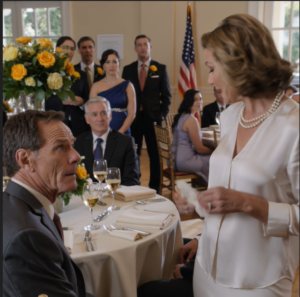
At My Son’s Wedding, His New Mother-In-Law Said, “Eat In The Lobby.” I Just Smiled…
Phân cảnh 1: The wedding humiliation
“A real guest needs that seat. You can eat your dinner out in the lobby.”
That is what the bride’s mother told me. And she said it while dropping my name card into a trash can in front of 150 people.
I didn’t raise my voice. I didn’t argue. I picked up my coat, walked down a hallway that smelled of lilies and spilled champagne, and knocked on a door marked management.
Because here is what Diane Vance did not know: every flower in that ballroom, every plate, every note of that music had been paid for by the man she had just sent to sit beside a vending machine.
$52,000, all of it mine, and I had signed one paper she never bothered to read.
40 minutes later, the music would stop dead, the bar would lock, the kitchen would go silent, and Diane would finally learn whose wedding she had been standing in.
But I never told anyone about that money, not even my own son. And the reason has nothing to do with pride. It comes from a promise I made beside a hospital bed. And I kept it for as long as a man possibly could.
Welcome back to Dignity Vault. Grab a warm drink, settle in, and let’s walk through today’s story together.
Phân cảnh 2: A promise to a dying wife
Because to understand how a quiet man ended a lavish wedding in 40 minutes, you have to start years earlier on a highway at 4 in the morning.
My name is Henry Walsh. I’m 66 years old, and for 35 years, my office was the driver’s seat of an 18-wheeler. 2 and a half million miles, give or take.
I’ve crossed the Rockies in ice storms, slept in rest stops from Barstow to Bangor, and eaten more gas station coffee and sunflower seeds than any man should admit to in public. I never minded.
Every mile had an address at the end of it: a small brick house with the porch light left on, and a woman named Eleanor waiting inside.
Eleanor kept the books for a dental office and kept the rest of us together. She wrote little notes on napkins and tucked them into my lunch cooler.
“Drive safe. Call when you stop. I’m proud of you.”
I kept every one of them. And they’re still rubber banded in a shoe box on my dresser.
When I told her I wanted to give her the life she deserved—a bigger house, a cruise, something with a view—she’d laugh and say, “Henry, the life I deserve is the one with you in it, so come home safe.”
But a man like me hears that and works harder, not softer. So I saved every dime of overtime, every holiday run nobody else wanted. I skipped the steakhouse and ate the sandwich she packed.
I told myself there would be time later to spend it all on her.
There wasn’t.
Four years ago, the illness came, and it moved faster than any of us could keep up with. On the last night, the machines were beeping softly, and the window showed nothing but parking lot lights, and Elellanar took my hand. Her grip was weaker than I remembered.
“Henry, promise me something,” she said. “Ethan is going to marry one day. Promise me he’ll have a wedding day full of joy. Not a perfect one, a joyful one.”
I told her, “I promised.”
She squeezed harder.
“And don’t you ever make him choose between you and his wife. He’s going to need both of you.”
I said, “I promised that, too.”
She passed that same week. And I have never meant anything more in my life.
Our son Ethan is 27 now. He’s gentle like his mother, with her eyes and her habit of apologizing to furniture when he bumps into it.
Phân cảnh 3: Paying for the secret
He works as a civil engineer for the county. He calls me every Sunday, and he has one weakness I could see from a mile away. He caught stand conflict.
Put him in a room where two people are tense, and he will fold himself into a smaller shape to make the tension go away. I used to think that was just kindness. I was only half right.
Three years ago, he brought home a young woman named Khloe Vance. She teaches second grade, and she laughed at my terrible jokes without making me feel pied.
The first time she came to the house, Miy washed every dish before I could stop her and asked me questions about the road. Real questions.
What did the mountains look like at dawn? What did I think about for all those hours?
Nobody had asked me that since Eleanor.
When Ethan proposed, I cried in my kitchen like a fool, alone with Eleanor’s last napkin note in my hand.
Khloe’s parents were a different matter. Marcus and Diane Vance lived in a gated neighborhood called Whitmore Hills, the kind of place where the mailboxes matched the shutters.
Marcus was a regional executive at an insurance firm, a tall, tired-l lookinging man who agreed with whoever spoke last, and usually that was his wife.
Diane was 54 and introduced herself by telling you who she knew. She wore her pearls the way some men wear a badge.
In March, Diane called me herself. She’d never called me before. Her voice was soft, careful, and slightly wet, like a woman who had rehearsed her tears in a mirror.
She explained that Marcus’s company was restructuring and his bonus had been delayed. They had always dreamed of giving Khloe a beautiful wedding at the Whitmore Hills Country Club, and the deposit was due.
She hated to ask. She truly hated it. She just didn’t know where else to turn.
I asked how much. When she named the number, I felt my stomach tighten.
$52,000. $150 guests, a seven-course dinner, imported flowers, a string trio for the ceremony, and a DJ for the dancing.
It was more than I had ever spent on anything except the house. I thought about the napkin notes. I thought about the promise.
And I said, “Diane, I’ll cover it.”
“Oh, Henry, I couldn’t,” she said in the voice of a woman who absolutely could and absolutely would.
I wrote the check from savings I had spent 35 years building. I asked for one thing in return: nobody tells Ethan, and nobody tells Chloe.
I wanted that day to feel like it simply happened, like joy that arrived on its own with no price tag on it. That was Eleanor’s wish, and I wasn’t going to let my son carry the weight of what it cost.
“Of course,” Diane said quickly. “Our little secret.”
I thought I heard something in her voice then. Relief, certainly. But underneath it, something smaller and sharper, like a lock clicking shut.
I wrote it off as nerves. I should have listened closer.
I met with the club’s events director a week later, a warm, sharp woman named Naomi Foster, who wore her reading glasses on a beaded chain.
Phân cảnh 4: Preparing for the worst
The general manager, a heavy set man named Gordon Pierce, sat in. They slid a master vendor agreement across the desk, and I did what I had done with every bill of lighting for 35 years. I read the whole thing slowly, with a pen in my hand.
Naomi watched me with a small smile.
“Most hosts skim.”
“Most hosts haven’t been burned by a freight broker,” I said. “In my line of work, every contract needs a clause for the day the other side doesn’t hold up their end.”
I asked for the same here. After some back and forth, we added a custom provision: clause 7.
It said that the contract holder, meaning the host, could terminate all services on site at any point before dinner service if there was a breach of venue policy or guest protocol. Any undelivered portion would be refunded.
Gordon read it twice and raised an eyebrow, but the club’s lawyers approved it that same week.
I signed. I was the only name on the paper, the only signature, and the only payer.
I tucked my copy in a folder and slid it into the inside pocket of my coat. And I honestly believed I would never need it.
I want to be fair to myself. I wasn’t planning a trap. I was planning for a bad day, the way a trucker plans for black ice.
Phân cảnh 5: Insults and expectations
The months that followed were a slow education in who Diane Vance really was.
She told everyone at the country club that she and Marcus were hosting. Everyone.
Chloe mentioned it once, laughing that her mother had told the entire garden committee. And Ethan shrugged it off the way he shrugs off everything.
I kept quiet. It stung, but I was keeping a promise. And promises cost something, or they aren’t promises.
Then came the suit. Ethan wanted me to wear what I had, and what I had was a single charcoal suit that Eleanor had picked out for his college graduation. It was tailored, simple, and perfectly fitted.
Diane glanced at it over coffee and said, “Oh, Henry, that old thing.”
She suggested I rent a tuxedo from her tailor. I said I’d wear the suit. She smiled with every tooth.
At the rehearsal dinner, she seated me at the far end of the table beside the kitchen door.
When she introduced me to her friends, she said, “This is Ethan’s father. He’s in transportation.” And gave a light little laugh, as if the word were slightly embarrassing.
A woman named Bunny Whitaker, with a tan the color of a good saddle, looked at my hands—the thick knuckles, the scars—and said, “How interesting,” in a tone that meant the opposite.
When it came time for toasts, Diane informed Kloe that toasts were limited to people with something polished to say. Kloe came to me that night with tears in her eyes and apologized, and I told her it was fine.
I wrote one anyway. I folded it and put it in my pocket, right next to a small, soft square of paper I had carried for four years.
I saw Ethan flinch every time his future mother-in-law spoke. I saw Khloe shrink beside her, and I saw Marcus Vance shake my hand at the end of that dinner and look somewhere over my shoulder.
He knew. He knew exactly who had paid for the evening, and he said nothing at all.
I didn’t confront anyone. I kept thinking about Eleanor’s voice.
“Not a perfect day, a joyful one.”
So I swallowed it, one small insult at a time. The way you swallow Miles.
Deianne had no idea she was spending her last quiet weeks as a woman who had never been told no.
The wedding day was golden and warm. I drove my old Silverado to the club, 10 years old, with a cracked dashboard and a bumper sticker faded to nothing.
A valley in a white jacket took one look at it and hesitated. And then a voice behind him said, “Not in the circle. Behind the kitchen.”
Diane, in a pale silk dress, didn’t even turn her head. The valet shrugged an apology and drove my truck past the dumpsters.
I walked in anyway, in my charcoal suit, with Eleanor’s note folded in my breast pocket.
The ceremony was held in the garden under an arch so thick with white roses it looked like a snow drift. Diane had arranged the chairs so that her friends filled the front rows.
I sat in the second row on the aisle, near enough to see my son’s face when the string trio began, and I saw it. Ethan looked up and watched Kloe walk toward him, and his whole face opened.
For one second, he looked exactly like his mother. I felt my throat close.
I thought, Ellanar, look at him. Look at what we made.
The vows were stiff, though—polished, rehearsed, every word handed down from the planner Diane had hired. Khloe’s voice shook, and I could tell they weren’t her own.
But when the officient said they were married and Ethan kissed her, the whole garden stood and applauded. I applauded too, harder than anyone.
Whatever else was wrong that day, my son was married to a woman who loved him, and that was enough to carry me through the first hour.
At the cocktail hour, I stood by a column and let the crowd pass. And I heard Diane working the room.
“Oh, we wanted something simple,” she told a cluster of women in wide hats. “Just 150 of our nearest. Marcus and I wanted Kloe to have everything.”
“It’s stunning, Diane,” someone said. “The flowers.”
“Well, you know me. I can’t help myself.”
I looked across the room and found Naomi Foster by the doors, her clipboard against her chest. She had overheard every word. She caught my eye, and her mouth tightened.
I gave her the smallest shake of my head. Not yet. Not today. Let it be.
She gave a slow, reluctant nod. That nod mattered more than I realized.
At a/4 to 7, the doors to the main ballroom opened. It was a beautiful room. I’ll give Diane that.
Chandeliers hung like frozen waterfalls. Round tables glowed with candles. Somewhere, a string quartet was warming up.
The whole place smelled of lilies, butter, roasted lamb, and warm bread. And for one honest minute, my heart lifted.
I had paid for this, not to be seen, but so my son could walk into a room like this one and feel like the world had said yes.
I went looking for my name. The family table sat at the head of the room, long and draped in ivory linen, with place cards in gold script.
I found Ethan’s. I found Khloe’s. I found Dian’s and Marcus’. And I found mine, Henry Walsh, sat at the far end next to Khloe’s grandmother’s seat, exactly where a father of the groom should sit.
Phân cảnh 6: The final indignity
I had barely reached the chair when Diane’s perfume reached me first.
“Henry,” she said, sliding up beside me with her hand on my elbow.
Her smile was a thin, bright thing.
“There’s been a small change.”
“What kind of change?”
“Well”—she glanced back at a table of her friends, then lowered her voice just loud enough for them to hear—“Mr. Whitaker has just been named a partner at Marcus’ firm. It would be awkward to seat him anywhere else. So, that chair is needed for a real guest.”
The room around me seemed to go very quiet.
“A real guest,” I said.
“Someone who matters to the evening, Henry. You understand?”
She lifted my name card from the linen between two fingers like it had a stain on it.
“Certain people just don’t fit the aesthetic. There’s a chair for you out in the lobby. You’ll be much more comfortable.”
And then she turned in front of her country club friends and dropped my name card into a waste basket by the service table.
It landed face up on a pile of napkins. Henry Walsh and Gold Script, staring at the ceiling.
I heard a woman gasp softly, and then a nervous little laugh from somewhere to my left. A fork scraped a plate. Someone cleared a throat.
A young waiter, hardly older than 20, stared at me with a face full of shame, as if it were his hands that had done it.
Another staff member carried a folding chair out into the hallway, and I realized with a slow, cold understanding that it was meant for me.
A leftover metal chair, the kind used at church fundraisers. It was set beside the vending machines.
“Mom,” Ethan said.
He had come up behind me. He was holding Khloe’s hand, and his face was white.
“Mom, Dad paid for—”
“Ethan.” Dianne’s voice cut him off like a knife through ribbon. “Not now. This is not the time. Your father should be grateful to be in the building at all.”
I watched my son’s mouth open and close. I watched him look at his mother-in-law, then at me, then at his bride, who was staring at the floor.
I saw every muscle in his face try to move at once, and none of them succeed. He froze.
The boy who had stopped traffic to rescue turtles, who had given his coat to a stranger once in January, froze like a deer at the edge of a road, and I felt no anger at him.
That surprised me. All I felt was an enormous, aching tenderness because I knew exactly what it looked like when a good man was too frightened to be brave.
I had watched it for four months, and I had watched his mother’s face on the day he was born, and I knew this was not the end of him.
So I smiled. I put a hand on his shoulder.
“Congratulations, son,” I said softly. “Eat something. I love you.”
Then I turned, picked up my coat from the back of the chair, and walked out of that ballroom without looking back.
Phân cảnh 7: A decision to act
The hallway outside was a different world. The air was cooler. The double doors muffled the music into a low, dull murmur.
And right there, under a buzzing fluorescent light, stood the vending machine, humming like a tired old refrigerator. And beside it, the metal chair.
I sat down on it. I don’t know why. Maybe because my knees needed it. Maybe because some part of me wanted to understand exactly what she had wanted me to feel.
The seat was cold through my trousers. A can dropped somewhere inside the machine with a hollow clunk. I could smell bleach and old coffee.
I took Eleanor’s note out of my breast pocket. I had carried it for 4 years, soft as cloth, folded so many times it was starting to tear along the creases.
It was the last one she ever wrote me in her slanting hand. Dated two days before she went into the hospital for the last time.
It said, “Henry, if I know you, you’ll be standing at the back with your hat in your hands. Don’t. Stand where Ethan can see you. And whatever happens, be kind. Even when kindness has to wear boots.”
I read it three times. Then I put it away and sat there in the humming light. And I thought about my promise.
Joy. I had told her a joyful day.
I had spent $52,000 of my life to buy that for my son. And I had done it quietly because I believed a gift is only a gift if the giver stays invisible.
But sitting beside a vending machine, I understood something I had missed. Joy built on a lie about who paid for it isn’t joy at all. It’s a stage set. And I had been paying for the lumber.
I could still honor Eleanor. I would not make Ethan choose. I would not curse or shout or flip a table. I would not humiliate anyone, not even her.
But I could stop financing my own insult.
“Kindness and boots,” I whispered.
I stood up. I folded the metal chair and leaned it carefully against the wall because that’s how I was raised. Then I buttoned my jacket and walked to the door marked management.
Before I could knock, it opened. Naomi Foster stood there with her reading glasses in her fist and her eyes bright with fury.
Phân cảnh 8: The wedding is dismantled
In her other hand, she was holding something small and rectangular.
“Mr. Walsh,” she said, “I believe this belongs to you.”
It was my name card. She had fished it out of the waist basket. There was a faint smear of frosting on one corner.
For the first time all night, I laughed, a short, rough sound.
“Thank you, Naomi.”
“I heard every word of that,” she said. “Come in. Gordon’s waiting.”
Gordon Pierce sat behind his desk with his hands folded and his jaw set. He had clearly been told the same story.
I took my folder from my coat, pulled out the contract, and laid it flat on his bladder. The paper was a little creased from 3 months in my pocket.
“Clause seven,” I said.
Gordon didn’t reach for it. He looked at me for a long moment, the way a man looks at a very deep river.
“Mr. Walsh, you understand what you’re asking. Once this is invoked, it’s final. There’s no pausing it, no apologizing it away. The kitchen stops, the bar closes, the music ends, and your son is in that room.”
“I understand.”
“Are you sure about your son?”
I thought about that for a long time.
“My son’s marriage will survive this,” I said at last. “What won’t survive is the performance.”
Gordon nodded slowly. He picked up the phone and called the club’s attorney, who confirmed the language in about 8 minutes. Then he called the board chair, who took 12. Then he had to brief the staff, and that took longer.
40 minutes is what it takes to dismantle a wedding the right way, I learned, when you refuse to do it cruy.
I made three requests. First, that every member of the staff be paid in full for the night, tips included, which my contract already covered.
Second, that every plate already prepared be boxed and sent to the veteran’s shelter on Fourth Street, because food shouldn’t be wasted just because a hostess forgot her manners.
And third, that nobody on the staff be made to feel they had done anything wrong.
Gordon wrote all three on a legal pad.
“You’re a better man than I would be,” he said.
“No,” I said, “just a tired one.”
While we waited, Naomi turned the monitor on Gordon’s desk toward me. It showed the ballroom from a high corner camera.
I watched in silence. The room was lit gold. Dinner was being served, the first course arriving on silver trays.
Diane stood at the head table with a champagne flute raised.
“To our beautiful Chloe and wonderful Ethan,” she said. “Marcus and I are just so proud to have hosted this evening.”
I watched my son. Ethan sat beside his bride, staring at the empty chair that should have held his father. He didn’t touch his plate.
Every few seconds, his eyes drifted toward the double doors. Chloe was holding his hand under the table so tightly her knuckles were white.
He kept looking at that door. I felt something loosen in my chest.
He was looking for me. Not for his mother-in-law’s approval, not for the rooms—for me.
That small thing, that glance at an empty doorway, was a spark of hope. I held on to the whole 40 minutes.
At 7:22, Gordon stood and straightened his tie.
“It’s time.”
The first thing that happened was the knives. Chef Antonio Reyes, a broad, careful man in a spotless white coat, stood at his station with the last tray of lamb.
When Gordon walked in and spoke a single quiet sentence, the chef looked at the tray, then at the staff, then set down his knife with a small, deliberate clink.
Without a word, every cook behind him did the same.
The second thing was the bar. A bartender named Luis, who had been pouring a 20-year scotch for one of Diane’s friends, lifted the bottle, wiped the neck with a clean cloth, and turned the little brass key in the cabinet lock.
The man at the bar blinked.
“Hey, I wasn’t finished.”
“I’m sorry, sir,” Luis said gently. “The bar is closed.”
The third thing was the music. A young DJ named Cole was halfway through a love song when Gordon signaled him from the doorway.
Cole looked at the dancing couples, then at Gordon, then very slowly drew the volume down until the singer’s voice thinned and vanished altogether.
And the ballroom went silent.
It’s a strange kind of silence when 150 people realize something gone wrong and nobody can tell what. Forks hung in the air. Someone’s laughed in the middle.
Dancers froze in each other’s arms, arms still raised. The chandeliers kept glowing as if nothing had happened.
Gordon walked to the microphone at the front of the room and cleared his throat.
“Ladies and gentlemen, good evening. I apologize for the interruption. I’m Gordon Pierce, the general manager of Whitmore Hills Country Club. The host of this event, who holds the contract with our club, has exercised a clause in that agreement.
“Effective immediately, all catering, bar, and entertainment services are concluded for the evening. We ask for your patience as we make arrangements.”
A buzzing murmur rippled across the tables.
“The host?” Diane said sharply, setting down her glass.
She marched to the front of the room, her heels cracking against the polished floor.
“Gordon, what is this? I’m the host. Marcus and I are the hosts. There must be some mistake.”
“There’s no mistake, Mrs. Vance,” Gordon said. “The contract holder is Mr. Henry Walsh.”
That was my cue. I stood in the open doorway at the back of the room in my charcoal suit, with my coat over my arm.
Phân cảnh 9: Leaving with dignity
150 heads turned.
Deianne saw me, and I watched it happen. I watched confusion cross her face first, then disbelief, then something I can only describe as the dawning of a very cold truth.
“Him?” Her voice cracked on the word. “That’s Ethan’s father. He drives a truck.”
“Drove,” I said quietly.
My voice carried farther than I expected.
“35 years, Diane. Every mile of it is on those tables.”
Nobody moved. Somebody’s chair scraped. Bunny Whitaker stared into her wine glass as if she hoped to climb inside it.
“This is outrageous,” Diane said, turning on Gordon. “You will tell your staff to resume at once. We have guests. We have a schedule. I will not be humiliated like this.”
“I’m afraid I can’t do that, ma’am,” Gordon said, perfectly polite. “Services can’t resume without a new signed agreement and payment in advance. The cost to continue this evening’s event is $52,000.”
“Then, Marcus will pay it. Marcus.”
All eyes swung toward her husband. Marcus Vance had been standing by the head table with his napkin still tucked into his collar. He looked like a man waking up in the wrong house.
He opened his mouth. He closed it. Then his shoulders dropped, and he said quite softly, “Diane. He already paid it.”
“What?”
“Henry paid for all of it back in March. I’ve known the whole time.”
His voice trembled.
“I let you tell people it was us. I should have stopped you. I’m sorry.”
The silence that followed was like a held breath that 150 people shared.
Diane’s face went from white to red to a strange, pinched gray. For the first time since I had known her, she had nothing to say.
Her eyes darted around the room, looking for a friend, and ally, and excuse. Her friends were all studying their shoes.
“If you refuse to vacate after the event concludes, Mrs. Vance,” Gordon added carefully, “I’ll have to ask security to escort you off the property and, if necessary, the sheriff’s department.”
“You wouldn’t dare.”
“I would regret it deeply,” Gordon said. “But I would.”
And that was when my son stood up.
Ethan pushed his chair back slowly. It scraped against the floor in the dead quiet.
I saw his hands shaking. I saw him look at his mother-in-law and at the empty seat at the end of the table and at me standing in the doorway.
“No,” Ethan said.
Dian turned.
“Ethan, sweetheart, let’s not—”
“Know.”
His voice cracked, then steadied, and I will remember what came next for the rest of my life.
“My father drove through blizzards so I could stand in this room. He ate cold sandwiches at truck stops so I could go to college, and you gave him a folding chair next to a vending machine.”
He drew a breath.
“I stood right there and said nothing. That’s on me, and I’ll carry it, but it ends tonight.”
“Ethan, you’re making a scene.”
“You made the scene, Diane. I’m just the first person who’s finally said so.”
He turned to Khloe. She was sitting very still in her white dress, her veil half pin, tears running down her face.
“Chloe,” he said gently, “I’m going to walk out to my father. I’m asking you to come with me, but I won’t make you.”
My daughter-in-law looked at her mother. I held my breath.
I had promised Elanor I would never make Ethan choose. I never imagined Khloe would be the one forced to.
“Chloe,” Diane said, her voice low and sharp. “Sit down.”
Chloe stood up slowly. She reached for the comb holding her veil, and she pulled it free.
“Mom,” she said, and her voice was small, but it didn’t shake. “You took my wedding and called it a gift. I’m done.”
She slid her hand into Ethan’s. And together they walked down the long aisle between the tables, past the candles and the silent guests, past the staff standing quietly along the walls with their heads lowered in respect.
Nobody said a word. Nobody applauded.
But when they reached the doorway, a woman in a gray dress, Khloe’s elderly aunt, reached out and touched Khloe’s hand as she passed, and Ken kept her fingers there a moment too long.
Ethan stopped in front of me. His eyes were wet.
“Dad,” he said. “I’m so sorry.”
“Don’t be sorry,” I said. “Just walk with me.”
Behind us, I heard Diane call his name once, high and cracked. And then I heard nothing more.
As we reached the front entrance, I glanced back one last time. Marcus Vance was still standing at the head table with his napkin in his hand and his wife’s voice dissolving into the silence behind him.
Phân cảnh 10: Pie and a new beginning
We drove to a diner on Route 9 in my battered Silverado, which I had personally retrieved from behind the dumpsters.
Ethan sat in the passenger seat in his tuxedo, with Khloe squeezed between us in her wedding dress, the skirt bunched up against the dashboard. Nobody said much.
The heater rattled. A country station played softly. At a red light, Khloe started to laugh, small and shaky, then cried, then laughed again.
By 11:00, the three of us were sitting in a corner booth eating pie. The waitress, a woman with a gray braid and a name tag that said “Dot,” brought us coffee without asking.
She looked at the dress and the tux and said, “Rough night.”
“Best night of my life,” Khloe said, wiping her eyes. “I think.”
Ethan couldn’t meet my gaze at first. He turned his coffee cup around in his hands.
“Dad, I should have said something at the table the second she took your card. I just froze.”
“I know.”
“I’m 27 years old. I’ve been afraid of that woman for 3 years.”
“I know that, too.”
I leaned back in the vinyl seat.
“You want to know something? I didn’t need you to fight for my chair. I needed you to know it was worth fighting for, and tonight you did.”
His shoulders shook. I reached into my breast pocket and slid Elanor’s note across the table.
He read it slowly. I watched his face fold up the way hers used to when she heard a sad song. When he reached the last line, he put his hand over his mouth.
“She asked me to give you a joyful day,” I said. “I kept my promise the only way I knew how. I hid the cost. I think I got that part wrong.”
“Dad.”
He reached across the table and gripped my hand in both of his.
“I would have rather had the folding chair next to you.”
Chloe wiped her cheeks with a paper napkin.
“Mr. Walsh,” she said. “I hope you know I had no idea about the money, about any of it.”
“I know, sweetheart.”
“I’d like to call you dad,” she said. “If that’s all right.”
I nodded because I couldn’t speak.
Dot refilled my coffee and quietly set a slice of lemon mering pie in front of Chloe.
“On the house,” she said. “Every bride should get dessert.”
Phân cảnh 11: A second, private wedding
The next morning at 9:00, in a small room on the second floor of the county courthouse, Ethan and Khloe were married a second time.
We were three people in a room with a retired judge and a baiff who acted as witness number two.
Ethan wore the same tuxedo with the tie loosened. Kloe wore a simple sundress and carried a handful of daisies she had picked from a flower bed outside the building.
The day before, they had stood where they were told to stand and said words someone else wrote. This time, they said their own.
Ethanss were awkward and wonderful. Khloe’s made the judge dab at his eyes.
I stood beside them in my charcoal suit—a witness, which is the only job I ever wanted—and signed my name on the line with a hand that was steadier than I felt.
When it was over, Khloe hugged me hard. Ethan stepped back, looked at me, and said, “Dad, I wish mom were here.”
I smiled.
“She was in the room, son. She always is.”
Naomi Foster arrived late, breathless, a paper bag in her hands. She had stopped at the club bakery before it opened. Inside were two perfect slices of the wedding cake packed in wax paper.
“I figured nobody should miss the cake,” she said.
And she pulled something else from her pocket and pressed it into my palm. It was my name card, its gold script slightly crinkled.
“I kept it,” she said. “I thought you might want it.”
I took it. I still have it in the Silverado, tucked behind the sun visor where I can see it every time I drive.
I haven’t told you what happened with Diane, and I want to, because what I did next surprised everyone, including me.
Phân cảnh 12: Reconciliation and peace
3 weeks later, I received a letter—not an email, not a text, but a handwritten letter on heavy cream paper, smelling faintly of perfume.
She asked if she could see me alone. She suggested neutral ground, and I told her my kitchen table would do.
She came on a Thursday afternoon. Marcus drove her and stayed in the car.
She sat across from me in a navy blazer without her pearls, her hands folded tightly in front of her. She looked 10 years older. She looked tired.
She didn’t touch the coffee I poured her.
“Henry,” she said, “I don’t know where to begin.”
“Begin where it hurts.”
She was silent a long time.
Then she said, “I was ashamed of where I came from. My father fixed refrigerators. Did you know that? I spent 30 years scrubbing that out of myself. And when I saw you in that suit, with your hands, I saw him. I hated it, and I took that out on you.”
Something in my chest unclenched, just a little. I hadn’t expected honesty. I hadn’t expected it to cost her so much to say.
I laid out my terms plainly. I wasn’t asking for money. I never a dime of it back.
I asked for three things. First, that she apologized to Ethan and to Khloe truly, with nothing hidden behind it, and then accept that they might not be ready to forgive.
Second, that she apologized to Naomi Foster and every person who worked that room, because they had watched her treat a man like garbage and had been powerless to stop it.
And third, that from this day forward, she stepped back from every decision in their marriage. No planning, no managing, invitations only.
“And if I do those things?” she asked.
“Then you’re welcome at our table. Not as a boss, as family. But I’m not going to pretend I trust you again overnight. Trust is a thing you earn, Diane. One ordinary day at a time. Forgiveness I can give. Trust you have to build.”
She nodded slowly. A tear slid down her cheek. And she didn’t wipe it away.
I won’t tell you she became a saint. People rarely do. But she did the first two things within a month.
She wrote Naomi a long, awkward letter and sent a fruit basket to the kitchen staff with a note that was surprisingly gracious.
She sat down with Ethan and Khloe, and the conversation lasted 3 hours. I wasn’t there, so I only know what Khloe told me afterward: that her mother cried, and that Khloe let her, and that it was a start.
Only a start.
A year passed. It’s strange how fast a year goes when you finally stop holding your breath.
Ethan and Khloe bought a small house with a crooked porch, and Ethan spent every weekend fixing it up. He learned to hold his ground, not just with Diane, but with everyone.
At work, they promoted him. At home, he and Khloe made decisions side by side, and neither of them shrank to make room for the other.
Eleanor would have loved the house. It had a yard just big enough for a garden.
On their first anniversary, they threw a small backyard party: 40 people, paper lanterns, a grill that Ethan was far too proud of.
I arrived early and parked my truck right out front where everyone could see it, and nobody so much as blinked.
Deianne and Marcus arrived last. Diane carried a casserole dish wrapped in a dish towel, and she stood at the edge of the lawn looking uncertain, as if she weren’t sure she’d be allowed to step onto the grass.
Ethan had set out a row of folding chairs along the fence for the older guests. Metal ones, scuffed, a little rusty.
Deianne looked at those chairs for a long moment. Watched her face, and then, very carefully, she unfolded one and sat down on it, set the casserole in her lap, and gave me a small, wobbling smile.
“I brought my own dish,” she said. “I hope that’s all right.”
“It’s more than all right,” I said.
Marcus came over afterward, hat in hand, and quietly shook my hand.
“I should have spoken up in March,” he said. “I should have said it was wrong. I’m sorry, Henry.”
“I know you are,” I said, “but it’s Chloe you owe it to every day.”
He nodded. He understood.
When the sun went down, Ethan and I sat on the porch steps alone with two paper cups of lemonade. Down the yard, Khloe was laughing with her mother, a little stiffly, but laughing. The lantern swayed.
“Dad,” Ethan said. “We have some news.”
I looked at him.
“Khloe is pregnant, due in March.”
He grinned so wide his eyes crinkled.
“If it’s a girl, we want to name her Eleanor.”
I couldn’t answer. I put my arm around his shoulders, and the two of us sat there in the dusk while the crickets started up in the grass.
I thought about a hospital room and a window full of parking lot lights. I thought about a promise, and I felt, for the first time in a very long while, completely at peace.
Phân cảnh 13: The value of dignity
Here is what I have learned. Justice does not have to be loud to be complete.
Dignity is not something another person can take from you, no matter how many chairs they move or name cards they throw away. It only leaves when you hand it over yourself.
And the greatest gift you can give the next generation is not a perfect day, but the courage to stand up on an imperfect one.
If you were placed in this exact situation, how would you have handled it? Tell me in the comments and let me know where you’re watching from tonight. I read every one of them.
If this story moved you, please give it a like. Subscribe to Dignity Vault so you never miss a story, and share it with someone who needs to hear it.
Thank you for sitting with me. Until next time, take care of each