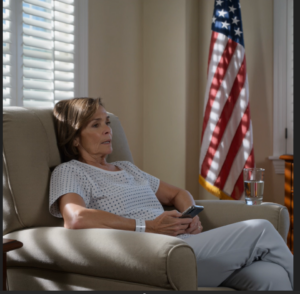
After Surgery, My Son Claimed My Beach House—So I Changed the Locks
Phân cảnh 1: A lonely recovery
The nurse wheeled me out of that hospital, and not one member of my family stood there to walk beside me. 68 years old, three days removed from surgery that could have ended my life, and the only handstying mine belonged to a woman who wasn’t even blood.
My name is Erlene Nashby. I’ve buried a husband, raised a son by myself after that, and built a life I was proud of, brick by brick, without asking anyone for help I didn’t absolutely need.
So when I say no one came, understand that I’m not a woman who says that lightly, and I’m not a woman looking for pity either. I’m only telling you what happened, plain, the way it happened.
My neighbor, Mr. Dolores, picked me up from the hospital that morning. She didn’t have to. She’d seen the ambulance leave my driveway 3 days before and just showed up at discharge time like she already knew nobody else was coming.
On the drive home, she glanced over at me at a red light and said, real quiet, “I thought Dorian would have been the one to come get you.”
I didn’t answer right away. I just watched the light change and told her to go on ahead. Mine turned green.
That’s my son’s name, Dorian. And in case you’re wondering, no, he wasn’t overseas. And no, he wasn’t in some hospital of his own fighting something worse.
He was 20 minutes away in his own house, living his own life, while his mother went through diagnosis, then chemo, then a surgery that carved 12 in across her stomach entirely without him.
Not once. Not for the diagnosis, when I sat in that cold office alone and heard the word cancer for the first time. Not for a single round of treatment, when I’d come home so sick I couldn’t stand long enough to make a bowl of soup.
Not for the surgery, when they wheeled me back, not knowing for certain if I’d wake up. A text here, a call there, always short, always distant, always exactly enough to say he hadn’t completely disappeared, and never enough to say he cared.
I want to ask you something before I go further, because it matters to me. What time is it where you’re at right now watching this? Morning with your coffee? Late at night, when the house finally goes quiet and it’s just you and your phone?
Tell me in the comments. I read every single one.
Miss Dolores walked me inside my own front door, sat with me until I got settled in my chair, and made sure I had water and my medication within reach before she finally left.
I sat there in that quiet house for the first time in days, not moving, just breathing, feeling my own heartbeat in a body that had been cut open and sewn back together without a single member of my family present to witness it.
I closed my eyes for a moment, just to rest them, just to feel, for one moment, like nothing else in the world existed but stillness.
Then my phone rang. I looked down at the screen, expecting Miss Dolores, checking that I’d made it in fine. It wasn’t her.
It was Dorian.
Phân cảnh 2: The betrayal revealed
I answered on the third ring, mostly out of habit. Some part of me still hoped it meant something when my son called.
“Ma.”
That was it. No “How are you feeling?” No “I heard the surgery went fine.” Just my name, flat, like he was reading it off a list.
“I’m here, Dorian,” I said. “Just got in.”
“Good. Good.”
A pause. The kind where I could hear him doing something else. Papers shuffling, maybe.
“Listen, I wanted to let you know so you’re not surprised or nothing. I had some work done on the Destin house.”
I sat up a little straighter in my chair.
“Work? What kind of work?”
“Remodel. New floors, repainted everything, redid the kitchen. It needed it, Ma. That place was outdated.”
He said it fast, like he was reciting something he’d rehearsed in his car on the way to work that morning.
I didn’t own that house with him. I didn’t own it with anyone.
I paid it off myself, dollar by dollar, over 11 years, back when his father was still living, and we’d talk about retiring down there one day. Dorian knew that. He’d always known that.
“Who told you to remodel my house?” I asked, keeping my voice even.
“I mean, it’s basically family property, Ma. Come on.”
A short laugh. The kind meant to make me feel foolish for even asking.
“And that’s the other thing. Latrice’s family needed somewhere to land, so I had them move in a couple weeks ago. They’re settled in real nice down there now.”
The room went very quiet on my end. Not because I didn’t understand him. Because I understood him perfectly.
“They live there now,” he said again, like I might need it repeated. “It’s working out good, actually. Her mama loves the beach.”
I looked at the wall across from me, at a photograph of my husband and me standing in front of that very house the year we bought it. Both of us younger, both of us proud of something we’d built together.
“Dorian,” I said, “that house has my name on the deed. Only my name.”
“Ma, don’t make this complicated. It’s not that deep. I handled it.”
His tone shifted just slightly toward the edge of irritation, like I was the one being difficult, like informing me my house was occupied by people I’d never met was a courtesy he was extending, not a decision he owed me an explanation for.
I thought about telling him right then exactly how deep it was. I thought about raising my voice for the first time in longer than I could remember. I thought about asking him where he’d been for the last 6 months while I sat in waiting rooms alone.
I didn’t do any of that.
“All right, Dorian,” I said instead, calm as still water. “Thank you for letting me know.”
He seemed almost thrown by how easy that was.
“That’s it? All right. Well, glad you’re not making a whole thing out of it. I’ll talk to you later, Ma.”
“You do that,” I said, and I hung up before he could say another word.
I sat there for a moment with the phone resting in my lap, the screen going dark on its own.
Then I smiled. Not because anything about it was funny. Because I already knew, with a certainty that settled into my bones like something ancient and familiar, exactly what I was going to do next.
My hand shook when I picked the phone back up. Not from fear. From something closer to fury, finally finding a place to go now that Dorian was off the line.
I scrolled to the name I needed and pressed call before I let myself hesitate.
Phân cảnh 3: Legal investigation
Otha Simmons had handled my husband’s estate all those years ago, and mine ever since. He’d known me since I was a younger woman with a living husband and a house full of noise.
He answered on the second ring, the way he always did, like he kept a phone in his hand out of habit.
“Erlin, I heard you were discharged today. How are you feeling?”
“I’ve been better, Oa, and I’ve been worse. But that’s not why I’m calling.”
I took a breath, steadying my voice until it came out even.
“My son just informed me that he had my beach house in Destin remodeled and that his wife’s family has moved into it, without asking me, without telling me until it was already done.”
There was a pause on his end, the kind of pause that told me he was already working, already thinking three steps ahead the way he always did.
“When you say your beach house,” he said slowly, “I want to make sure I’m remembering this correctly. That property is titled how exactly?”
“Solely in my name,” I said. “It’s always been solely in my name. I bought it after Charles passed, paid it off myself. Dorian’s never had any claim to it, and he knows that.”
“That’s what I have on file as well,” Otha said. “But I want to be direct with you, Erine, because I know you don’t need me softening anything.
“If your son has been telling people, even informally, that it’s family property or that he has some right to make decisions on it, that tells me something. People don’t usually make that kind of move unless they believe, on some level, they can get away with it.”
I sat with that for a moment. Not because it hurt. Because it was true, and hearing it said plainly by someone outside my family made it real in a different way than hearing it from Dorian himself.
“So, where do we start?” I asked.
“First thing tomorrow, I’ll pull the deed myself, get you an official copy so there’s no ambiguity for anyone, including you. If it’s titled the way we both believe, then anyone occupying that property without your permission is there unlawfully, and we can move quickly on that. But Erine…”
He paused again, and something in the shift of his voice told me the pause wasn’t procedural this time.
“I need you to think back for me. In the last year or so, since your diagnosis, has anyone had you sign anything? Any paperwork? Any forms, anything you might not remember clearly because of everything you’ve been going through?”
I frowned, the question catching me somewhere I hadn’t expected to feel caught.
“Why are you asking me that?”
“Because I want to rule something out before it becomes a problem,” he said. “I’d rather ask you now while I don’t have a reason to worry than find out later that I should have.”
I didn’t have an answer ready for him. Not yet.
Something in the back of my mind stirred, faint and unclear, like a memory standing just outside a lit doorway, refusing to step all the way in.
“I’ll think on it,” I told him. “Call me tomorrow with the deed.”
“I will,” he said. “Get some rest, Erine. You’re going to need it.”
I didn’t sleep much that night. I lay in bed replaying every word of that phone call, hearing the certainty in Dorian’s voice. The way he’d said, “It’s basically family property,” like he believed it down to his bones.
A man doesn’t speak that plainly unless somewhere along the way he convinced himself the lie was true.
Oa called a little after 9 the next morning, earlier than he’d said he would.
“I pulled it first thing,” he said.
No small talk this time.
“I wanted you to hear it directly from me before you spent another hour wondering.”
“Go on.”
“The deed to the destined property is titled exactly the way you remembered it. Solely in your name. No joint ownership, no transfer of interest, nothing added or amended in years.
“Dorian’s name doesn’t appear anywhere on that document. Not as an owner, not as a beneficiary, not as anything.”
I closed my eyes and let out a breath I hadn’t realized I was holding since the moment he’d called me yesterday. Relief moved through me first, quick and clean.
Phân cảnh 4: Confronting the occupants
Then something else moved in right behind it.
“He knew that, oatha,” I said quietly. “Dorian knew that house wasn’t his. He stood in that living room. He helped his father and me talk about retiring there. He knows exactly whose name is on that deed.”
“I believe you,” OA said. “And that matters, because it tells us this wasn’t a misunderstanding. A person who thinks they might have a legitimate claim usually hesitates, checks first, asks a question somewhere along the way.
“He didn’t ask you anything. He informed you after the fact, once people were already living there.”
“So what does that mean legally?”
“It means anyone currently occupying that house is doing so without the consent of the actual owner, which is you. Since no lease or rental agreement exists, and Dorian was never an owner with any authority to create one, the people living there don’t hold any teny rights.
“That doesn’t mean police can remove them the moment we file a report. It means we can give them clear formal notice to leave with a deadline. And if they don’t comply, that refusal is what allows it to move forward as trespassing rather than something that has to sit in civil court for months.”
I thought about the Marber, people I’d never met, sleeping in rooms Dorian had repainted with money I hadn’t given him permission to spend, on floors he’d installed like he was already the man of that house.
I felt something for them briefly. Not much. They weren’t the ones who owed me an explanation.
“What do we do now?” I asked.
“I’d recommend we contact the Destin Police Department today so an officer can go out, verify the deed, and deliver formal written notice directly. I’ll have a certified copy sent over as well, so there’s no question raised about authenticity.”
“Do it,” I said without hesitation. “Today.”
I paused, choosing my next words carefully.
“I don’t want this to look like cruelty. Whatever happens to the people in that house, I want them given a fair chance to gather their things and go on their own if they’re willing. I’m not interested in putting anyone out onto the street with nothing.”
“Understood,” he said. “I’ll make sure the notice reflects that. A clear deadline, but a reasonable one. But Erlene, I want to prepare you. Once law enforcement gets out there, they may find more than just the occupancy issue.”
Something in his tone shifted, careful and deliberate, the way it had the night before when he’d asked about paperwork I couldn’t quite remember.
“What do you mean?” I asked.
“I mean, renovations like the one Dorian described don’t pay for themselves. Someone financed that work. And I’d like to know where that money actually came from before we’re surprised by the answer.”
I wasn’t standing on that porch in Destin when it happened. I was still in Atlanta healing, waiting by my phone, but Otha called me not even an hour after Deputy Marcus Teal knocked on that door, and he walked me through every detail while it was still fresh, because he knew I needed to hear it plainly, not softened.
Teal arrived a little past 10 that morning, alone, unannounced. A woman answered the door.
Otha said her name was Mrs. Marberry, Latrice’s mother, and behind her, he could see the shape of a family settled in. Shoes lined up by the entrance, framed photographs already hung on walls that used to hold mine.
“I’m going to need to see a lease agreement for this property,” Teal told her. “Or any documentation showing you have legal permission to be here.”
She hesitated, called out for someone deeper in the house. Her husband came to the door next, along with one of their grown sons. And between the three of them, they produced nothing.
No lease, no rental agreement, no utility bill in their name, no piece of paper anywhere that tied them to that house beyond the fact that they were standing inside it.
“My son-in-law set all this up,” Mr. Marberry said. “Dorian. He told us it was handled.”
“I understand that’s what you were told,” Teal said, “but I need to be direct with you. Dorian Ashb doesn’t own this property. He’s never owned this property, which means he had no legal authority to grant anyone permission to live here, whether he called it family property or not.
“Right now, the three of you are occupying a home that belongs to someone else without a lease, without a rental agreement, and without the actual owner’s consent. That’s not a tenency dispute. That makes you occupants with no legal standing here at all.”
OA said there was a long pause after that. The kind where people’s faces change before their words catch up.
“We didn’t know,” the younger Marberry son said. “We really didn’t know any of that.”
“I believe you didn’t know,” Teal told them. “But not knowing doesn’t change what it is. Because there’s no lease and no rent being paid, this isn’t a teny that requires a formal eviction.
“I’ll be leaving written notice today, giving you a deadline to vacate voluntarily. If that passes without you leaving, it moves into trespassing territory from there.”
Mrs. Marberry’s voice cracked when she spoke again.
“We just moved our whole life down here. Latrice said this was going to be home.”
OA told me Teal’s expression didn’t change, but his voice softened just slightly, enough to be human about it without bending the facts.
“I understand this is hard to hear,” he said. “But my job right now is to determine the legal status of this property, and I have to do that based on what’s actually documented, not on what anyone was told.”
He asked if he could look around, mostly to confirm there was no separate rental paperwork tucked away somewhere they’d forgotten to mention. And Mr. Marberry, wanting to cooperate, waved him toward the kitchen himself.
“Look wherever you need to. We got nothing to hide. We just didn’t know.”
It was Mr. Marberry who reached for the folder sitting on the counter beside a stack of unopened mail, opening it himself to show Teal there was nothing inside but paperwork from the renovation.
“See, this is just Dorian’s stuff from the contractor. That’s all that is.”
Teal looked closer anyway, now that it was open and offered to him. Invoices. Renovation invoices dated over the last several months, every single one of them addressed directly to Dorian Ashb.
OA called me a second time that afternoon, and I could tell by the pace of his voice that things had moved forward while I sat in my own living room, still healing, still hundreds of miles away from a house I’d never invited anyone into.
“Deputy Teal spoke with the Marberry family again after seeing those invoices. He said he wanted me to relay something to you directly, and I think you should hear it exactly as he said it.”
“Go on,” I told him.
“He explained to them that because there’s no lease, no rental agreement, and no proof of rent or utilities ever being paid in their name, they don’t hold any tenant rights under Florida law. Since Dorian never had ownership or legal authority over that property, he couldn’t have created a valid teny in the first place.
“That means this doesn’t require a formal eviction process the way a real tenency would. What it requires is written notice with a clear deadline to leave voluntarily. If they don’t comply by that deadline, it moves forward as trespassing from there.”
I sat with that for a moment. Not triumphant, just still.
“What did they say to that?” I asked.
“Mrs. Marberry asked if there was any way to have a little longer, get their bearings, figure out where they’d go next. Teal told her that wasn’t his decision to make, that the timeline belonged to you as the owner.”
“And what did you tell him?”
“I told him what you’d already told me. No cruelty, but no more time than what’s fair either.”
“Give them a day,” I said. “One full day to gather their belongings and go on their own. Not because the law requires it, because I’m not the kind of woman who puts people out with nothing, even people I never invited in to begin with.
“But make sure the notice is clear, OA. If they stay past it, I need them to understand exactly what that means.”
“That’s what I relayed,” OA said. “Teal delivered the notice to them exactly that way, in writing, with the deadline spelled out. A day starting this morning.”
I thought about that family for a moment, truly thought about them, the way I imagine most people wouldn’t in my position. They hadn’t asked to be caught in the middle of what my son had done. They’d simply believed him the way people do when someone they trust tells them a thing is settled.
“How did they take it?” I asked.
“Not well,” Otha said. “Teal said the younger son got upset, started saying this wasn’t fair, that they’d already given up their old apartment, already had their mail forwarded down there. Mrs. Marberry didn’t say much. She just sat down at the kitchen table and put her face in her hands.”
I closed my eyes briefly, letting that image settle without letting it move me off what I already knew needed to happen. Sympathy and consequence aren’t opposites. A person can hold both at once.
“They’ll manage,” I said quietly. “People do.”
“I imagine so,” Oa said.
Then his voice shifted the way it always did right before he told me something that mattered more than the sentence before it.
“Erine, there’s something else. When Mr. Marbury opened that folder to show Teal it was only renovation paperwork, Teal asked if he could photograph the pages before he left, just to have a copy for the file. Marberry didn’t object, so he’s sending them to me directly, not just noting them in his report.”
“Why would he want copies of that?”
“Because he said something about them didn’t sit right with him. The dates, the amounts, the way they were organized. He said, in his words, that it looked less like a homeowner’s renovation and more like someone was keeping a paper trail they didn’t want questioned.”
Oa didn’t call that evening. He came by my house in person, which told me something before he said a single word.
I let him in and we sat in my living room. The same chair I’d been sitting in when Dorian first called me with his news. Oa didn’t waste time on pleasantries.
Phân cảnh 5: The financial discovery
“I pulled the invoices Teal sent over and traced the payment records myself,” he said. “Since you’re still a signer on that account, I had you sign an authorization earlier this week so the bank would release the statements directly to me. I wanted to see this with my own eyes before I said anything to you.”
“And what did you see?”
“The renovation was paid for through wire transfers and checks, all processed through an account with two names attached to it. Dorian’s and yours.”
I sat very still.
“That’s not possible. I don’t have any joint accounts with my son. Never have.”
“You do,” Oa said gently but without hesitation. “An old one. From what I can tell, it goes back to when Charles was alive.
“Likely set up as a backup account in case something happened to either of you. Dorian was added as a secondary signer years ago, probably as a precaution. It looks like it was never formally closed after Charles passed.”
Something in my chest went cold and quiet at the same time. I thought of that account buried somewhere in the back of my memory, one of a dozen things Charles and I had set up decades ago, and simply stopped thinking about once the immediate need for it passed.
“I forgot that account existed,” I said quietly. “I haven’t touched it in years.”
“That’s exactly the problem,” OA said. “You forgot it. He didn’t.”
I felt my hands tighten in my lap, the composure I’d been holding on to since that first phone call beginning for the first time to genuinely slip.
“How much?” I asked. “How much did he take out of it?”
“I don’t have the full picture yet. What I can tell you is that the renovation invoices alone account for a significant sum, and they were paid directly out of that account over several transactions. Spaced out, not all at once.”
“Spaced out,” I repeated. “Like he was trying not to draw attention to it.”
“That’s what it looks like to me too,” OA said. “But Erine, I don’t want to guess at the scope of this based on a handful of invoices. I need to see the full statement history for that account.
“Going back as far as the bank will allow, months, maybe longer. I need to know exactly when this started. And I need to know if renovation costs were the only thing that money went toward.”
I looked at him, and for the first time since this entire nightmare began, I felt something other than resolve move through me. Something closer to real fear.
Not fear of Dorian. Fear of what I might be about to learn about my own son, in black and white, with dates and numbers that wouldn’t lie to me the way he had.
“Pull it,” I said. “All of it. Whatever’s there.”
I hadn’t even finished my coffee the next morning when my phone rang with a number I didn’t recognize.
“Mrs. Ashb, this is Renee Callaway. I’m calling from the fraud compliance department at your bank. Do you have a few minutes?”
I set my cup down slowly.
“I do.”
“I want to let you know upfront, this call was generated by our monitoring system, not because anyone contacted us directly. We flag accounts automatically when there’s a pattern of large repeated transactions that fall outside typical activity for that account. Yours came up in our review.”
“Which account?” I asked, though some part of me already suspected the answer.
“The joint account under your name and Adorian Ashb. There’s been some unusual activity, and given that you’re the primary account holder, we wanted to confirm a few things directly with you and make sure everything on file is accurate.”
I felt something settle in my chest. Not relief exactly, but something close to it. Confirmation.
I hadn’t imagined any of this. A machine with no opinion about my family and no stake in any of it had looked at the numbers and decided something was wrong.
“I appreciate you calling,” I said. “I actually have an attorney already reviewing that same account.”
“That’s good to hear,” Renee said. “Since he’s already working on this, I’d recommend having him submit a formal records request directly to us. Once we have that on file, we can release the full transaction history to him, so he’s working from everything, not just what’s already come up on your end.”
I called OA the moment I hung up with her, and he listened without interrupting until I finished.
“That confirms what I suspected,” he said. “This wasn’t just something we stumbled on to ourselves. The bank’s own systems flagged it independently, which means when this goes anywhere near a courtroom, we’re not relying only on my findings. I’ll get the request filed with them today so I can pull everything they have.”
It took him until the following afternoon to get the full release back from the bank. When he called, his voice carried the particular calm he used right before telling me something that wasn’t calm at all.
“I have it,” he said. “The renovation payments were what triggered their system. But once I had the complete history in front of me, the pattern went a lot further than just those construction payments.”
“Meaning what?”
“Meaning the irregular withdrawals didn’t start with the renovation. They go back much further than that. Further than I expected, and further, I think, than you’re going to want to hear.”
OA asked to come by that afternoon instead of saying it over the phone. And the moment I saw his face at my door, I understood why.
“I have the full timeline now,” he said, sitting across from me, a folder resting unopened in his lap like he didn’t need it to say what he’d already memorized. “I want to walk you through it carefully, because I think the order of events matters more than the numbers themselves.”
“All right.”
“The withdrawals from that joint account didn’t begin around the time of the renovation. They started earlier than that. Small amounts at first. A few hundred here, a few hundred there.
“Spaced out enough that they wouldn’t have caught anyone’s attention easily. That pattern began roughly 8 months ago.”
I did the math without meaning to, the way a mind does when it’s trying to protect itself from a truth it already senses coming.
“Oa, I wasn’t diagnosed until 5 months ago.”
“I know,” he said quietly. “I checked that against your treatment records before I came over. The withdrawals started three full months before your diagnosis, before anyone, including you, knew you were sick.”
The room seemed to tilt slightly, not from dizziness, but from the sheer weight of what that meant settling into me all at once.
“So, this was never about me getting sick,” I said slowly. “He didn’t start taking that money because he was scared of losing me.”
“No,” OA said. “Based on what I’m seeing, he started taking it before there was ever a reason to, which tells me this wasn’t a reaction to your illness at all. It was already in motion.”
I wanted, for one brief and foolish moment, to find some version of this that made sense in a way I could forgive. Maybe he’d needed help with something and was embarrassed to ask. Maybe there was a debt, a hardship, something human and understandable underneath it.
“Is there any explanation for it?” I asked. “Other than the obvious one?”
OA didn’t rush his answer, and I respected him for that.
“I’ve looked at this from every angle I can think of. The amounts are inconsistent with an emergency. The timing doesn’t match any hardship I can find on record.
“And the way the withdrawals were spaced, deliberately small and irregular, tells me someone was trying not to be noticed, not trying to solve a single urgent problem.”
I sat with that in silence for a long moment. Whatever anger I’d been carrying since that first phone call felt suddenly beside the point.
This wasn’t rage anymore. This was grief, plain and simple, for a version of my son I apparently never really knew.
And then, uninvited, a memory surfaced.
Months back, during an earlier hospital stay, long before this last surgery, Dorian had shown up unannounced with a folder of paperwork, telling me it was just a routine update to my old healthcare directive. I remembered signing something, groggy, barely able to hold the pen steady.
I hadn’t thought about that folder once since that day until now.
I told Oa about the folder the next morning. Every detail I could recall. The hospital room. Dorian standing over my bed instead of sitting.
The way he’d said “just paperwork” so casually I hadn’t thought to ask him to slow down and let me read it properly before I signed.
Oa didn’t say much while I talked. He just listened, jaw tight, the way a man listens when he’s already building something in his mind.
“I want to widen the document request tied to the financial investigation,” he said when I finished. “If Dorian had something prepared in advance, there’s a good chance a copy exists somewhere in his own records. An email, a saved file, something he kept for himself, even if he never filed it anywhere official.”
It took him two days to track it down. When he came back, he didn’t call first.
He simply arrived. And I knew from the set of his shoulders that whatever he’d found had unsettled even him.
Phân cảnh 6: The power of attorney
“I found it,” he said, laying a single page on the table between us. “It turned up in the records his bank released as part of the exploitation review, a scanned copy he’d saved himself.
“It’s an amendment to your existing power of attorney. As written, it would have expanded Dorian’s authority significantly, giving him control over financial decisions well beyond what your original document allowed.”
My hands went cold, looking at my own signature, shaky, barely resembling my normal handwriting.
“Is it valid?” I asked, though some part of me already feared the answer.
“No,” OA said.
And for the first time since this began, I heard something like relief in his voice.
“It’s not valid, and it never was. A change like this requires proper witnesses and a notary to be enforcable under Florida law. This document has neither. No notary seal, no witness signatures, nothing.
“Whoever prepared this either didn’t understand the requirements or knew exactly what they were and hoped no one would ever look closely enough to catch it.”
“So he never actually had that authority?”
“No, legally it changed nothing. Your original power of attorney remained exactly as it was.
“But Erlene, I don’t want you to focus only on the fact that it failed. I want you to focus on the fact that he tried it at all. And he tried it while you were medicated, recovering in a hospital bed, in a moment when you were least able to protect yourself.”
Something shifted in me hearing him say it plainly like that. Not surprise. Something colder, quieter, more settled than the grief I’d carried since learning about the withdrawals.
“He didn’t just take money from me,” I said. “He tried to take control of me.”
“Yes,” Oa said simply.
No softening, no cushioning.
“That’s exactly what this is.”
I sat with that truth until it no longer made my hands shake.
“What does this change?” I asked. “Legally, I mean.”
Oa closed the folder slowly, meeting my eyes with a kind of resolve I hadn’t seen from him yet in all of this.
“It changes everything,” he said. “Attempting to exploit a power of attorney while you were incapacitated isn’t just a financial matter anymore.
“Depending on how the prosecutor wants to proceed, this could elevate what we’re dealing with well beyond simple theft. Erine, this is the piece that could turn an internal family matter into a criminal case with real consequences.”
Phân cảnh 7: Charges and consequences
Deputy Teal called OA directly the next morning, and OA patched me in so I could hear it as it happened rather than secondhand.
“I wanted to update you both together,” Teal said. “After the notice to vacate was delivered, the Marberry family was given until yesterday evening to leave the property voluntarily. They didn’t.
“When I went back out this morning, they were still there. And Mrs. Marberry told me directly they had nowhere else to go yet and weren’t ready to leave. At that point, with clear notice already given and refused, the state attorney’s office moved forward with trespassing charges.”
“So, they knew,” I said. “They knew they had to go and they stayed anyway.”
“They knew,” Teal confirmed. “I made sure of that myself, in writing, with a timeline attached.
“I also want you both to know the financial irregularities you flagged have been forwarded to a separate unit that handles exploitation cases involving elderly or protected individuals. That investigation is opening independently now alongside this one.”
“Independently meaning what?” I asked.
“Meaning it’s no longer just your attorney building a case,” Teal said. “It’s now a matter law enforcement is actively investigating on its own, separate from the property issue.”
I thanked him, and the call ended quietly, almost gently, considering the weight of what it confirmed. I hadn’t even set my phone down fully when it rang again.
Dorian’s name lit up the screen for the first time since that first call when he’d told me so casually that they lived there now. I answered.
“Ma.”
His voice came fast, clipped. Nothing like the breezy confidence from before.
“Ma, what did you do? Latrice’s parents just got served with charges. Trespassing. You had them arrested.”
“I didn’t have anyone arrested, Dorian,” I said, keeping my voice level. “They were given a clear deadline to leave and chose to stay past it. What happened after that wasn’t my decision to make.”
“You could have called me first. You could have given me a chance to fix this before it went this far.”
“You had months to tell me the truth,” I said. “You chose not to.”
There was a pause, and when he spoke again, his tone shifted, softer, almost pleading.
“Ma, please. Latrice’s family has nowhere else to go right now. Can’t you just drop it? I’ll pay you back. Whatever it costs, just make this go away.”
“Pay me back,” I repeated slowly. “For the house or for the account you’ve been pulling from since before I even got sick?”
The silence on his end stretched long enough that I knew without him saying a word that he understood exactly what I meant.
“Ma, I don’t know what you think you found, but—”
“Don’t,” I said quietly. “Don’t do that right now. Not after everything.”
“This isn’t fair,” he said.
And for the first time, I heard something crack underneath the anger in his voice. Something closer to fear.
“You’re really going to let this destroy everything over a house?”
“It was never about the house, Dorian,” I said. “Not really. It stopped being about the house the moment I found out what else you’d been doing.”
He didn’t respond right away. I could hear him breathing uneven, like a man realizing the ground beneath him wasn’t as solid as he’d believed.
“What else?” he said finally, quietly. “What do you think you found?”
I didn’t answer that. Not yet.
I simply ended the call, the way I had the very first time, and sat once more with the silence I’d learned to trust far more than his voice.
I didn’t witness what happened next firsthand. OA pieced it together over the following two days, partly from Teal, partly from what eventually reached us through the Marbury’s own attorney once they’d hired one.
Phân cảnh 8: Silence as a resolution
Dorian had gone straight from our phone call to the county jail, trying to post bail for Latrice’s parents and her brother himself. Confident at first, the way he’d been confident about everything up to that point.
He gave the clerk his account information, expecting it to move through the way it always had. It didn’t.
The transaction was declined, then declined again on a second attempt, this time with a message indicating the account was under review and temporarily restricted.
OA explained it to me plainly when he called.
“Once a formal financial exploitation investigation opens, the specific account under review gets a hold placed on it while the investigation is conducted. It’s standard practice meant to preserve whatever funds remain until investigators can determine what happened.
“That joint account is frozen now, and he has no access to move money out of it. Not for bail, not for anything else, until the investigation concludes or a court says otherwise.”
“What about his other accounts?” I asked. “The ones that have nothing to do with any of this?”
“Those aren’t affected,” O said. “The hold only applies to the account under investigation. But from what Teal mentioned, it sounds like Dorian didn’t have much built up anywhere else. Whatever he’d normally have relied on for something like this, he’d been running through that joint account for a long time.”
I imagined him standing at that counter, humiliated, watching his name get flagged in front of strangers, unable to produce the one thing he’d promised the Marber he could fix.
He apparently tried calling around after that. First a personal loan from a coworker, then a payday service. Scrambling in ways OA said rire of a man realizing in real time the full weight of what he’d done.
Nothing came together fast enough. The Marberries remained held overnight, waiting on a bail hearing instead of the quick release Dorian had promised them.
Latrice, from what her own attorney later confirmed, had been standing beside him at the jail when the second transaction failed. She said very little in the moment.
According to the account Oa received, she simply stood there watching her husband’s composure unravel in front of her, in front of her own family, over money he’d sworn up and down was never a problem.
It wasn’t until they were back in the car alone that she finally spoke.
“Dorian,” she said, her voice steady in a way it apparently hadn’t been all day. “Where did all that money actually come from? The renovation, the down payments, all of it. I want the truth this time, not the version you gave me before.”
He didn’t answer right away, Oa said. The silence stretched long enough that Latrice apparently asked him again, sharper this time, like a woman no longer willing to accept his silence as an answer in itself.
“Dorian,” she said, “where did it come from?”
Dorian sat with his hands on the steering wheel, engine off, staring straight ahead like the windshield owed him an answer he couldn’t find anywhere else.
“Latrice,” he started.
“Don’t say my name like that,” she said. “Just answer me. Where did the money come from?”
He exhaled slowly, and when he spoke, the confidence that had carried him through months of careful lies finally gave out completely.
“My mother’s account,” he said. “An old joint account from when my father was alive. I’ve had access to it for years. I used it for the renovation. For some other things, too, before that.”
Latrice didn’t move.
“Some other things? What does that mean, Dorian?”
“It means I’d been taking from it for a while,” he said. “Before she got sick, before any of this house stuff even started.”
She turned to look at him fully then, something in her expression shifting from anger into something colder, more exact.
“You’ve been stealing from your mother while she was sick. While she was in the hospital fighting for her life, you were taking her money.”
“I wasn’t stealing,” he said, weak even to his own ears. “I always figured it’d be mine eventually anyway. I just—”
“Stop,” Latrice said. “Just stop talking.”
She sat there a long moment, and something in her began working backward through months she’d let pass without asking the questions she now realized she’d always had the instinct to ask.
The renovation moving faster than his salary should have allowed. The way he’d brushed her off once when she’d asked directly where the money was coming from. The way she’d let it go because the answer, whatever it was, was giving her parents a beautiful place to live, and she hadn’t wanted to be the one to ruin that.
“I asked you once,” she said quietly. “I asked you where the money was coming from, and you told me not to worry about it. And I didn’t push. I just took the answer I wanted to hear and let it be enough.”
“Latrice, that’s not the same as—”
“I’m not finished.”
Her voice hardened.
“I let myself not know, Dorian. I saw enough to wonder, and I chose comfort instead of asking harder. That’s on me.
“But you, you looked me in the eye every single day, knowing exactly what you’d done, knowing exactly whose money was under our new floors and our new kitchen. And you let my parents move into a house built on a lie you never planned to tell any of us.”
He said nothing. There was nothing left to say that would undo what was already spoken.
“My parents are in a jail cell right now,” she said, “because of something you did, not something they did. And you couldn’t even bail them out because the money you promised them was never really yours to give in the first place.”
She reached for the door handle, then paused, her hand resting there for a moment before she turned back to him one final time.
“I need to see my parents,” she said. “Before I decide anything else about you, about us, about any of it, take me to them now.”
The first call came in that evening, not long after Latrice had walked out of that car and, from what I later learned, out of their house as well, taking a bag with her to stay with a cousin.
I watched Dorian’s name light up my screen and let it ring until it stopped on its own. The second call came 4 minutes later.
“Ma, please just pick up. I need to talk to you.”
His voicemail was rushed, pleading, a version of his voice I hadn’t heard directed at me in years. I listened to it once all the way through and didn’t call back.
By the fifth call, his tone had shifted. Less pleading, more accusing.
“You’re really going to let this ruin everything over money you weren’t even using? Latrice left. Ma, she left because of what you dug up. I hope you’re satisfied.”
I set the phone face down on the table and made myself a cup of tea. The calls kept coming through the night, closer together as the hours passed, like a man trying to outrun something he could no longer see the edges of.
OA called once in the middle of it, letting me know the prosecutor’s office had confirmed formal charges would be pursued against Dorian directly, separate from whatever happened with the Marbberies. I thanked him, calm, and returned to my chair.
Somewhere past midnight, Dorian’s voice had changed again. This voicemail came through quiet. None of the earlier heat left in it.
“Ma, I don’t even know what to say to you anymore. I don’t know how any of this got this far. I just need to hear your voice, please.”
I sat with that one longer than the others, not because it moved me toward answering, but because I recognized, finally, the fear underneath all his noise.
Not fear of consequences. Fear of what he already understood he’d lost, and couldn’t buy or argue or charm his way back into.
By morning, the calls had thinned to nothing, then started again in a fresh wave once the sun came up, as though a full night of silence from me had convinced him a new day might yield a different result.
“Ma, it’s me again.”
His voice cracked slightly on the last word.
“I talked to a lawyer. He says I could be looking at real charges. Ma, I could go to prison over this. Please just call me back. Please.”
I counted later, out of something between curiosity and disbelief, scrolling back through the log OA’s office had asked me to keep for the record. 72 missed calls spread across less than 24 hours.
Each one a small monument to a man discovering, one ring at a time, that the mother he’d assumed would always be there to catch him wasn’t answering anymore.
I never picked up. Not once.
And then, sometime in the early afternoon, the calls simply stopped. The silence that followed felt different than the silence before it. Not painful, not empty. Earned.
OA called a week later with an update, the kind that no longer landed as a shock, only as confirmation of where all of this had always been heading.
The Marbberies had accepted a plea agreement on the trespassing charge, given the circumstances OA had made sure were documented clearly, that they’d been misled by Dorian rather than acting with any intent of their own.
They’d moved back in with relatives near their old home, starting over somewhere far simpler than a renovated beach house that was never truly theirs to accept.
Dorian’s case moved slower, the way these things often do, but it moved.
Formal charges were filed for financial exploitation of a vulnerable adult, built primarily on the withdrawal pattern itself and the bank’s own independent findings.
The attempted power of attorney amendment couldn’t stand as a crime on its own since it had never legally taken effect. But OA said the prosecutor was using it as clear evidence of intent, proof that what happened wasn’t a son’s confusion about family property, but a deliberate effort to gain control while I was at my most vulnerable.
Between the timeline, the withdrawals, and that one unnottorized document, OA said there was little room left for any other explanation.
Latrice never went back to that house.
She stayed with her parents for a while after everything came out, helping them rebuild in the quiet, unremarkable way people do after losing something they never should have been given in the first place.
OA mentioned once that she’d reached out to him directly, not about Dorian’s case, but simply to say she was sorry for her part in not asking harder questions sooner.
I didn’t need the apology. I understood better than most how easy it is to let a comfortable answer stand in for an honest one.
As for me, I healed the way bodies do, slowly, in a house that finally felt entirely mine again in every sense of the word.
I didn’t reclaim the destined house right away. I let it sit for a while, empty, until I was ready to decide what it meant to me now, separate from everything that had happened inside it.
I never did tell Dorian directly what I’d found. Not the withdrawals, not the paperwork, not any of it. I let the investigators, the charges, and the silence do what words never could have done as cleanly.
Sometimes I think about that first phone call, how casually he told me, “They live there now,” like my life was simply a formality he’d already worked around.
I think about how easy it would have been to scream, to argue, to demand answers right then and there. I didn’t need to, because everything that followed, every discovery, every consequence, every ring of a phone I refused to answer, was really just the answer to a question he never should have needed me to say out loud in the first place.
That I was still here, still capable, still exactly who I’d always been, even after everything he assumed I’d lost.
He called 72 times looking for the mother he thought he already buried. I let the phone ring because I’d already told him everything he needed to know the moment I smiled and hung…