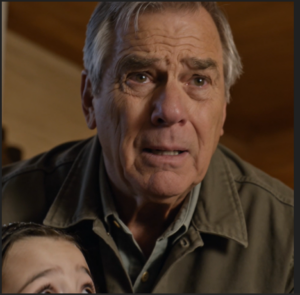
After My Daughter Died, I Saw a Little Girl Standing in the Blizzard Outside My Window—I Thought…
Phân cảnh 1: The unexpected arrival
The night my granddaughter knocked on my door, I had been sitting on the floor of Anna’s old bedroom for the better part of an hour, going through a box I had not opened since I moved into the cottage.
Outside, the storm had been building since noon. By 8:00, it had turned into something serious. The kind of February squall that comes off Lake Champlain and forgets to stop, piling snow in drifts against the fence posts, bending the hemlocks at the property line until they looked like old men leaning into a conversation.
I had lived in Vermont for 62 years. I knew how to read that kind of weather, and what I was reading told me the roads would be impassible by morning.
I was not thinking about the roads. I was thinking about a photograph.
It was small, 4×6, the kind that gets printed at a drugstore and then sits in a drawer for 20 years. Anna was 11 in it, standing in front of my workshop with both hands raised, holding up a birdhouse we had built together over three Saturdays in October. She was grinning so hard her eyes had nearly disappeared.
I had my arm around her shoulders, and I was grinning, too. The way a man grins when he is aware that a moment is good, but does not yet understand how good it actually is.
I had not understood it then. I understand it now.
I set the photograph down on the bedroom floor, and that was when I saw her.
Through the frost-edged window, in the space between the hemlock and the fence post, where the motion sensor light reached, a child was standing in the snow. She was not moving.
The storm was moving. The branches were moving. The snow was moving sideways in long diagonal sheets.
And this child simply stood in the middle of all of it, perfectly still, facing the window, facing me.
I was on my feet before I finished the thought. My hand went flat against the cold glass. The child did not move.
Grief does something to the mind that no one warns you about. It makes you see things.
For 5 years, I had been seeing Anna in shopping centers and parking lots, and once, on a Tuesday afternoon in September, in the face of a young woman getting off a bus two blocks from the hardware store in Burlington. I had followed that woman for half a block before I caught myself. It had cost me 2 weeks of sleep.
I told myself this was the same thing. The snow, the dark, the box of photographs I had just opened. My tired, worn-out mind doing what it always did.
Then the knocking started.
Phân cảnh 2: A child in the storm
Three hard wraps on the front door. Rapid, frightened. The sound of small fists working harder than they should have to.
I crossed the living room in four steps and got the door open.
She was six years old, maybe seven. Dark hair plastered against her face by the wet, a winter coat that had done its best and lost the argument with the weather about 20 minutes ago, soaked through to what I suspected was a thin sweater underneath.
Her boots were the right kind for the cold, but her laces had come undone, and one sock had slipped halfway off her heel. Her lips were the color of a bruise.
She looked up at me and said, in a voice so thin I almost missed it over the wind, “Please, mister, I’m really cold.”
I did not think. I brought her inside.
I got her coat off and sat her in front of the wood stove and added two logs without thinking about it, working from 30 years of muscle memory.
When I turned back to her, she had her hands extended toward the heat, palms flat, fingers spread, that instinctive gesture children have that looks like they are trying to take hold of the warmth itself.
I went to the closet for the heaviest blanket I owned. And when I came back and started to wrap it around her shoulders, I stopped.
Under the soil coat, she was wearing a cord around her neck, a simple length of braided leather, and hanging from it was a figure carved from cherrywood: a cardinal, small enough to fit in a closed fist, wings folded, head turned just slightly to the left.
On the left wing, if you looked carefully, you could see where the carving took a small detour, a thin vine curling across the feathers, covering a chip in the wood, where my knife had slipped on a cold November afternoon in my workshop 22 years ago.
I had carved that cardinal myself.
I had carved it for Anna’s 10th birthday, spent 6 weeks on it, and when the knife slipped and chipped the wing, I had been so annoyed at myself that I spent another three evenings finding a design that would make the mistake look intentional.
Anna had examined it the way children examine things that matter to them, turning it over slowly in her hands, running her thumbnail along the vine.
“You made the vine because the wing broke,” she said.
Not a question, an observation.
“Yes,” I said. “Is that okay?”
She looked at me very seriously.
“It’s better,” she said.
I stood there in my living room with the blanket half wrapped around this child’s shoulders, and I could not move.
“Mister?” Her voice was worried. “Are you okay?”
I made myself finish tucking the blanket around her. My hands were steadier than I had any right to expect. I crouched down in front of her, so I was at her level.
“What’s your name, sweetheart?”
“Sophie.”
“How old are you, Sophie?”
“Six.” She considered. “Almost 7. My birthday is in April.”
“Okay.”
I kept my eyes on hers. The shape of her face was doing something to me that I was not ready for. I set it aside.
“Can you tell me what happened? How did you get out here in this storm?”
Her chin trembled.
“We were driving and the car went off the road. It went into a ditch and it tipped over.”
She pressed her lips together hard, fighting [snorts] it.
“My dad was driving and he wasn’t waking up. I tried to wake him up a lot of times, but he didn’t.”
My stomach dropped straight through the floor.
“Who’s your dad, honey?”
“Rafael.” She said the name carefully, three full syllables. “Rafael Medina. He’s my dad.”
I was already reaching for my coat.
I want to tell you who I was before all of this because it matters. I grew up in
Phân cảnh 3: The family history
Shelurn, Vermont, the second of three boys, in a house where my father kept a workshop off the back of the garage that smelled of sawdust and linseed oil, a smell I have never been able to separate from the word home.
I learned to use a chisel at 9, a hand plane at 11. By the time I was 17, I could build a cabinet from raw stock without a set of plans.
I had my own shop by 30, nothing grand, a converted barn on the edge of Shelburn with a sign out front and a parking area that flooded every spring.
I built furniture mostly, kitchen tables and bedroom sets, and the occasional piece of something custom: a rocking chair, a blanket chest, a cradle, the kind of work that moves into people’s homes and stays there.
That was where I met Cecilia.
She came in on a Friday afternoon in late August to commission a dining table for a house she had just sold. She was a real estate agent by then, doing well, the kind of well that involved new clothes and a new car every 2 years.
She wanted something with a farmhouse look, but not too rustic. I told her I could do that. She told me her timeline and her budget and the exact dimensions of the dining room.
She had done her research. I respected that.
We were married 14 months later.
I want to be honest about who Cecilia was because she was not a villain from the beginning. She was ambitious and particular, and she cared about appearances more than I did. But those things on their own do not make a person dangerous.
In the early years, I understood them as features of a woman who had grown up with very little and was working hard not to go back there. I had grown up with enough.
That difference in our starting points was always somewhere in the room. But for a long time, it stayed in the background where I could almost forget it.
Anna arrived in our lives on a Wednesday morning in March, 7B even, with a full head of dark hair and an expression that suggested she had significant opinions about the whole situation.
I held her for the first time and thought, “Everything I have done up until this moment was just the route that brought me here.”
She was quick and curious and stubborn in the particular way that made Cecilia tired and filled me with an unreasonable amount of pride.
She spent entire Saturdays in the workshop with me from the time she was old enough to sit safely on a stool, watching, asking questions, eventually doing. By 14, she could cut a proper dovetail joint. By 17, she was helping me finish pieces on deadline.
Cecilia thought it was not the right use of her time.
They did not fight about it openly. Cecilia rarely fought anything openly. She operated in suggestions and silences, and the particular look she had of looking at me across the dinner table that communicated a large amount without requiring her to say any of it out loud.
Over the years, I had gotten very good at reading that look and making adjustments before she had to articulate them. It was a skill I had developed the way a man develops any skill: through long practice and a genuine desire to keep the peace.
The problem was that I had been so focused on keeping the peace that I had not been paying attention to the war.
Anna was 22 when she came home on a weekend in November and sat across from me at the kitchen table and told me about Raphael. She had met him at the architecture firm where she had just started working.
He had immigrated from Colombia 3 years earlier. His green card application was in process. She told me they had been together 8 months and that she loved him and that she was 10 weeks pregnant.
I told her I was happy for her. I told her I wanted to meet him. I told her everything was going to be fine.
Cecilia was in the next room. She had not come to the table when Anna arrived, which was unusual enough that I had noticed it.
The argument that came later that night, after Anna had gone to bed, was the clearest Cecilia had ever been with me. She did not raise her voice. She never raised her voice.
She told me that Anna’s situation was going to become a problem. That Raphael’s immigration status made the whole thing precarious. That an unmarried daughter with a foreign boyfriend and an unplanned pregnancy was not something she was prepared to manage in front of her clients and colleagues and the people in this community who had watched her build something from nothing over 20 years.
I told her Anna was our daughter and this was our grandchild.
She looked at me with that particular expression and said very quietly that some situations required a practical response and that I was not equipped to provide one.
I should have pushed harder. I know that now.
I should have stood at that kitchen counter and told Cecilia in plain language that there was no version of practical that was going to override my daughter’s choices. And if she disagreed, she was welcome to say so directly rather than managing it in the background.
I should have said it that night. I should have said it every time it needed saying over the 23 years before that night.
I did not. I went to bed. I told myself it would sort itself out in the morning.
It did not sort itself out.
Anna was gone when I woke up. Her bedroom door was open. Her bed was made. The small carved cardinal that usually sat on her nightstand was gone.
I called her cell twice that day and got voicemail both times. I left messages I deleted afterward because they sounded like a man who did not know how to be what his daughter needed.
4 days later, Cecilia sat across from me at the kitchen table and told me that Anna had
Phân cảnh 4: Grief and deception
been in an accident. A highway outside of Burlington, a patch of black ice, early morning.
She said it had happened 2 days ago. She said it had been fast.
She said Anna had been cremated, that it had been something Anna mentioned once years ago, and that the arrangements had been made.
There was no service. There was no grave. There was nowhere to go.
I remember the specific quality of light in the kitchen that morning. The way it came through the window above the sink at a low winter angle and caught the grain of the table I had built myself 20 years earlier.
I asked for proof.
Cecilia produced a printed page, a brief obituary, Anna’s name, the dates. I read it three times and none of the words settled.
She told me calling around would only make things worse. She told me to let her handle it. She was good at handling things. I knew that better than anyone.
I took the pills she offered me that night. Something for sleep, she said, left over from a difficult period at work. I did not ask what they were.
The rest of it happened the way things happen when a person has left their own life and is watching the machinery run from somewhere far away.
The divorce papers appeared. I signed them. The workshop sold in an estate sale Cecilia organized while I was at my brother’s house for a week. The family home sold 3 weeks after that. I did not watch it go.
The cottage on Lake Champlain had been my parents’. My mother left it to me when she passed 12 years before all of this.
I drove there in February with a bag of clothes, my tools, and a cardboard box of things from Anna’s bedroom.
The box contained the photograph from the science fair, a small clay cardinal she had made in sixth grade that listed slightly to the left, and a birthday card she had drawn herself when she was eight.
A crayon cardinal on the front, red and lopsided, with an arrow pointing to it, and the words “Like yours, Dad” written in careful 8-year-old printing.
The cardinal in the picture had a chip on its left wing. I did not understand at the time why she had drawn it that way.
I sat with that card for a long time before I put it back in the box.
The first winter was the worst. Not because of the cold or the isolation, though both were real. Because of the silence, a particular silence that presses against the walls from the inside and reminds you at 3:00 in the morning that you are the only person in the building and that this is the situation indefinitely.
Hal Bricker, who lived in the next cottage down the road and had been my father’s fishing partner for 30 years, started leaving things on my porch in the second week.
Firewood once, a container of soup another time, a bag of rock salt when the steps iced over. He never knocked. I would just find the things there when I opened the door in the morning.
He was 71 years old and had been a game warden for three decades and understood, I think, the particular dignity of a man who needs help but cannot ask for it.
Dy Marsh at the general store in town started adding a second item to my bag every time I came in. I did not mention it. She did not mention it. We had arrived at an arrangement by the end of the first month without either of us having to name it.
Clarence Web at the lumber yard let me come in 2 days a week and do repair work. He did not ask about my life. He handed me jobs and I did them and the cash kept the heat on. That was the entire arrangement, and it was sufficient.
I thought about Anna every day. That did not change, and I did not expect it to. But the nature of it changed slowly, the way everything changes slowly when you give it enough time and enough mornings standing at a window watching the lake.
6 months before the night Sophie knocked on my door, I was reorganizing the closet in the back bedroom and found a box I had pushed to the far corner behind a pair of waiters in my father’s old fly fishing kit.
Inside were things I had not thought about since I packed them. Anna’s drawings from childhood, a report card from fifth grade, and at the very bottom, an envelope, small, off-white, my name on the front in Anna’s handwriting.
Just three letters. Dad.
The postmark on the upper right corner was dated 16 months after the morning Cecilia told me my daughter was dead.
The back flap had been torn open, not carefully—roughly, by someone who either did not care about the envelope or wanted whatever was inside quickly.
The envelope was empty.
I sat at the kitchen table with that envelope in my hands for a very long time. The lake outside was still. The porch light threw a yellow square on the snow.
Either the postmark was a clerical error or Anna had been alive when she wrote this. There were no other possibilities.
I sat with both of them until the coffee went cold. I did not sleep that night or the night after.
I drove into Burlington on the third morning and spoke to an attorney who looked at the documents I brought in with the careful, unhurrieded attention of someone who had seen versions of this before.
He told me what I had was not nothing. He told me there were things worth investigating. He told me to gather everything I had.
I was in the middle of that gathering when the February storm arrived. And the night it turned serious, I went into Anna’s room
Phân cảnh 5: Rescuing the father
to look for a specific letter I thought I had put in the box and found myself sitting on the floor instead with the science fair photograph in my hands, not looking for anything anymore.
And then I saw Sophie through the window. I got her warm. I got her talking.
And then I went out into the storm.
The cold hit me like a wall. I bent my head against it and moved toward the road, sweeping the flashlight beam low across the snow.
The tire tracks were still visible. Two parallel depressions filling in fast, but not gone yet. I followed them along the road and then off the shoulder into the treeine where the ground dropped sharply into the drainage ditch.
The car was there, a dark green SUV, passenger side down against the bank, one headlight still on, the beam angling uselessly up into the falling snow. The windshield had a long crack across the upper left corner.
I climbed up onto the driver’s side and got the door open against the resistance of the bent frame.
Inside, a man was slumped against the passenger side window. Dark hair, broad shoulders, a cut above his left ear that was bleeding steadily along the line of his jaw. The airbag had deployed and lay across his lap.
I checked his pulse and his airway and his breathing, and all three were present, which was the only thing that mattered.
I got him out. I will not pretend it was graceful.
I am 62 years old and I have a right hip that has been complaining since last spring, and the man was close to 200 lb at an angle that worked against every lever I had available. But I got him out and I got him back to the cottage, one arm over my shoulders, his feet finding the ground approximately.
Hal met us on the porch without being asked. He had seen the flashlight moving down the road from his window and made a decision.
That was Hal. I did not have to explain anything.
He got under the man’s other arm and we brought him inside and put him on the couch.
Sophie scrambled off the chair where I had left her.
“Papy.”
The word came out broken. She grabbed both his hands.
“Papy, wake up.”
His eyes opened slowly, unevenly, the way eyes open when the brain is still finding its way back from somewhere dark. He looked at the ceiling. He looked at Sophie. He looked at Hal.
Then he looked at me.
His expression shifted in a way I could not immediately name.
“Are you…”
His voice was a scrape. He swallowed, tried again.
“Are you Anna’s father?”
The room tilted.
I pulled a chair close to the couch and sat down. Hal took Sophie to the kitchen to find something warm. I could hear him opening cabinets, asking her in his quiet way whether she preferred hot chocolate or tea, and her small voice answering.
“Take your time,” I said.
He shook his head.
“I’ve been waiting to say this for 3 years.”
He looked at the ceiling for a moment, then back at me.
“Anna is alive. Her name is Anna Medina now. We got married 4 years ago at the courthouse in Burlington. Sophie was the flower girl.”
The corner of his mouth moved.
“She threw every pedal individually and took it very seriously.”
I put my hands on my knees. I did not trust my voice, so I said nothing.
“She never stopped trying to find you,” he said. “She wrote letters. She called your old number until it was disconnected. She drove past the workshop once, 2 years after everything, and it was already sold and someone else was inside.”
He paused.
“She didn’t know about the cottage. She thought maybe you had moved somewhere new. Started over.”
His jaw tightened.
“She thought maybe you had decided it was easier.”
“I never decided that,” I said.
“I know that now.”
“The letters,” I said. “I found one envelope, just the envelope. Empty.”
He looked at me, a single flat look that said the rest without words.
“Cecilia,” I said.
“The first time she came to us,” Raphael said, his voice careful and even, “Anna was 7 months along. We were in a one-bedroom apartment off North Wooki.
“Cecilia showed up at the door on a Saturday morning like she was making a house call. She told Anna you were devastated, that you blamed Anna for everything that happened, that you had said…”
He stopped, started again.
“That you had said you had no daughter anymore.”
The fire crackled. Neither of us moved.
“Anna didn’t believe it at first,” he continued. “She kept trying to reach you, but Cecilia kept coming back every few months. Each time she came, she brought something new, something you had supposedly said, something you had supposedly done, and she knew about my visa situation.
“My green card application was still pending then. She made sure we understood she knew people in positions to complicate things.”
He looked at the window.
“I wanted to call her bluff. Anna wouldn’t let me. She was terrified of what it would mean for Sophie if I was removed. She was protecting our family.”
“She was protecting all of you,” I said. “That’s Anna.”
Something softened briefly in his expression.
“She believes in not hurting people. Cecilia knew exactly how to use that.”
“Where is she?”
“Fletcher Allen.”
The large hospital in Burlington.
“She went in 4 days ago. A mass they found in October. Benign, but it had grown and it needed to come out urgently. The surgery went well. She came through it fine. Fen.”
He looked at me.
“But before she went in, she made me promise something. She said, ‘If anything got more complicated than expected, if she needed longer to recover than planned, take Sophie to the cottage at the lake. Find the man with the cardinal.’ She said you would have kept the one she made for you.”
I turned and looked at the shelf by the woodstove.
On it, among the few things I had arranged in 5 years of solitary living, sat a small clay cardinal, red, listing slightly to the left, exactly as it had listed when Anna made it in sixth grade and presented it to me with the gravity of an artist presenting her finest work.
She had remembered. She had told Sophie about it. She had told her where to find me.
“She talks about you,” Raphael said quietly. “Every day she talks about you. She tells Sophie about the workshop, about the cardinal you carved and the vine on the wing.”
He looked at me directly.
“She tells her that her grandfather spent three extra evenings turning a mistake into something beautiful because he didn’t want to give her something broken.”
I pressed the back of my hand against my mouth.
“She says that is who he is,” Raphael said. “She says that is the most important thing to know about him.”
From the kitchen, Sophie’s voice floated through.
“Can I see the clay bird?”
She was standing in the doorway, halled behind her with two mugs, watching me with her mother’s eyes.
I stood up, crossed to the shelf, and brought the clay cardinal to her. She took it with both hands and turned it carefully, found the slight list to the left, ran her thumb along the base.
“Mom said it was the first bird she ever painted,” she said very seriously. “She said she made it when she was my age, and she gave it to you to keep. She said you would still have it.”
“I kept everything,” I said.
She nodded once, as if this settled something she had needed to confirm.
She fell asleep on the couch an hour later. The clay cardinal sat carefully on the arm where she could see it. Hal draped a blanket over her and looked at me across the room with the expression of a man who has witnessed something he will not speak of unless asked.
I was still sitting across from Raphael when I heard the car.
It was the sound of it more than the sight: an engine running too smooth for the road conditions, the
Phân cảnh 6: Confronting the truth
particular quiet of an expensive vehicle that had never needed to work for anything.
The headlights swept across the front window and stopped.
Hal saw it first. He moved very quietly to the window and looked out, then back at me with the expression of a former game warden who has spotted something that does not belong in the territory.
“Silver car,” he said. “Vermont plates. Sitting.”
I already knew.
The door opened and she stepped out. I recognized the coat before I recognized her face. Fulllength, dark, the kind of coat that announces itself.
Then I recognized the way she moved. Deliberate, unhurried, the walk of a woman who has decided in advance that she belongs wherever she is standing.
I reached into my shirt pocket and pressed record on my phone.
She knocked three times, the kind of knock that does not ask permission. I opened the door.
She looked past me into the cottage first, taking inventory the way she always had, cataloging and assessing before she decided to engage. Her eyes moved from Hal to Raphael on the couch to Sophie asleep under the blanket.
Then they came to rest on me.
“James,” she said.
My full name in her mouth after 5 years sounded like something she was picking up off a shelf just to set it back down.
“I heard there was an accident on the road. I wanted to make sure everyone was all right.”
“Everyone is fine,” I said.
I did not move from the doorway. She put one hand on the frame and stepped past me as if I had not spoken.
That was always Cecilia. She did not argue with obstacles. She moved around them.
She stood in the center of my cottage and looked at the furniture I had built over 5 years of long, quiet evenings. And her expression communicated everything she had decided not to say.
“Rafael.”
She used his name flatly. No warmth in it.
“I’m glad you’re looking better than I expected, considering.”
Rafael said nothing.
She turned towards Sophie with a smile that did not reach any part of her face above the mouth.
“There’s my granddaughter. Come on, sweetheart. Let me take you somewhere warm.”
“She’s staying here,” Raphael said.
Cecilia turned to him slowly.
“She’s staying here,” he said again, “with her grandfather.”
The word landed in the room and stayed there. Cecilia went very still, not surprised—recalculating.
“Her grandfather,” she repeated.
“He is Anna’s father,” Raphael said, “which makes him Sophie’s grandfather, which is why we are here.”
She looked at me then, really looked at me for the first time since she had walked through the door. I watched something move behind her eyes, the social composure shifting, something older and colder coming through the cracks.
“So, she sent you here,” Cecilia said.
Her voice had lost its smoothness.
“After everything I did to manage this situation, after all the years I spent making sure this didn’t become something that destroyed everything I had built…”
“Anna is not a situation,” I said.
“Anna made choices,” she said.
Her voice was rising, the careful control of it fraying at the edges.
“Impulsive, short-sighted choices that would have touched every single person connected to me in this community. My reputation, my relationships, my career. A foreign boyfriend with a visa complication and an unplanned pregnancy was not something I was going to let attach itself to my name.”
Hell had moved to the door, not blocking it, just present.
“You told me she was dead,” I said.
She looked at me and something moved across her face. Not regret, not shame, something colder than either: a calculation.
“I told you what was necessary,” she said. “Anna had walked away from this family. I simply made it final.”
“She didn’t walk away.” Raphael’s voice was flat. “You pushed her out.”
She turned to him with an expression she reserved for people she considered beneath engagement. Then she turned back to me, and the mask came apart the rest of the way.
“You want the truth, James?”
The smoothness was entirely gone now, replaced by something harder and older underneath.
“You couldn’t have handled it. You were never equipped for any of it. You spent your whole life in a barn making tables and you called that a career, and you could not understand that some of us needed more than that.
“I made decisions because someone had to. I protected this family from something that would have humiliated everyone involved.”
Sophie was awake. I could tell from the change in her breathing. She had been awake for a while.
“Anna was not an embarrassment,” I said. “She was our daughter.”
“She was a liability.”
The word came out flat, certain, completely without apology.
“And you were too sentimental to see it. That was always your great flaw, James. You felt everything too much and thought about consequences not at all. Someone had to be practical.”
The room was completely quiet except for the fire.
Die Marsh spoke from the doorway. I had called her from the kitchen while Raphael was still talking, shortly after I pressed record. She had driven through the tail end of the storm without being asked twice.
“I heard that,” Doie said. “I heard all of it.”
Cecilia turned slowly. Her expression did not change, but something behind it went very still.
“You come into the store every week,” Dottie said, “for 11 years. And you talk the way people talk when they think the person listening is just scenery.”
Her voice was steady.
“You used to talk about Anna like she was a problem you had solved, like it was something to be proud of. I said nothing because I told myself it wasn’t my place.”
She paused.
“I was wrong about that. I am correcting it now.”
Cecilia opened her mouth.
I took the phone from my coat pocket and held up the screen so she could see the recording timer. 4 minutes 51 seconds.
She looked at the screen. Then she looked at me.
For the first time in 25 years of knowing this woman, I saw something cross her face that I had never seen there before.
Fear.
I let her look at it.
“You planned this,” she said.
Her voice had gone thin.
“I turned it on when I heard your car,” I said. “I paid attention. That is the difference between us.”
What happened next took about 30 minutes, and at the end of it, Cecilia had signed a document I had written at the kitchen table in four attempts while Sophie slept.
And she had said in her own voice, with Hal and Die and Raphael present, the simple and true thing I had needed her to say: that Anna was alive, that she had lied, that she had intercepted correspondence, that she had used Raphael’s immigration status as leverage, that she had visited Anna repeatedly and told her I wanted no contact.
She said it all in the flat, careful tone of a woman making a calculation and determining this was the least costly option available.
There was no remorse in it. I had not expected remorse.
Remorse would have required her to believe she had done something wrong. And I do not think, even standing in my cottage in the wreckage of what she had built, that Cecilia believed that.
She signed the document. She picked up her purse.
She walked out the door and down the steps and got into her silver car and drove away down the road until the taillights disappeared around the bend in the treeine.
The room let out a breath.
Sophie was sitting fully upright on the couch, the clay cardinal in her
Phân cảnh 7: Reuniting with Anna
lap, watching the door where her grandmother had been.
“Grandpa,” she said.
Just like that. No announcement, no ceremony, as if she had been saying it her whole life and was simply remembering to use it now.
I crossed the room and crouched down so I was at her level.
“Is the scary part done?” she asked.
“Yes,” I said. “The scary part is done.”
She looked at me for a moment with her mother’s eyes. That exact combination of seriousness and warmth that I had spent 5 years believing I would never see again on any face in the world.
“Can we go get mom now?”
Something broke open in my chest. 5 years of holding the line. 5 years of plants and cardboard boxes and long mornings standing at a window watching a frozen lake.
All of it cracking apart at once.
And what came through was not pain. It was something I had forgotten entirely. Something warm and unguarded and without condition.
“Yes,” I said.
My voice was not steady, and I did not try to make it so.
“Yes, sweetheart. Let’s go get your mom.”
Hal drove. The roads were passable by then. The storm finished. The world outside washed clean and white and still.
Sophie sat between me and Raphael in the back seat with the clay cardinal in both hands, watching the trees go past. Nobody spoke much. That was exactly right.
Fletcher Allen sat low and lit against the dark sky. We came through the automatic doors into warmth and fluorescent light and a lobby that smelled of floor cleaner and something antiseptic. The particular smell of a building where people are being put back together.
A nurse named Lenora met us in the corridor before we reached the desk. 50s, steady eyes. The unhurried walk of someone who has worked difficult rooms long enough to know that rushing rarely helps.
She looked at Raphael, then at Sophie, then at me. She stopped in front of me.
“You’re her father,” she said.
Not a question.
“I am,” I said.
She looked at me for a long moment. Something in her expression made my throat tighten before she had said another word.
“She talks about you,” Lenora said. “Every day she has been in this building, she has talked about you.”
I pressed the back of my wrist against my mouth and breathed through my nose until I was sure of myself again.
Lenora led us down the hall. Sophie took my hand somewhere between the lobby and the room at the end of the corridor, her small fingers wrapping around two of mine, the clay cardinal tucked under her free arm.
I looked down at her as we walked. She was looking straight ahead with that serious expression of hers, her small jaw set with a determination that belonged entirely to her mother.
6 years old, and she had walked through a February blizzard alone to find a grandfather she had never met. Guided by nothing but a description and a bird with a painted chip on its wing.
She was the bravest person I had ever known. I intended to tell her that. Not today. Today had enough in it already.
But soon.
Lenora pushed the door open and stepped back.
She was sitting up in the bed, pale, dark hair loose around her shoulders, an IV line on the back of her left hand and a hospital bracelet on her wrist, thinner than I remembered.
Older, 30 years old, a woman now, not the girl I had been carrying in my memory. But her eyes were open and clear, and they were her mother’s, and they were her own, and they were the eyes that had looked at a chipped wooden cardinal and told me the vine made it better.
She looked at Sophie first. The whole shape of her face changed.
“Baby.”
Her voice came out rough and soft at the same moment. Sophie crossed the room and climbed carefully onto the edge of the bed and pressed herself against her mother’s side.
Anna wrapped one arm around her and closed her eyes, her cheek against the top of Sophie’s head.
Then she looked up at me.
I was still standing in the doorway. I do not know how long I had been standing there. Long enough that Hal had quietly stepped back into the hallway behind me and Raphael had moved to the far side of the room and Lenora had disappeared entirely, leaving us the space that this moment required.
“Dad,” she said.
One word, just the one word, and it crossed the room and undid 25 years of learning how
Phân cảnh 8: Healing and reconciliation
to hold things together on my own.
I walked to the bed. I sat on the edge of it and I put my arms around my daughter, careful of the Ivy line, mindful of the surgery. And she leaned into me the way she had when she was four years old and something had frightened her and I was the thing that made it less frightening.
“I tried to find you,” she said against my shoulder.
Her voice was muffled and uneven.
“I never stopped trying.”
“I know,” I said. “I know that now.”
“I wrote so many letters. I called until the number was disconnected. I drove past the workshop and it was gone. And I thought—I thought maybe you had decided it was easier without—”
“No,” I said.
No hesitation, not a single beat of doubt.
“Not for one day.”
She pulled back just enough to look at my face. Her eyes moved across it the way you look at something you have been afraid you misremembered.
“She told me you didn’t want me,” she said. “She said it enough times that I almost…”
She stopped.
“I almost believed it. That is the part I cannot forgive myself for.”
“You protected your family,” I said. “That is not something to forgive yourself for. That is something to be proud of.”
She shook her head slightly.
“I should have fought harder.”
“You fought as hard as you could,” I said. “So did I. We just didn’t know we were fighting for the same thing.”
She was quiet for a moment.
Her hand had found mine somewhere in the middle of all of that. Both of hers wrapped around one of mine. The same grip she had used since—since she was small, crossing parking lots, walking through crowds, any situation that felt larger than she was.
Both hands around one of mine, 23 years old or 30. It was exactly the same grip.
Sophie held up the clay cardinal.
“I brought it back, Mom,” she said. “He kept it just like you said.”
Anna took it with her free hand and turned it over. Found the slight list to the left. Something crossed her face, a smile through the tears, unguarded and completely real.
“You kept it,” she said softly.
She looked at me.
“I knew you would.”
“I kept everything,” I said. “The photograph from the science fair, the birthday card with the crayon cardinal…”
“The one I drew with the chip on the wing?”
“On the shelf by the wood stove.”
She shook her head slowly, the way you shake your head at something that is both painful and good at the same time.
Then she reached into the drawer of the bedside table and produced a small object and held it out to me.
It was the cherrywood cardinal, the one I had carved for her 10th birthday, the one Sophie had been wearing on a braided leather cord when she knocked on my door.
Anna held it in her palm, and I picked it up carefully and turned it to find the vine on the left wing.
“I told Sophie,” Anna said, “that her grandfather spent three evenings turning a mistake into something beautiful because he didn’t want to give her something broken. I told her that was the most important thing to know about him.”
She looked at me.
“I told her if she ever found herself in trouble and needed to find you, she should look for the man who keeps the clay bird. I said you would have it on a shelf where you could see it.”
She paused.
“I said you kept everything that mattered.”
I held the cherrywood cardinal in my hands and thought about a cold November afternoon in my workshop and a knife that slipped and three evenings of extra work and a 10-year-old girl who had looked at the result and said, “It’s better.”
Raphael had moved to the far side of the bed, and he sat down and took Anna’s other hand, and she leaned briefly against his shoulder, and then straightened.
The four of us stayed like that for a long time without talking, without needing to. Sophie wedged between us with the clay cardinal held in both hands, the morning light coming through the hospital window and landing on the bed in a long warm stripe.
I thought about 62 years of living, about what gets taken and what remains, about a postmark on an envelope and a vine carved over a chip and a child standing in the snow with her mother’s face.
I thought about the cottage at Little Lake Champlain, the drafty back door and the frozen lake and the long silent winters. And I thought about how it would sound different now.
How a child’s voice carries through thin walls in a way that changes the quality of silence permanently. How a family, even a small one, even a broken one that has been put back together with careful stitching and patience, fills a space in a way that nothing else can.
I thought about Hal, who had left firewood on my porch without knocking and stood in my corner the night before without being asked, and driven home this morning without making anything of it.
About Daddy, who had put extra items in my bag for 5 years without once mentioning it. About Clarence, who handed me work two days a week and ask nothing.
About the kind of people who hold the world together without credit or ceremony. The ones who show up and say nothing and leave soup and a steady hand on your arm in a hospital corridor.
I had spent 5 years in a small community being held very quietly by people like that. And I had not fully understood it until now.
I thought about an old carpenter with rough hands and nothing the world would call remarkable, sitting on the edge of a hospital bed with his daughter’s head against his shoulder.
And I decided that this, exactly this, was the only thing I had ever actually needed to build.
“Dad,” Anna said very softly, not asking anything, just saying it.
Placing the word into the room the way you place something precious on a surface you trust.
“I’m here,” I said.
“I know,” she said. “I know that now.”
Some things, it turns out, cannot be erased. No matter how hard anyone tries, no matter how many letters are intercepted or how many lies are carefully maintained over how many years, the vine was always going to be there.
The bird was always going to be kept. The granddaughter was always going to walk through the storm and knock on the door.
I am just an old carpenter. My hands are rough, and my cottage still lets cold air in under the back door every February, and I do not have much that the world would call valuable.
But I have my daughter back.
I have a granddaughter who walked through a blizzard alone and knocked on a stranger’s door and called me grandpa like it was the most natural word she had ever said.
That is everything. That is more than everything.
If there is one thing this taught me, it is this: silence is not protection.
I stayed quiet when my daughter needed me to speak, and it cost us 5 years. Do not be like me.
When the person you love needs you to stand up, stand up. When something is wrong, say so. Do not hand the truth to someone else to manage and trust that they will handle it the way you would.
I believe that God puts the right people outside our windows at the right moment. Even in February, even in blizzards, even when we have been alone long enough that we have almost stopped believing anyone is coming.
My granddaughter knocked and I opened the